
Services
Import customs clearance
We review duty rates and import requirements before shipment, provide estimated duties and taxes, and file import declarations on your behalf.
Overview
| Item | Details |
|---|---|
| Eligible applicants | Businesses and individuals importing foreign goods |
| Declarant | An Ubis customs broker files on behalf of the cargo owner (the cargo owner may also file directly) |
| Declaration timing | Usually after the cargo arrives and enters a bonded area. Within 30 days of entry |
| Tax payment | Before acceptance for advance payment; within 15 days of acceptance of the duty payment declaration for deferred payment |
| Costs | Taxes (customs duty and VAT), brokerage fees, warehousing and transportation costs |
Goods subject to declaration and requirements
Goods requiring customs confirmation, such as electrical appliances, broadcasting and telecommunications equipment, and food, are declared after confirmation of compliance with the requirements. We check the products and advise you of documents you must obtain in advance, such as KC certificates or test reports. Goods may not be removed from their storage location before the declaration is accepted.
Declaration timing
Import declarations are usually filed after the cargo arrives and enters a bonded area such as a bonded warehouse or container terminal. If you send the documents immediately after shipment, we review duties, taxes and requirements before arrival and file the declaration as soon as the cargo enters the bonded area.
For cargo that needs to be released on the day of arrival, a pre-arrival declaration or pre-departure declaration may also be filed before arrival. If goods declared before arrival are selected for inspection, they enter a bonded area for inspection.
Procedure
- Send documentsAfter shipment, please send the invoice, packing list and a copy of the B/L.
- Estimated duties and taxesWe check the HS code, duty rate, import requirements and whether country of origin marking is required, and send you an estimate. We file the declaration after you review it and reply.
- Import declarationWe file the declaration after the cargo arrives and enters a bonded area.
- Customs review and inspectionWe respond to customs requests for documents or physical inspection.
- Billing and paymentWe send an invoice combining customs duty, VAT and the customs clearance fee. The declaration is accepted once taxes have been paid or security has been provided.
- Acceptance and releaseWe send the certificate of import declaration, and the cargo is released from the bonded warehouse. If transportation arrangements are needed, please provide the delivery address and the on-site contact person's details.
Documents to prepare
Documents for each shipment
- Commercial invoice (product names, quantities, unit prices and amounts)
- Packing list (product names, specifications, quantities, net weight, gross weight and volume for each package)
- Copy of the B/L or AWB
- Certificate of origin (when applying an FTA preferential tariff rate)
- Delivery terms (FOB, CIF, etc.) and whether the goods are paid for or free of charge (goods received free of charge are also assigned a value and declared)
- Product photos, catalog or sales website URL
- Import requirement documents (for goods subject to requirements, such as electrical appliances and food)
Import requirement documents and applications for duty reduction or exemption or end-use tariff rates must be submitted before acceptance of the declaration.
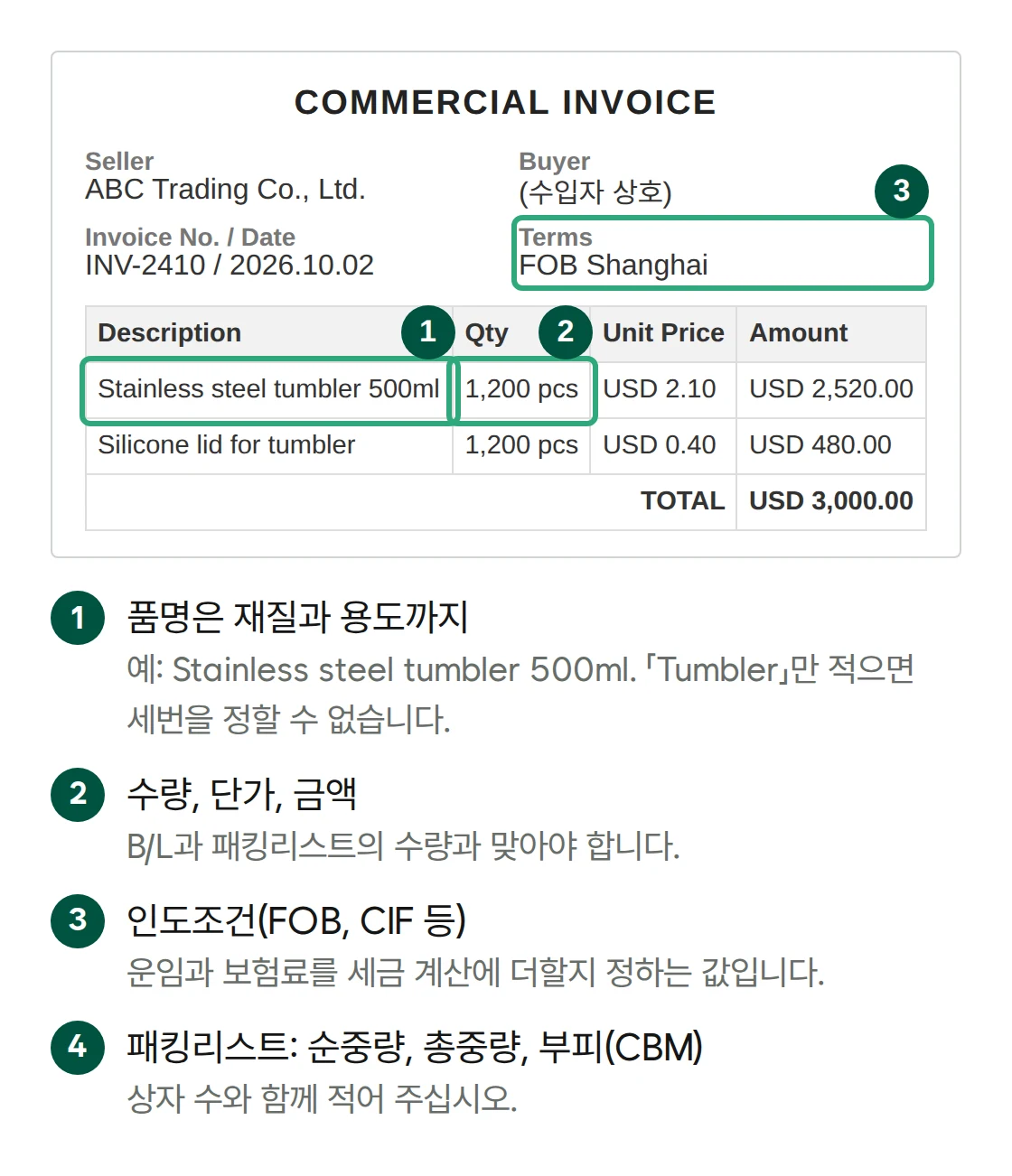
Documents required only for the first transaction
- Business registration certificate
- Contact person's telephone number and email address for receiving tax invoices
- Customs clearance code (if you do not have one, apply through our code application service at the same time)
If importing as an individual, please send your name, Personal Customs Clearance Code (PCCC), address, telephone number and email address instead of a business registration certificate.
Tax calculation
The customs value is the price of the goods plus freight and insurance up to arrival in Korea. Customs duty is calculated by multiplying the customs value by the duty rate, and VAT is 10% of the sum of the customs value and customs duty (including individual consumption tax and other applicable taxes).
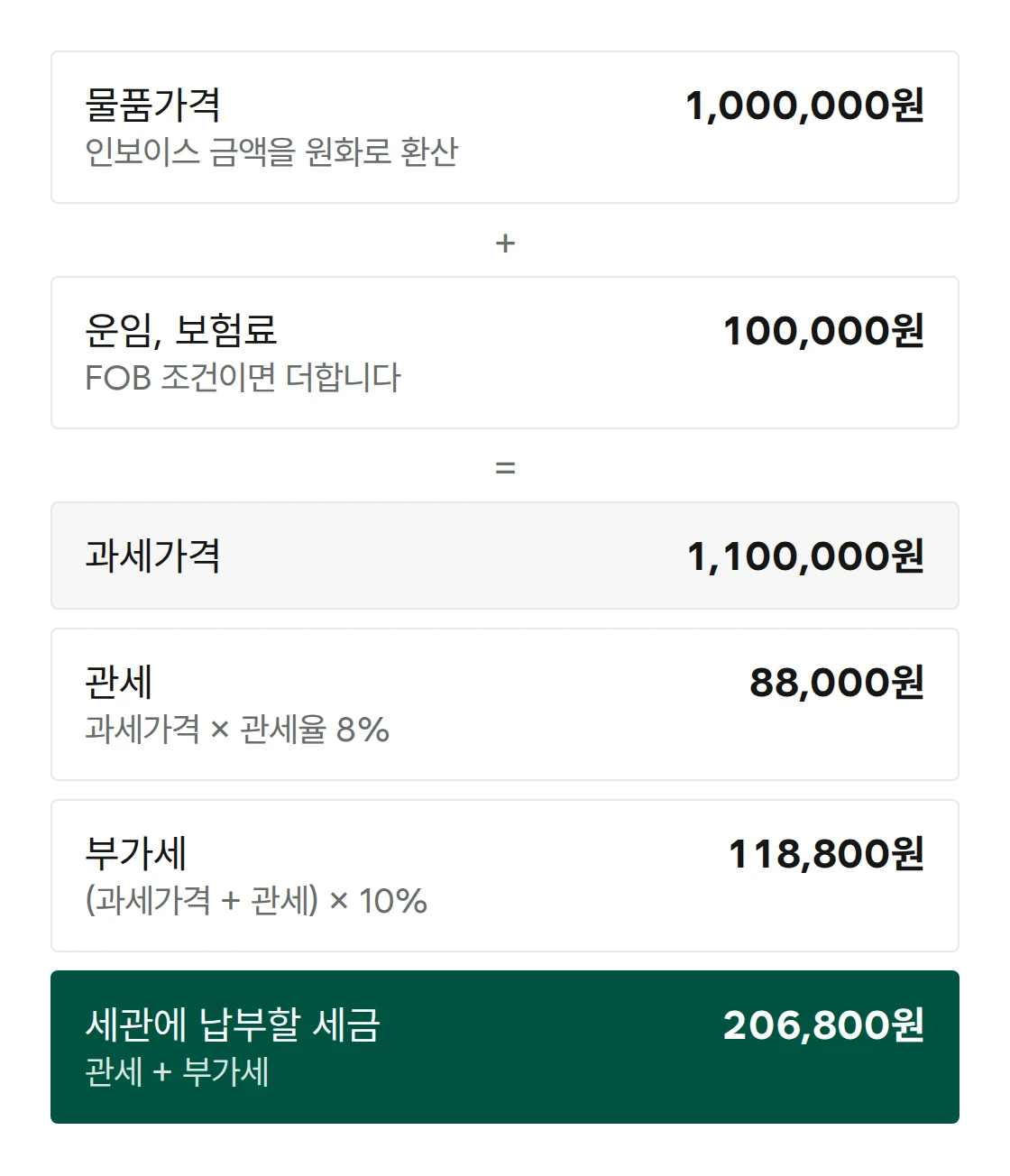
We send estimated duties and taxes before declaration, and customs review determines the final amount.
Deadlines and processing times
| Category | Deadline |
|---|---|
| Import declaration | Within 30 days of entry into a designated storage area or bonded warehouse (or the date of storage if stored outside a bonded area). If exceeded, a penalty tax of 0.5 to 2% of the customs value (capped at KRW 5,000,000) applies (we check whether the goods are subject to it) |
| Customs inspection | Selection for inspection delays clearance by approximately 1 business day |
| Declaration withdrawal | Only before the goods are released |
| Document retention | Certificates of import declaration, import transaction contracts and price determination records: 5 years from acceptance |
Services we provide
| Service | Details |
|---|---|
| Review of duties, taxes and requirements | Check of HS codes, duty rates, FTA applicability, import requirements and country of origin marking requirements, and estimated duties and taxes |
| Import declaration | Filing after entry into a bonded area, or before arrival for urgent cargo |
| Customs liaison | Handling of document submission, requests for supplementation and physical inspections |
| Tax payment and cargo release | Payment of customs duty and VAT, delivery of the certificate of import declaration, guidance on release and transportation arrangements |
| Post-clearance services | Declaration amendments and withdrawals, retrospective application of FTA preferential tariffs, customs duty refunds |
Fees
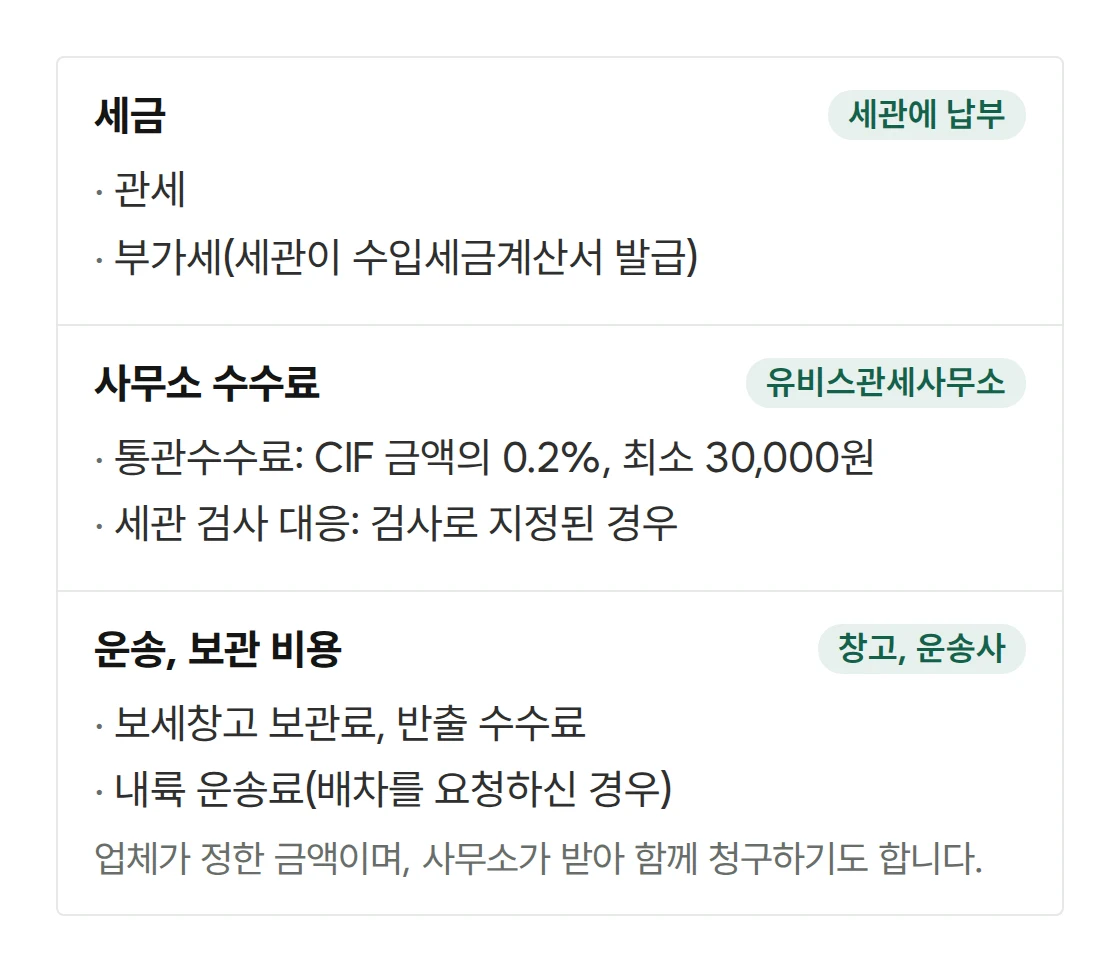
| Item | Basis | Fee |
|---|---|---|
| Import clearance Same for general cargo, express shipments and EMS | 0.2% of the customs value Minimum KRW 30,000 for a customs value up to KRW 15,000,000 | From KRW 30,000 |
| Confirmation of exemption from requirements | KRW 50,000 under the Radio Waves Act; KRW 100,000 under the Electrical Appliances and Consumer Products Safety Control Act Institutional fees for electrical products charged separately | From KRW 50,000 |
| Application for consumer product requirements | Per case | KRW 50,000 |
| Application for approval of exemption from requirements | Per case Institutional fees charged separately | KRW 100,000 |
| Application for sample permit | Per case | KRW 50,000 |
| Livestock product quarantine | Per case Quarantine agency fees and customs clearance fees charged separately | KRW 150,000 |
| Plant quarantine Plants not intended for cultivation | KRW 20,000 for the quarantine application; KRW 50,000 per inspection KRW 20,000 per additional item customs clearance fees charged separately | KRW 70,000 |
| Plant quarantine Plants intended for cultivation | Per case KRW 20,000 per additional item bonded transportation, container inspection and customs clearance fees charged separately | KRW 150,000 |
| Processed plant product quarantine | Cases not requiring submission of a phytosanitary certificate | KRW 70,000 |
| Pet (dog and cat) quarantine | Per case Quarantine agency fee of KRW 10,000 and customs clearance fees charged separately | KRW 500,000 |
| Customs inspection (imports) | Attendance and assistance when selected for inspection by customs, per inspection Varies with the inspection location and scope of work | From KRW 50,000 |
| Declarations with multiple items | For declarations with 15 or more item lines (lines grouping goods with the same HS code), or many specification rows by model, color or size, the fee is agreed based on the time required to organize the items Examples: a declaration with approximately 100 item lines for a single import of around 100 types of general merchandise; a declaration with 16 item lines but more than 90 specification rows Basis for agreement: KRW 2,000 per item line exceeding 15 Basis for agreement: as low as KRW 1,500 per item line for repeated imports on 3 or more occasions | By agreement |
| KC certification and radio certification verification | Application for customs confirmation for electrical appliances, consumer products and broadcasting and communications equipment, per case Additional fees apply according to the number of certified models For electrical products, an institutional fee of KRW 3,400 is charged separately | From KRW 20,000 |
| Remedial work application | Application for approval of remedial work such as labeling, per case | KRW 20,000 |
| Amendment of import declaration | Amendments following changes to the invoice, quantity or value after declaration, per case KRW 20,000 if the tax amount is unchanged From KRW 30,000 if the tax amount changes Fees are agreed if the work is equivalent to preparing a new declaration No fee is charged for amendments due to an error by our office | From KRW 20,000 |
| Cargo release | Arranging cargo release on your behalf, per case No fee is charged if you arrange release yourself Additional KRW 20,000 if e-D/O issuance is required | KRW 20,000 |
| Declaration of transfer of bonded cargo | Per case | KRW 50,000 |
When selected for customs inspection
If selected for inspection, the goods are physically inspected at a bonded warehouse (LCL) or terminal (FCL). Please check the following before inspection.
- Whether the country of origin is marked on the goods themselves
- Whether the product types and quantities in the documents match the actual cargo
- For mixed-product cargo, the box number or location inside the container of the goods to be inspected (providing this information reduces inspection time and costs)
Reasons for clearance delays
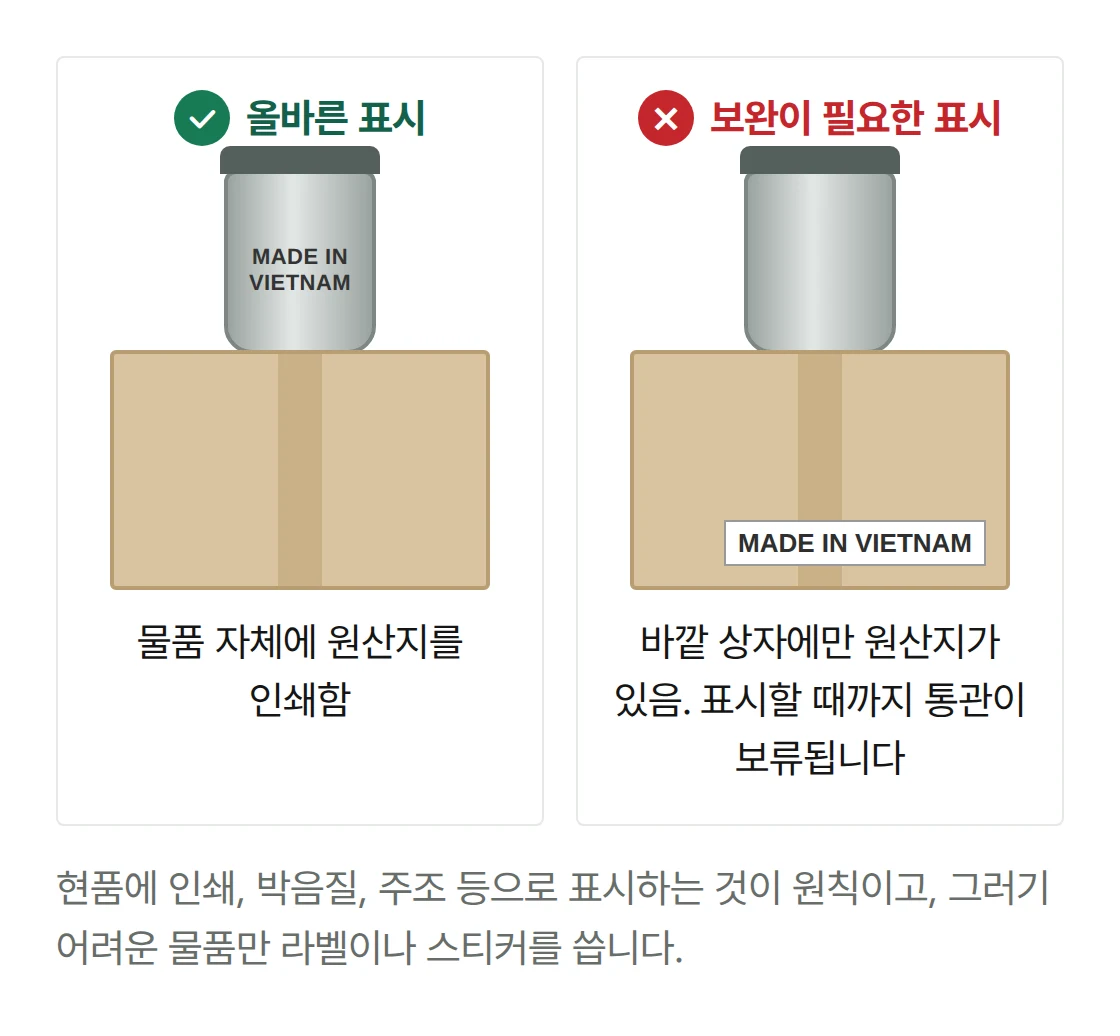
- Country of origin marking: As a rule, the country of origin must be marked on the goods themselves by printing, stitching, casting or similar methods, and labels or stickers are used only for goods that are difficult to mark in these ways. For goods that must be marked on the goods themselves, marking only the outer box results in clearance being withheld, and the cargo owner bears marking and warehousing costs. Marking violations are subject to corrective measures and a penalty surcharge of up to KRW 300,000,000.
- Undocumented goods: Promotional gifts and replacements for defective goods included by the seller must also be declared.
- Quantity discrepancies: If declared and actual quantities differ, the declaration must be amended.
- Intellectual property infringement: Counterfeits of well-known brands and character merchandise produced without a license cannot clear customs.
Frequently asked questions
Q. What can I do for products that are difficult to classify?
An advance ruling on tariff classification may be requested, and the Korea Customs Service responds within 30 days of receiving the application (excluding time for deliberation by the Tariff Classification Committee, supplementation, analysis and similar procedures).
Q. This is my first import and I do not have a customs clearance code.
Send us a power of attorney and we will apply on your behalf. You may also apply directly as a corporate member of UNI-PASS.
Consultation
Request an import clearance quotation
Related laws and resources
- Korea Customs Service guide to "Import clearance"
- Korea Customs Service guide to "Retention of declarations and submitted documents"
- Customs Act, Article 241 (Declaration of export, import or return)
- Customs Act, Article 9 (Deadlines for payment of customs duties, etc.), Article 12 (Retention of books, etc.)
- Foreign Trade Management Regulation, Article 76 (General principles of country of origin marking for imported goods)
Effective dates: Customs Act 2026-10-02, Foreign Trade Management Regulation 2024-03-08. Accessed through the National Law Information Center on 2026-10-21.