
Services
Imported food (MFDS import declaration service)
For companies importing food, food additives, utensils such as tableware, containers and packaging for sale or business use, we handle import declarations to the Ministry of Food and Drug Safety (MFDS) and customs clearance.
Overview
| Item | Details |
|---|---|
| Scope | Food, food additives, utensils and containers and packaging in direct contact with food, health functional foods, and livestock products for sale or business use |
| First-time requirements | Hygiene training, business registration as an imported food import and sales business, and registration of overseas manufacturing facility |
| Declaration timing | Usually after the cargo enters a bonded warehouse (declarations may also be filed from 5 days before expected arrival) |
| Processing time | 2 to 10 days depending on the inspection type |
| Costs | MFDS declaration service fee, customs clearance fee, inspection fees and taxes |
Scope and requirements
A business operator importing food and related products for sale or business use must file an import declaration with the Minister of Food and Drug Safety. Imported food and related products comprise food, food additives, utensils, containers and packaging, health functional foods, and livestock products. Companies importing for the first time must first complete the following 3 steps.
- Complete food hygiene trainingBefore business registration, complete the hygiene training for imported food import and sales businesses (4 hours) at a hygiene training institution (Korea Food Industry Association, Korea Health Functional Food Association, Korea Food Safety Association). Business operators complete 3 hours annually.
- Business registrationApply through "Application for business registration for imported food and related products" in the electronic civil application service of Food Safety Korea , or submit the application in person or in writing to the regional food and drug safety office having jurisdiction over your business location (Enforcement Rules of the Special Act on Imported Food Safety Control, Article 16 (Business registration, etc.)).
- Registration of overseas manufacturing facilityWe check whether the factory is registered and, if it is not, apply for registration before import declaration. Acceptance of import declarations for products from unregistered factories may be refused. Registration is valid for 2 years, and we apply for renewal.
Inspections and processing times
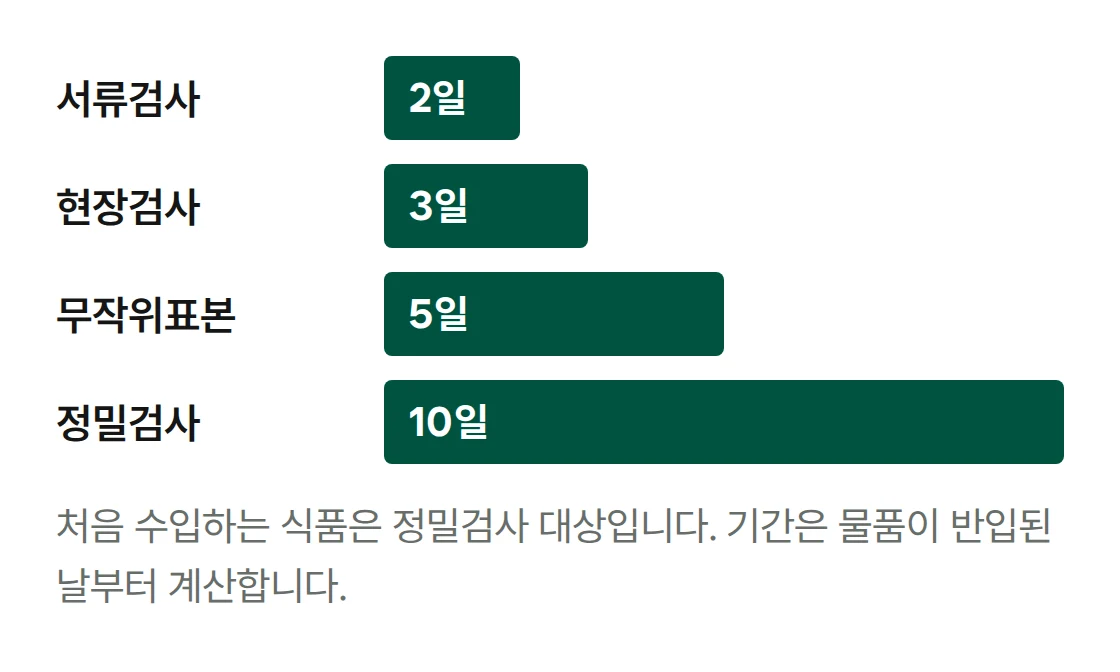
These processing times apply to food and related products and health functional foods and are calculated from the date of entry into a bonded warehouse. When testing is commissioned, inspection fees are paid directly to the testing and inspection institution. If selected for customs inspection after MFDS inspection, clearance takes an additional 1 to 2 days.
Procedure
- Preliminary reviewWe check product photos and the ingredient list to determine whether the product may be imported and advise on the expected inspection type.
- Affix Korean labelingPlease affix Korean labeling to the product before customs clearance. We review the label design.
- MFDS import declarationAfter the cargo enters a bonded warehouse, we file the import declaration with the competent regional food and drug safety office and handle inspections.
- Customs clearanceUpon a finding of compliance, we file an import declaration with customs. Noncompliant products are returned to the exporting country, sent to a third country or destroyed.
Documents to prepare
First transaction only
- Business operating registration certificate and business registration certificate
- Overseas manufacturing facility's business name and address in English, and evidence that it is licensed, registered or notified under the exporting country's laws
Each product
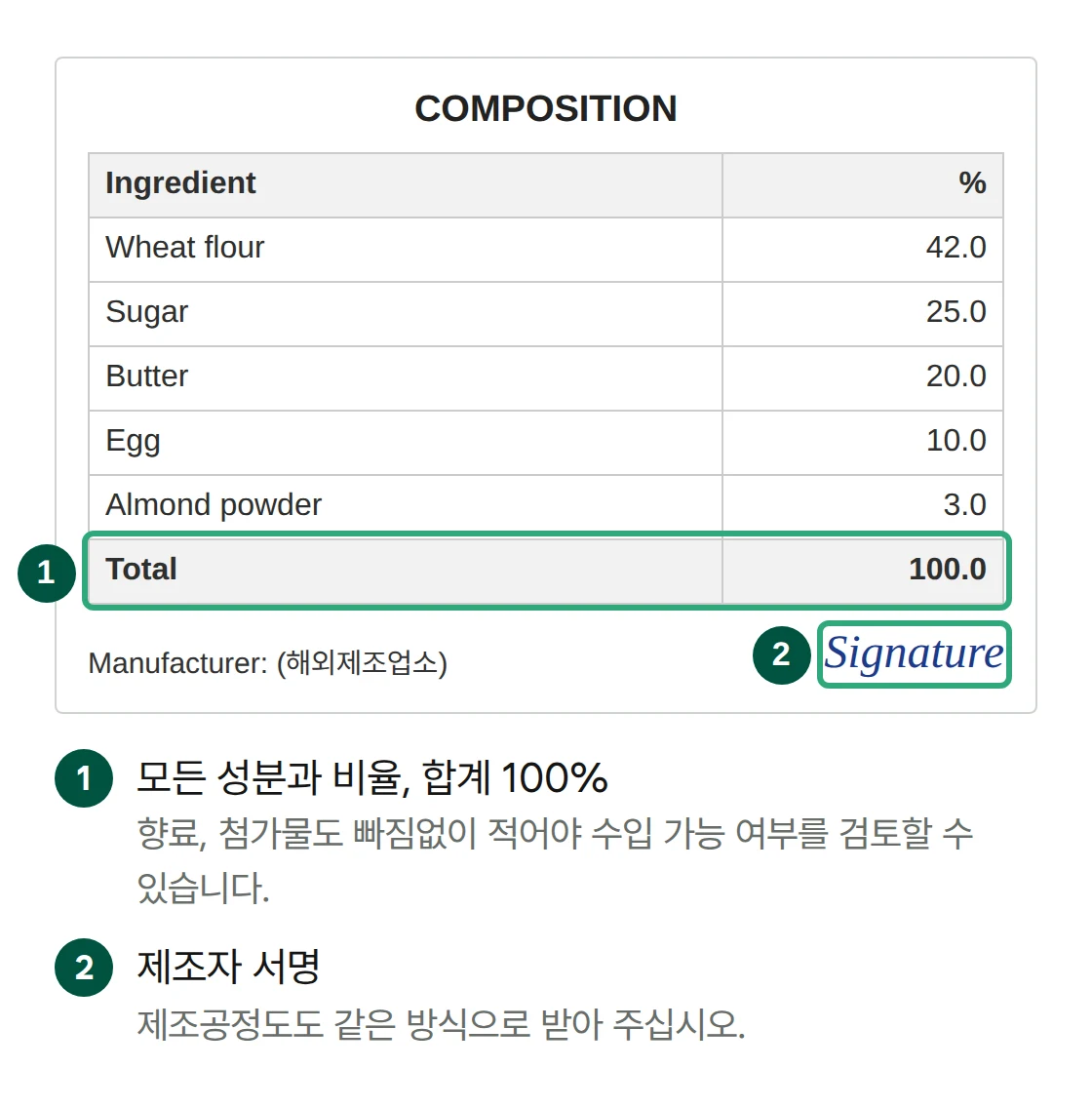
- Ingredient list (all ingredients and percentages totaling 100%, signed by the manufacturer)
- Manufacturing process chart (signed by the manufacturer)
- Full-color product photos showing the Korean labeling and exporting-country labeling
- Korean labeling design or text
- Where applicable: health certificate or inspection certificate (fishery products from countries with an agreement), export health certificate (livestock products or food of animal origin)
Each shipment
- Invoice, packing list and B/L
- Utensils and containers such as tableware and cups: material certificate (a document identifying the material, such as a manufacturing certificate or MSDS, signed by the exporter) and product photos
Korean labeling example
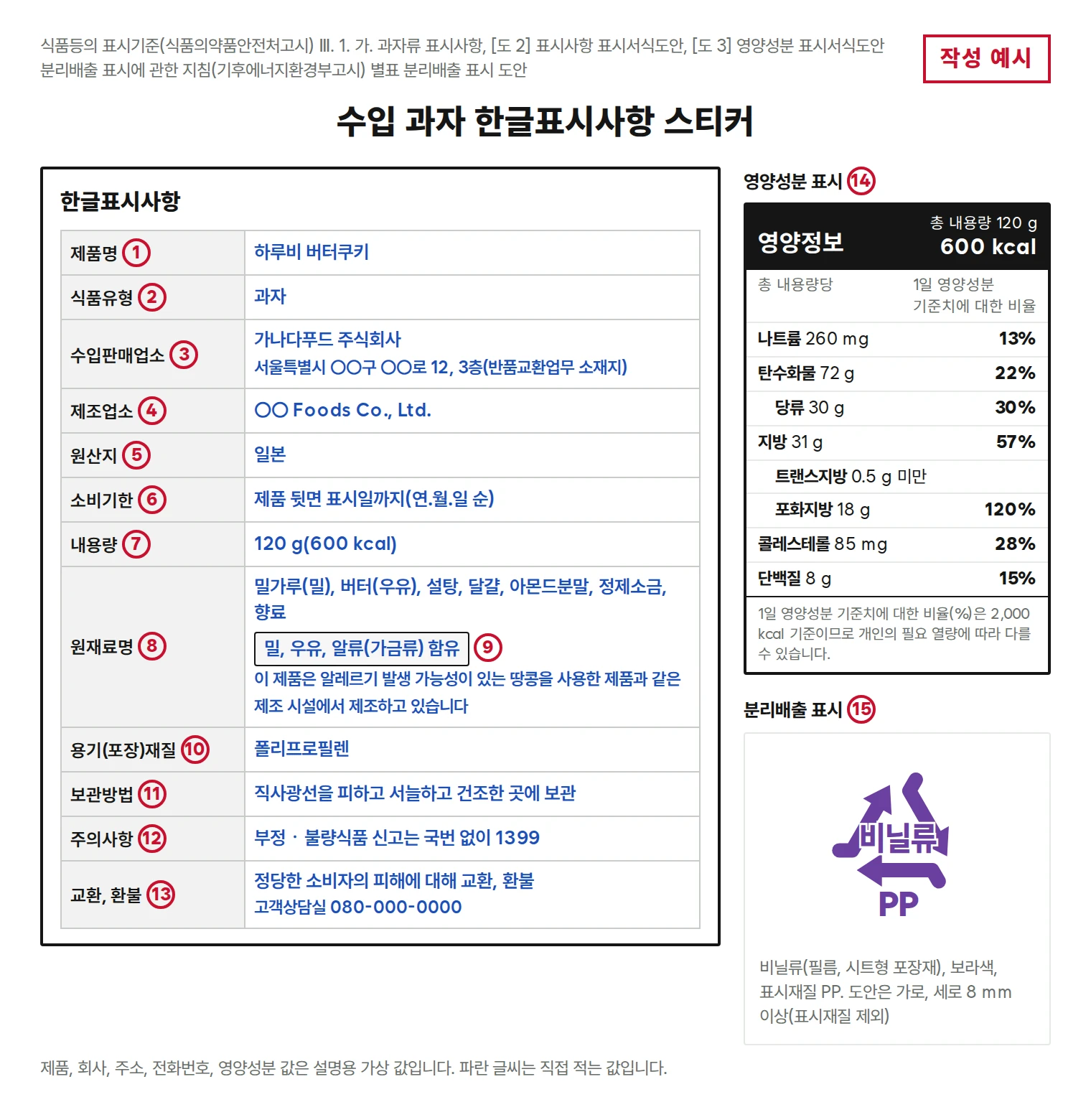
When affixing a Korean label sticker to the exporting country's packaging, attach it firmly and do not obscure key information on the exporting country's packaging, such as the product name and use-by date.
- Product name: Indicate the name declared in the import declaration.
- Food type: Indicate the most specific classification under the Food Standards and Specifications (confectionery categories are snacks, candies, chewing gum, bread and rice cakes).
- Importer and seller: Indicate the business name and address submitted for business registration.
- Manufacturer: Indicate the overseas manufacturer's name. If it is displayed in a foreign language, the Korean labeling may be omitted.
- Country of origin: Indicate it in a format such as "Country of origin: country name" or "Made in country name".
- Use-by date: If using the date shown on the exporting country's packaging, state where it appears. If the order of year, month and day differs from the Korean format, state an example of the order.
- Net contents and calories: Indicate calories in parentheses after the net contents. Example: 100 g(240 kcal)
- Ingredients: Indicate all ingredients in descending order of the amount used.
- Allergen declaration: Provide a separate declaration near the ingredient list and indicate all of the 19 allergens used. If other allergens are used in the same facility, indicate a statement on possible cross-contact.
- Container (packaging) material: Indicate the material name, such as polypropylene. This may be omitted if the recycling mark indicates PE, PP, PET or another material.
- Storage instructions: Indicate these where applicable.
- Food violation reporting: Indicate the statement "To report illegal or substandard food, call 1399 without an area code".
- Exchanges and refunds: Indicate exchange and refund information and the customer service telephone number.
- Nutritional information: Snacks are subject to nutrition labeling. Also indicate the percentage (%) of the daily nutrient reference value.
- Recycling mark: For film packaging such as snack bags, indicate the material designation (such as PP) below the triangular arrow symbol (including the words "Plastic film"), and make the symbol at least 8 mm wide and 8 mm high. Packaging with a surface area of less than 50 cm² (less than 100 cm² for film) or contents of 30 g or less is not subject to the marking requirement.
Services we provide
| Service | Details |
|---|---|
| Preliminary review | Import eligibility, Korean labeling, expected inspection type |
| Overseas manufacturing facility registration | Check of registration status, applications for registration and renewal |
| Import declaration | MFDS import declaration and inspection handling, customs import declaration |
Fees
| Item | Basis | Fee |
|---|---|---|
| Food import declaration Document inspection | MFDS import declaration on your behalf, per case Inspection fees charged separately | KRW 70,000 |
| Food import declaration First import, laboratory inspection | MFDS import declaration and laboratory inspection arrangements on your behalf, per case Inspection fees charged separately | KRW 150,000 to 200,000 |
| Import declaration for utensils and containers | Document inspection KRW 50,000; first-import laboratory inspection KRW 100,000 to 150,000 Inspection fees charged separately | From KRW 50,000 |
| Korean labeling review | KRW 30,000 for utensils and containers; from KRW 50,000 for food Printing and design are not included | From KRW 30,000 |
| Attendance at on-site food inspection | Per case | KRW 50,000 |
| Registration of overseas manufacturing facility | Per case | KRW 50,000 |
| Import clearance Same for general cargo, express shipments and EMS | 0.2% of the customs value Minimum KRW 30,000 for a customs value up to KRW 15,000,000 | From KRW 30,000 |
Reasons for clearance delays
- Incomplete ingredient list: If some ingredients are missing or percentages do not total 100%, import eligibility cannot be determined, and clearance is delayed.
- Missing Korean labeling: If Korean labeling is entirely absent, MFDS returns the declaration documents, so labeling is affixed through remedial work in a bonded area before declaration.
Frequently asked questions
Q. Must food imported for the first time undergo laboratory inspection?
Yes. If food with the same country of manufacture, overseas manufacturing facility, manufacturing method and ingredient names is imported again within 5 years of receipt of the import declaration confirmation following laboratory inspection, it is excluded from the initial laboratory inspection requirement. If the overseas manufacturing facility changes location, the first-import laboratory inspection is required again.
Q. Are cups and plates also subject to declaration?
Utensils, containers and packaging that directly contact food are subject to declaration; products that do not contact food are not. If the intended use is unclear, send photos and a description of use so we can first check whether declaration is required.
Consultation
Consult us about imported food declarations
Related laws and resources
- Imported Food Information Maru: overseas manufacturing facility guide
- Special Act on Imported Food Safety Control, Article 5 (Registration of overseas manufacturing facilities), Article 20 (Import declarations, etc.), Article 21 (Import inspections, etc.)
- Enforcement Rules of the same Act, Article 27 (Import declarations for food and related products)
Effective dates: Special Act on Imported Food Safety Control 2026-10-08, Enforcement Rules of the same Act 2026-09-30. Accessed through the National Law Information Center on 2026-10-21.