
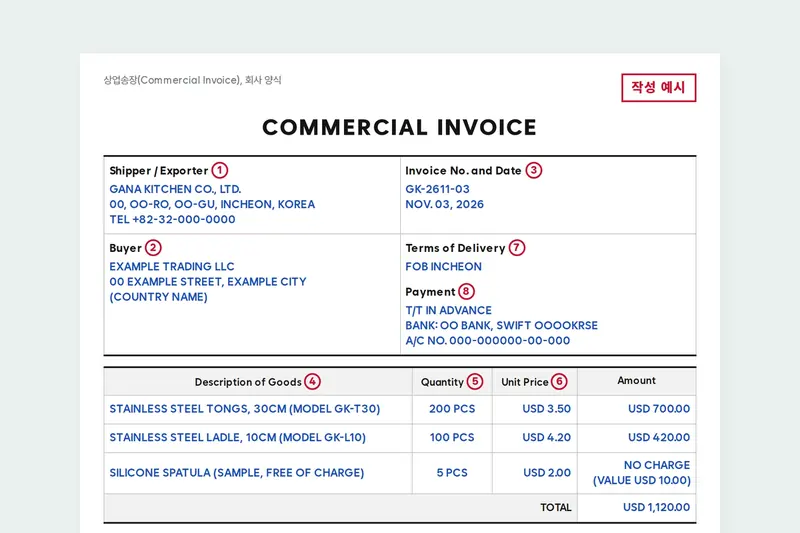
Export invoice and tax invoice
When you sell goods to an overseas buyer, you issue an invoice instead of a tax invoice. This is because exported goods are subject to the zero tax rate of value-added tax and exempt from the obligation to issue a tax invoice.
Prepare the invoice on your company form, and state in full the product name, quantity, price and buyer information that the Licensed Customs Broker transfers to the export declaration.
What to state on the invoice
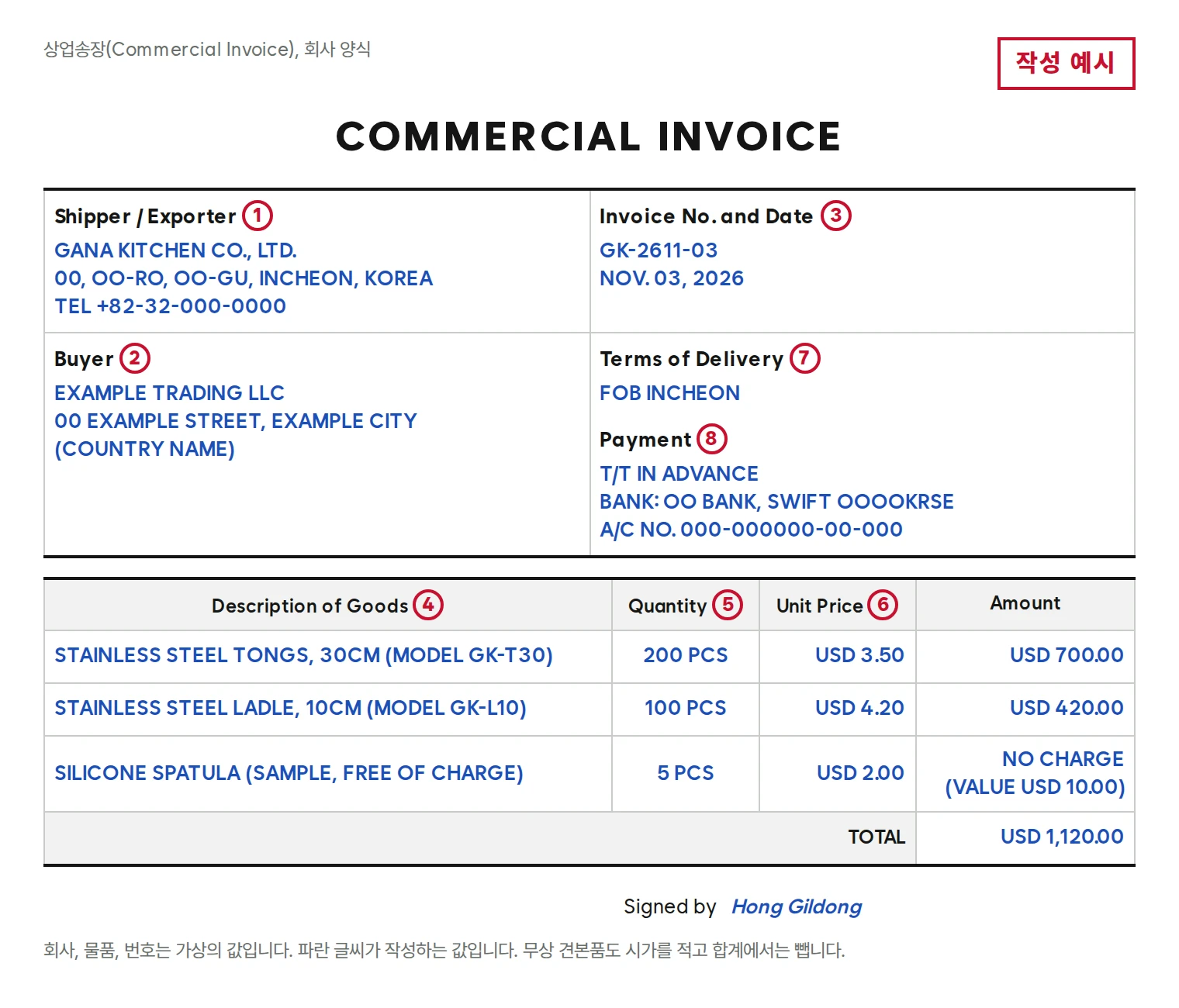
- Exporter: enter in English the same company name and address as on the business registration certificate.
- Buyer: enter the country, company name and address in English. The Licensed Customs Broker uses this information to apply for the buyer's overseas supplier code.
- Invoice number and date: any number that your company manages is acceptable.
- Product name and model: do not lump items together as "Sample" or "Parts"; state them so that it is clear what the goods are.
- Quantity and unit: state in a countable unit such as pieces, sets or boxes.
- Unit price and amount: state the currency, such as USD, together. Because the price must be entered on the export declaration, enter the market price rather than 0 even for samples for which no payment is received.
- Delivery terms: state the delivery terms, such as FOB or CIF. The export declaration price is on an FOB basis, so under CIF terms the Licensed Customs Broker deducts freight and insurance when declaring.
- Payment method: state the method, such as remittance or letter of credit, and the account to receive payment. If no payment is received, state Free of Charge.
Goods sent without a buyer, for exhibition or local consignment sale, are declared in a different way, so consult the Licensed Customs Broker before shipment.
Why a tax invoice is not issued
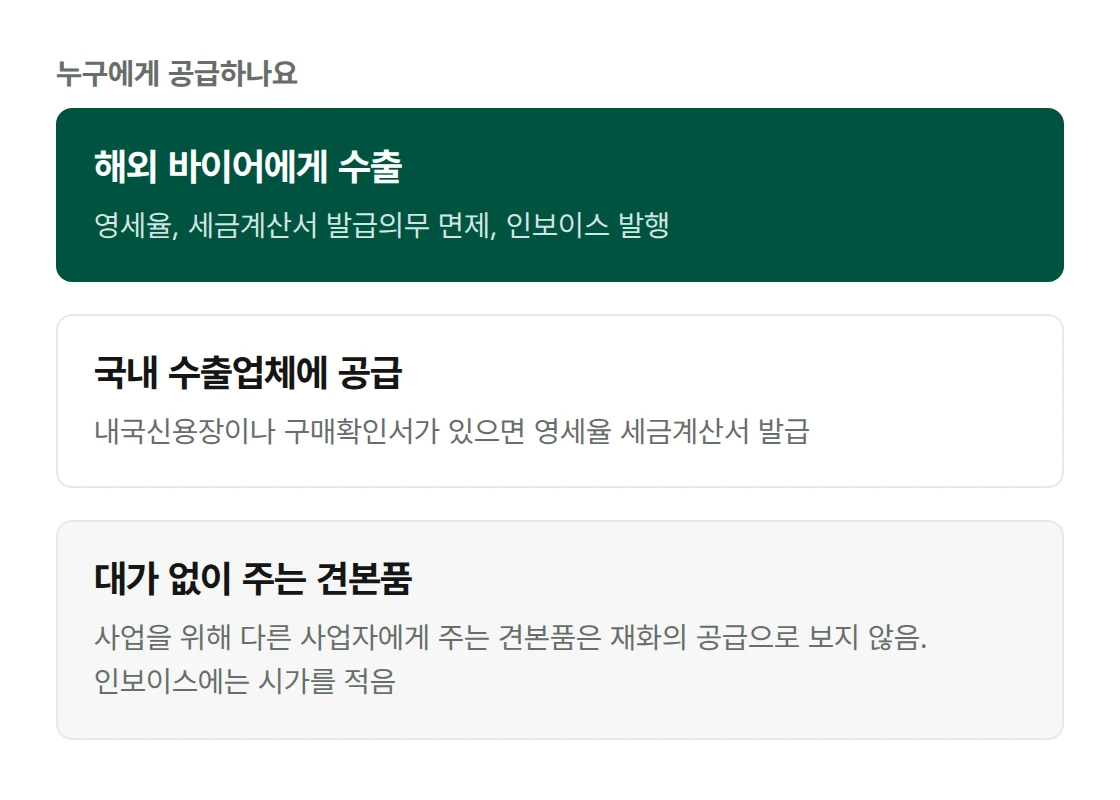
Goods exported directly to an overseas buyer are subject to the zero tax rate and exempt from the obligation to issue a tax invoice.
However, if you supply goods to a domestic exporter by local letter of credit or purchase certificate, you issue a tax invoice even though the zero tax rate applies.
Samples given free of charge to another business for business purposes are not regarded as a supply of goods.
When you file value-added tax at the zero tax rate, attach the statement of the actual exports. Keep the certificate of export declaration and the invoice together, and consult your tax representative about the filing.
Export declaration services are described at export clearance.
Related articles
- Applying for the customs clearance code and trader's identification number for a first export
- Hand-carry and express shipment: export declaration methods for small quantities
Source: Customs Act Article 241 (Declaration of export, import or return), Enforcement Decree of the Customs Act Article 246 (Declaration of export, import or return), Notice on Registration and Management of Customs Clearance Codes and Overseas Supplier Codes Article 9 (Application for an overseas supplier code), Value-Added Tax Act Article 10 (Special provisions on the supply of goods), Article 21 (Export of goods), Enforcement Decree of the Value-Added Tax Act Article 20 (Scope of gifts for business purposes not regarded as a supply of goods), Article 71 (Exemption from the obligation to issue tax invoices, etc.), Article 101 (Submission of documents attached to zero-rate filings). Confirmed on October 22, 2026, based on the Customs Act in force on October 2, 2026, the Enforcement Decrees of the Customs Act and the Value-Added Tax Act in force on February 27, 2026, and the Value-Added Tax Act in force on January 2, 2026.