
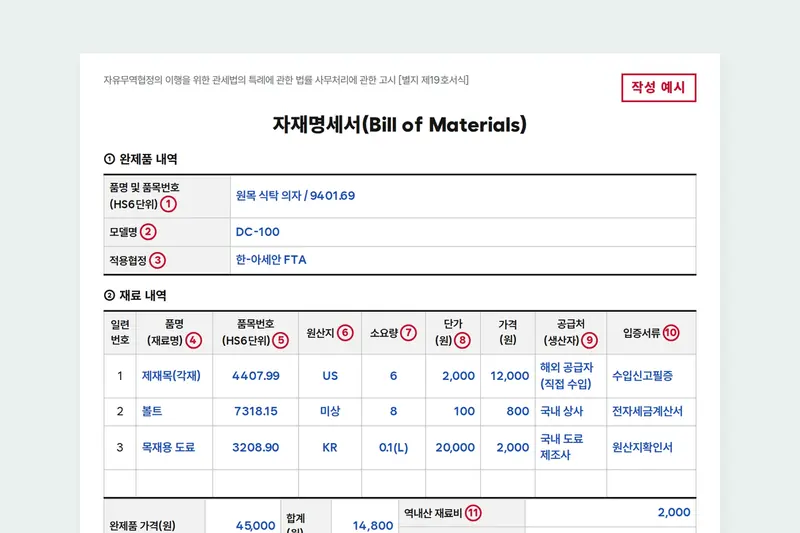
The 3 documents for a first certificate of origin
A company applying for an FTA certificate of origin for the first time prepares 3 documents: a bill of materials (BOM), a manufacturing flow chart and a Declaration of Origin.
The company that produces the finished product prepares the bill of materials and the manufacturing flow chart. The suppliers of materials or finished products prepare the Declaration of Origin and provide it to the producer or exporter.
Once you have these documents, a Licensed Customs Broker handles the origin determination, the preparation of the origin explanatory statement and the certificate of origin application. An exporter that entrusts the work to a Licensed Customs Broker sets up the own-performance authority in UNI-PASS.
If the issuing authority cannot confirm from the submitted documents whether the criteria for determining origins are met, it may request documents that substantiate the origin explanatory statement. The bill of materials (BOM), the production process specification and the Declaration of Origin (including the blanket Declaration of Origin) are among these supporting documents (Enforcement Rule of the Act on Special Cases of the Customs Act for the Implementation of Free Trade Agreements, Article 10 (2); Notice on Procedures under the Act, Article 27 (1)).
How to prepare the bill of materials (BOM)
The bill of materials submitted as a supporting document for the origin explanatory statement is the bill of materials in Form No. 19 of the Notice on Procedures (Notice, Article 27 (2)). The form has 2 parts, the finished product details and the material details, and may be submitted as a PDF or Excel file. For the finished product, enter the product name and HS number (6 digits), the model name and the applicable agreement.
| Material details field | What to enter | Where to find it |
|---|---|---|
| Product name (material name) | Name and specification of the material used to produce 1 finished product | Production BOM, work order, purchase records |
| HS number (6 digits) | The 6-digit HS number of the material | For imported materials, the first 6 digits of the HS number on the certificate of import declaration. For materials purchased in Korea, box 6 of the supplier's Declaration of Origin |
| Origin | Country of origin of the material. Enter "unknown" if it cannot be confirmed | Origin on the certificate of import declaration, box 11 of the supplier's Declaration of Origin |
| Quantity required | Quantity needed for 1 finished product (1 unit) | Production BOM, raw material inventory ledger |
| Unit price (KRW), price (KRW) | Amount per unit of material, and that amount multiplied by the quantity required (in KRW) | Tax invoice, transaction statement, certificate of import declaration |
| Supplier (producer) | The company that sold the material | Tax invoice, transaction statement, import invoice |
| Supporting document | Name of the document used to confirm the origin | Declaration of Origin, certificate of import declaration, electronic tax invoice, etc. |
Below the material details, enter the price of the finished product (KRW), the total (KRW), the cost of originating materials and the cost of non-originating materials. Materials confirmed as KR origin go under originating materials, and all other materials, including those marked unknown, go under non-originating materials. Check with the Licensed Customs Broker which category applies to materials imported from a partner country of the agreement.
For example, suppose you produce a solid wood dining chair (9401.69), import the sawn timber directly, buy the bolts from a domestic trading company and buy the wood paint from a domestic manufacturer. The material details are as follows.
| Serial no. | Product name (material name) | HS number (6 digits) | Origin | Quantity required | Unit price (KRW) | Price (KRW) | Supplier (producer) | Supporting document |
|---|---|---|---|---|---|---|---|---|
| 1 | Sawn timber (squared) | 4407.99 | US | 6 | 2,000 | 12,000 | Overseas supplier (direct import) | Certificate of import declaration |
| 2 | Bolts | 7318.15 | Unknown | 8 | 100 | 800 | Domestic trading company | Electronic tax invoice |
| 3 | Wood paint | 3208.90 | KR | 0.1 (L) | 20,000 | 2,000 | Domestic paint manufacturer | Declaration of Origin |
In this example, the total is KRW 14,800, the cost of originating materials is KRW 2,000 and the cost of non-originating materials is KRW 12,800.
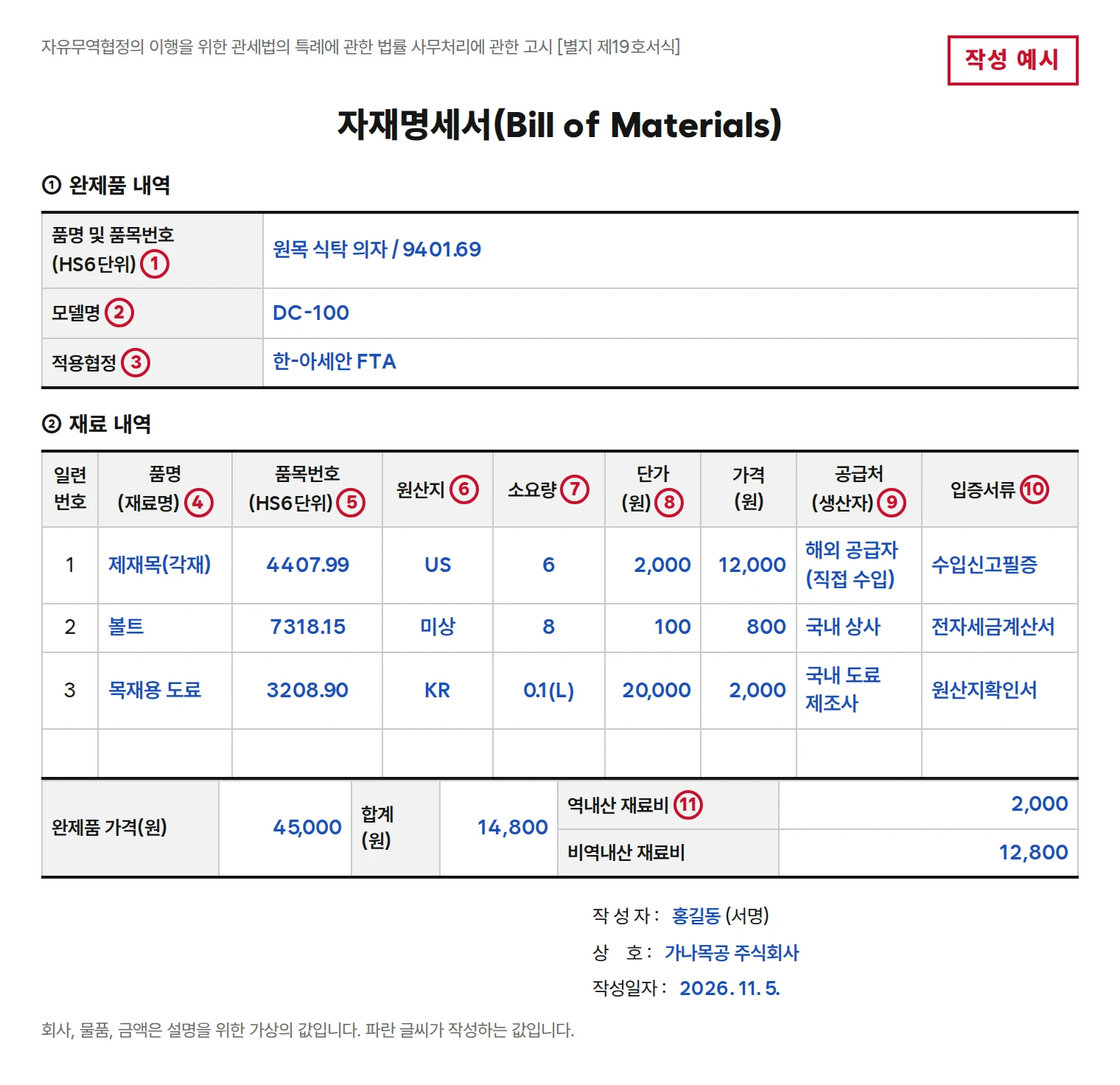
- Product name and 6-digit HS number of the finished product
- Model name of the exported product
- The agreement under which you will receive the certificate of origin
- Name and specification of the materials currently used in production
- 6-digit HS number of the material (first 6 digits of the certificate of import declaration, box 6 of the supplier's Declaration of Origin)
- Origin of the material. Enter "unknown" if it cannot be confirmed
- Quantity needed for 1 finished product
- Unit price, with all materials stated on the same amount basis
- The company that sold the material
- Name of the document used to confirm the origin
- Cost of materials confirmed as KR, and cost of the remaining materials (including unknown)
Common mistakes in the bill of materials are as follows.
- Entering KR for a material whose origin is unknown: Buying a material in Korea does not make it Korean-origin. The Busan Regional Customs guidebook instructs that the origin of a material not confirmed by a Declaration of Origin (including the blanket Declaration of Origin) be entered as "unknown".
- Unit price basis that differs by material: If some materials are priced per piece, others per bundle, or value-added tax is included for some and not others, the total material cost will differ from the actual cost. State every material on the same amount basis as the quantity required for 1 finished product.
- Missing 6-digit HS number: The change in tariff classification criterion checks whether the HS number of the finished product differs from the HS number of the non-originating material at a given level or higher, so the origin cannot be determined without the material's HS number (Enforcement Rule, Article 2, subparagraph 9).
- A list that differs from the materials actually used: The Korea Customs Service guide to standard preparation materials explains that if materials a, b and c are actually used but the BOM lists d, e and f, its consistency as origin proof is weakened. Prepare the BOM from the materials currently used in production, not the design BOM.
How to prepare the manufacturing flow chart
There is no form prescribed by law for the manufacturing flow chart, which corresponds to the production process specification listed as an example of supporting documents for the origin explanatory statement (Notice, Article 27 (1) 1). The Korea Customs Service guide to standard preparation materials explains that the manufacturing flow chart is used to check the process details, the processing sequence, the manufacturing dates and whether processes beyond the insufficient operations were performed, and that the link between the BOM and the manufacturing flow chart is checked. The sample in the Busan Regional Customs guidebook enters the exporter, the preparer and the applied product (product name, 6-digit HS number, model specification, applicable agreement) at the top, and lists the processes in order below.
- Enter the processes one per line in the actual order.
- For each process, enter the materials used under the same name as in the bill of materials serial number.
- For processes that use non-originating materials (including unknown), enter the 6-digit HS number of the material. For the process that produces the finished product, enter the 6-digit HS number of the finished product, so that the point where the HS classification changes is shown.
- For outsourced processes, enter the subcontractor and the place of performance. If any process was performed overseas, mark that process.
The manufacturing flow chart for the dining chair above can be written as follows.
| Order | Process | Materials used (serial no., 6-digit HS) | Performed by |
|---|---|---|---|
| 1 | Cutting | 1 Sawn timber (4407.99, US) | Own factory |
| 2 | Shaping, sanding | None | Own factory |
| 3 | Assembly | 2 Bolts (7318.15, unknown) | Own factory |
| 4 | Painting | 3 Wood paint (3208.90, KR) | Outsourced (domestic painting company, Gyeonggi-do) |
| 5 | Inspection, packaging | None, finished product solid wood dining chair (9401.69) | Own factory |
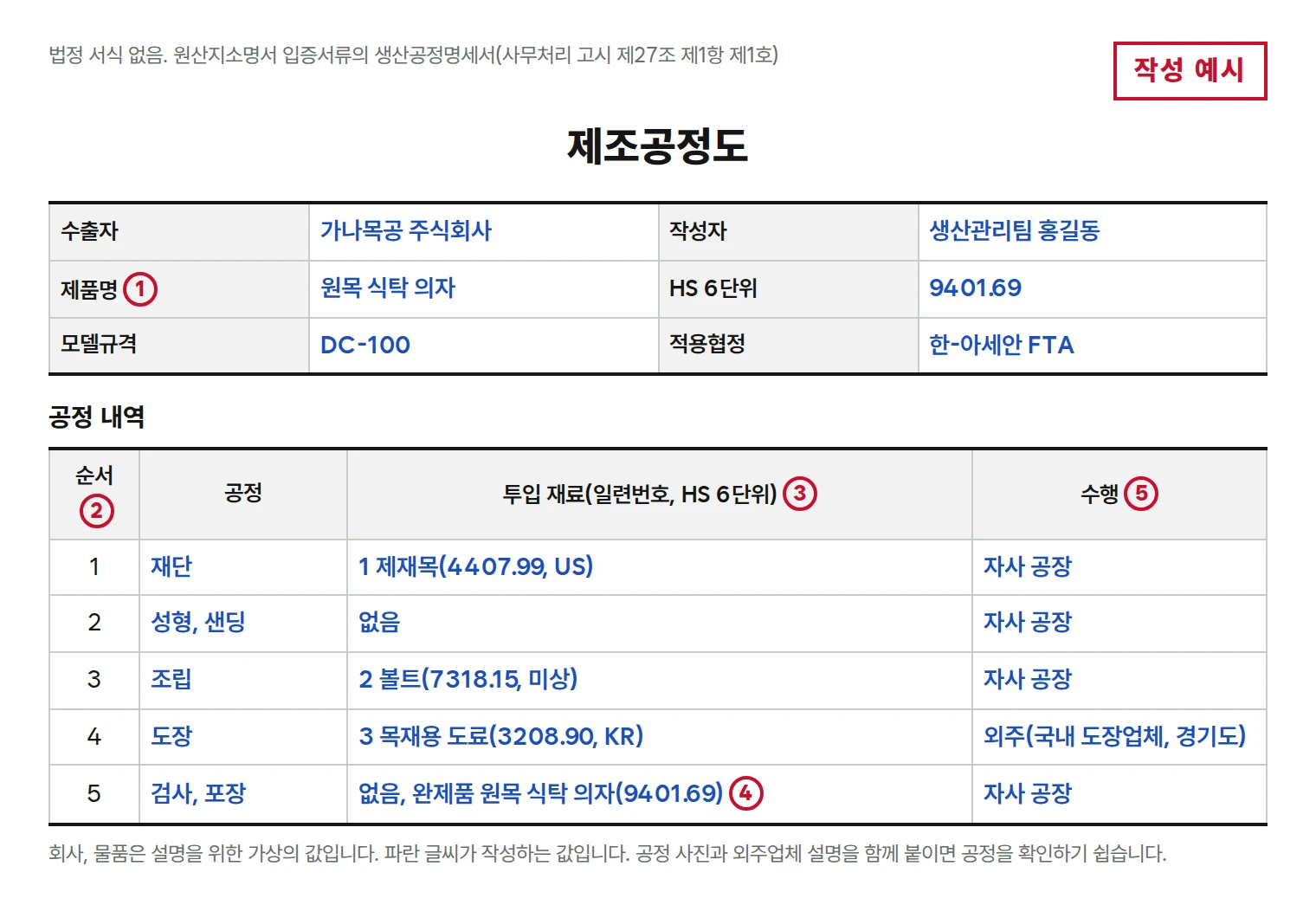
- Name, 6-digit HS, model specification and applicable agreement of the applied product. Enter them the same as in the finished product details of the bill of materials.
- The processes, one per line in the actual order
- The materials used, under the same name as the bill of materials serial number, with the 6-digit HS and origin for non-originating materials
- The 6-digit HS of the finished product in the process that produces it
- For outsourced processes, the subcontractor and the place of performance
In this example, the non-originating materials, sawn timber (Chapter 44) and bolts (Chapter 73), differ from the finished product (Chapter 94) from the 2-digit level. The Licensed Customs Broker determines whether this difference meets the product-specific criteria for determining origins of the agreement with the destination country.
Common mistakes in the manufacturing flow chart are a material in the bill of materials that appears in no process, an outsourced process entered as if it were an own process, and processes entered in an order different from the actual one. The Busan Regional Customs guidebook instructs that the flow chart by manufacturing process, process photos, a description of the subcontractor for outsourced processing, whether each process is performed outside the territory, and the basis for entries in the enterprise resource planning (ERP) system be entered together.
How to prepare the Declaration of Origin (suppliers)
The Declaration of Origin is a document that a person who produces or supplies materials or the final goods prepares and provides after confirming the origin at the request of the producer or exporter (Enforcement Rule, Article 12 (1)). The Korea Customs Service FTA Portal explains that the exporter does not prepare it directly. The company that produces or supplies the raw materials or parts prepares it according to the criteria for determining origins of each agreement. If the producer and the exporter are different, the exporter attaches the Declaration of Origin for the final goods received from the producer to the application for issuance (Enforcement Rule, Article 10 (1) 3).
If goods are supplied repeatedly to the same producer or exporter over a long period, a blanket Declaration of Origin may be prepared. It allows the first Declaration of Origin to be reused repeatedly within a period not exceeding 12 months from the date of supply of the goods (Enforcement Rule, Article 12 (2)). Both use the same form, Form No. 5 of the Enforcement Rule. If box 12, the blanket period, is left blank, it is treated as a single-shipment Declaration of Origin.
| Box | What to enter (form instructions) |
|---|---|
| 1. Issuance number | Issuance number that the issuer of the Declaration of Origin manages itself |
| 2. Supplier | Supplier's company name, business registration number, representative's name, telephone and fax numbers, address and e-mail address. For an approved exporter, the approved exporter number |
| 3. Recipient | The same information for the recipient |
| 4. Serial number | If there are several different types of goods, a serial number for each type |
| 5. Name of the free trade agreement | Name of the agreement whose criteria for determining origins were applied. Example: Korea-ASEAN FTA, Korea-India CEPA, RCEP |
| 6. HS number | HS number (6 digits) of the supplied goods |
| 7. Product name and specification | Product name and specification of the supplied goods |
| 8. Quantity and unit | Quantity and unit of the supplied goods, only if it is not a blanket declaration |
| 9. Criteria for determining origins | The criterion applied from among WO, PE, CC, CTH, CTSH, BD, BU, MC, NC, SP, OP and Other. If 2 or more are met at the same time, combine them, as in CTH + BD |
| 10. Whether the criteria for determining origins are met | Enter "√" under Met if the criteria are met |
| 11. Origin | Country of origin of the goods that meet the criteria for determining origins. For Korean-origin goods, "KR" or "Korea" |
| 12. Blanket period | Repeated-use period not exceeding 12 months from the date of supply of the goods |
| 13. Simplified Declaration of Origin goods | Enter "√" if issued for goods under simplified Declaration of Origin |
| 14-16. RCEP origin country confirmation | Complete only when the producer of the exported goods issues it to the exporter for applying RCEP |
At the end of the form, enter the signature (or seal), position, company name and address, and date of preparation of the person who prepared it. Suppose the paint manufacturer in the example above determined the origin under the Korea-ASEAN FTA, met the 4-digit change in tariff classification criterion, and supplies repeatedly for 1 year. Row 1 of the supplied goods statement is then entered as serial number 1, Korea-ASEAN FTA, 3208.90, wood paint 4L, quantity box left blank, CTH, met, KR, 2026.11.01 - 2027.10.31.
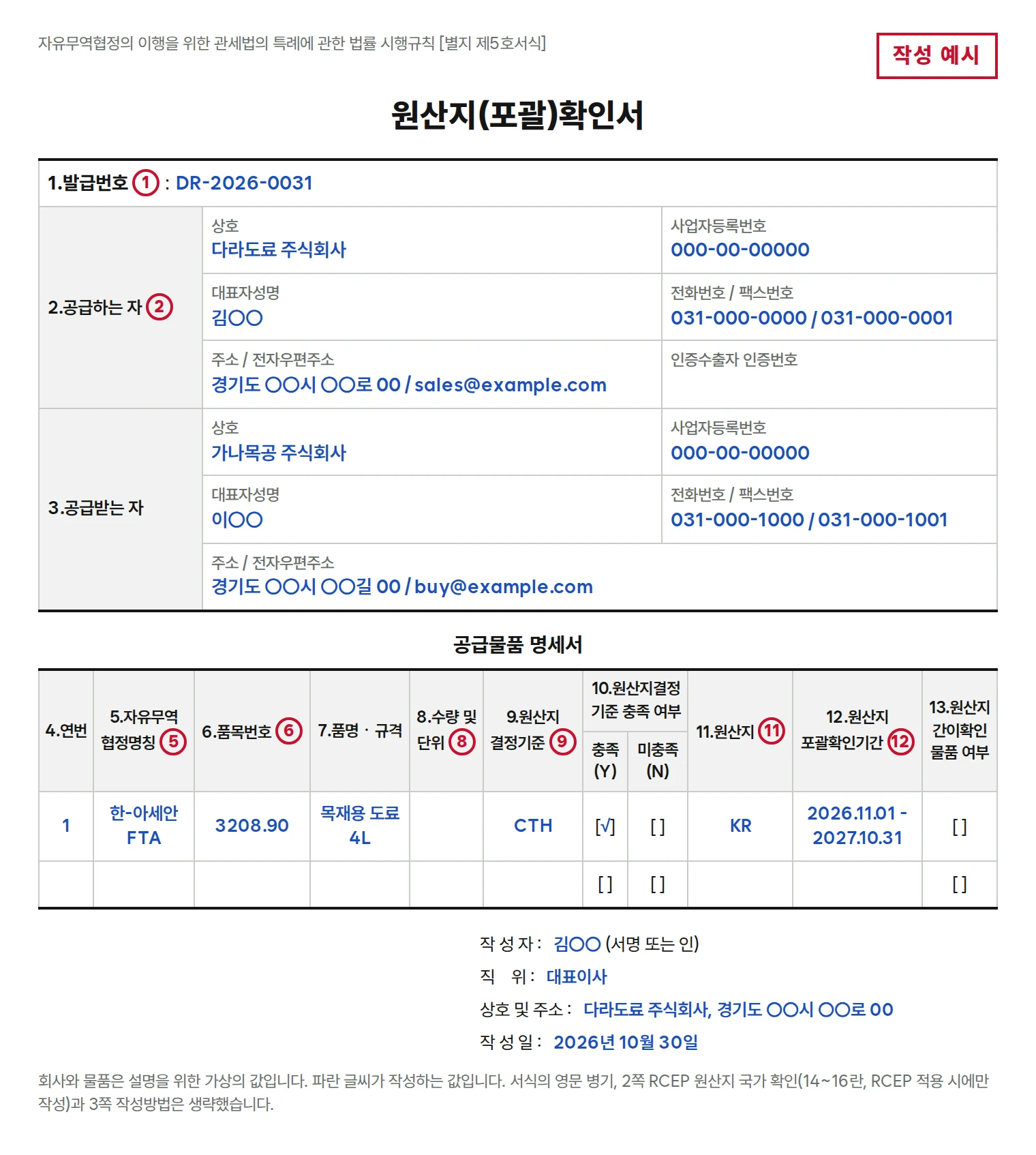
- Box 1: Issuance number that the supplier manages itself
- Box 2: The supplier that prepares the Declaration of Origin. For an approved exporter, include the approval number
- Box 5: Name of the agreement that the exporter told the supplier
- Box 6: 6-digit HS number of the supplied goods. The exporter copies this value into the HS number (item 5) field of the bill of materials.
- Box 8: Leave blank for a blanket declaration.
- Box 9: Symbol of the criterion applied. For the 4-digit change in tariff classification criterion, CTH
- Box 11: Origin of the goods that meet the criteria for determining origins
- Box 12: Within 12 months from the date of supply of the goods. If left blank, it is treated as a single-shipment Declaration of Origin.
Common mistakes in the Declaration of Origin are as follows.
- Missing agreement name in box 5, or preparation under the criteria of a different agreement: The Korea Chamber of Commerce and Industry explains that criteria for determining origins differ by product for each agreement, so goods that meet the criteria under one agreement may fail under another. The exporter states the agreement and the product for export when making the request, and the supplier determines origin under that agreement's criteria.
- Wrong symbol in box 9: The unit and the symbol do not match, such as entering CTH for a 2-digit change in tariff classification, or only one criterion is entered although a combined criterion was met. Notations such as "RVC 40%" and "CTC" used on the certificates of origin of individual agreements are not in this form's instruction table.
- Entering a quantity on a blanket declaration, or exceeding the period: A blanket Declaration of Origin leaves box 8, quantity and unit, blank, and the period in box 12 must not exceed 12 months from the date of supply of the goods.
- Entering box 11 for goods that do not meet the criteria: Box 11, origin, is entered for goods that meet the criteria for determining origins.
A producer (including a producer of materials) that prepared and provided a Declaration of Origin records and manages a preparation ledger (Notice, Article 42 (2)). The producer keeps the documents prepared and provided to the exporter, together with the cost statement, the raw material statement and the process specification, for 5 years from the date of preparation or issuance of the certificate of origin (3 years for the agreement with China) (Enforcement Decree of the Act on Special Cases of the Customs Act for the Implementation of Free Trade Agreements, Article 10).
Source: Enforcement Decree of the Act on Special Cases of the Customs Act for the Implementation of Free Trade Agreements, Article 10 (Origin proof documents subject to retention), Enforcement Rule of the same Act, Article 2 (Definitions), Article 10 (Procedure for issuing certificates of origin for exported goods), Article 12 (Declaration of Origin), Form No. 5 (Declaration of Origin (blanket)), Notice on Procedures under the Act on Special Cases of the Customs Act for the Implementation of Free Trade Agreements, Article 27 (Supporting documents for the origin explanatory statement), Article 42 (Voluntary origin certification procedure), Form No. 19 (Bill of Materials), Korea Customs Service guide to standard preparation materials for FTA origin verification for importers and exporters, Busan Regional Customs origin management guidebook (easy step-by-step), Korea Customs Service FTA Portal, Declaration of Origin (blanket), Korea Chamber of Commerce and Industry Certificate of Origin Center, guide to preparing the Declaration of Origin (blanket). Checked on October 16, 2026. Based on the Enforcement Decree in force from January 6, 2026, the Enforcement Rule from May 1, 2026 and the Notice from June 30, 2026.