

Registration sequence before your first export
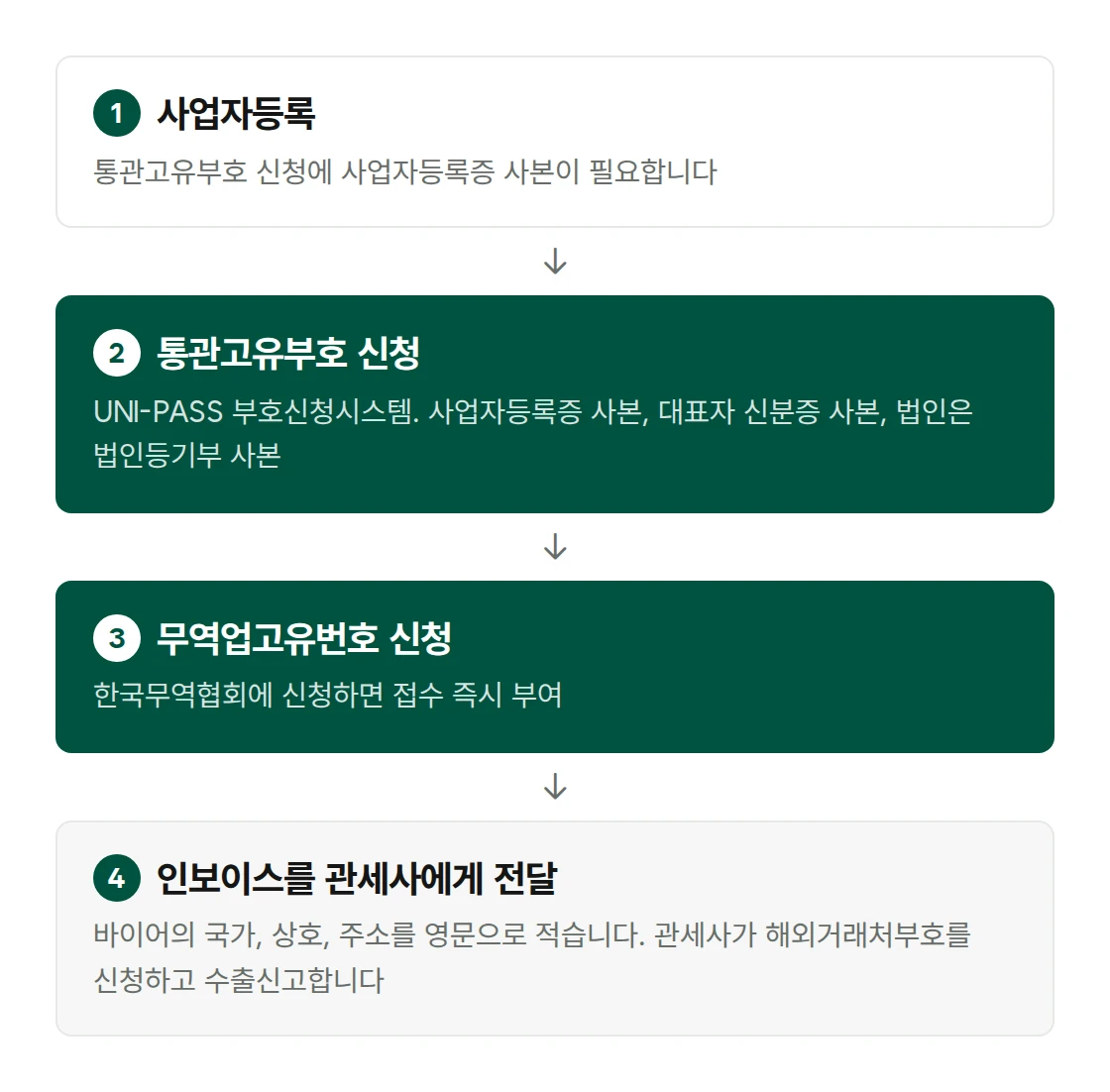
A business exporting for the first time must obtain 2 numbers in advance. Apply for the customs clearance code in UNI-PASS and the trader's identification number from the Korea International Trade Association.
The Licensed Customs Broker applies for the buyer's overseas supplier code together with the export declaration, using the buyer information written on the invoice, so you do not need to prepare it separately.
Customs clearance code
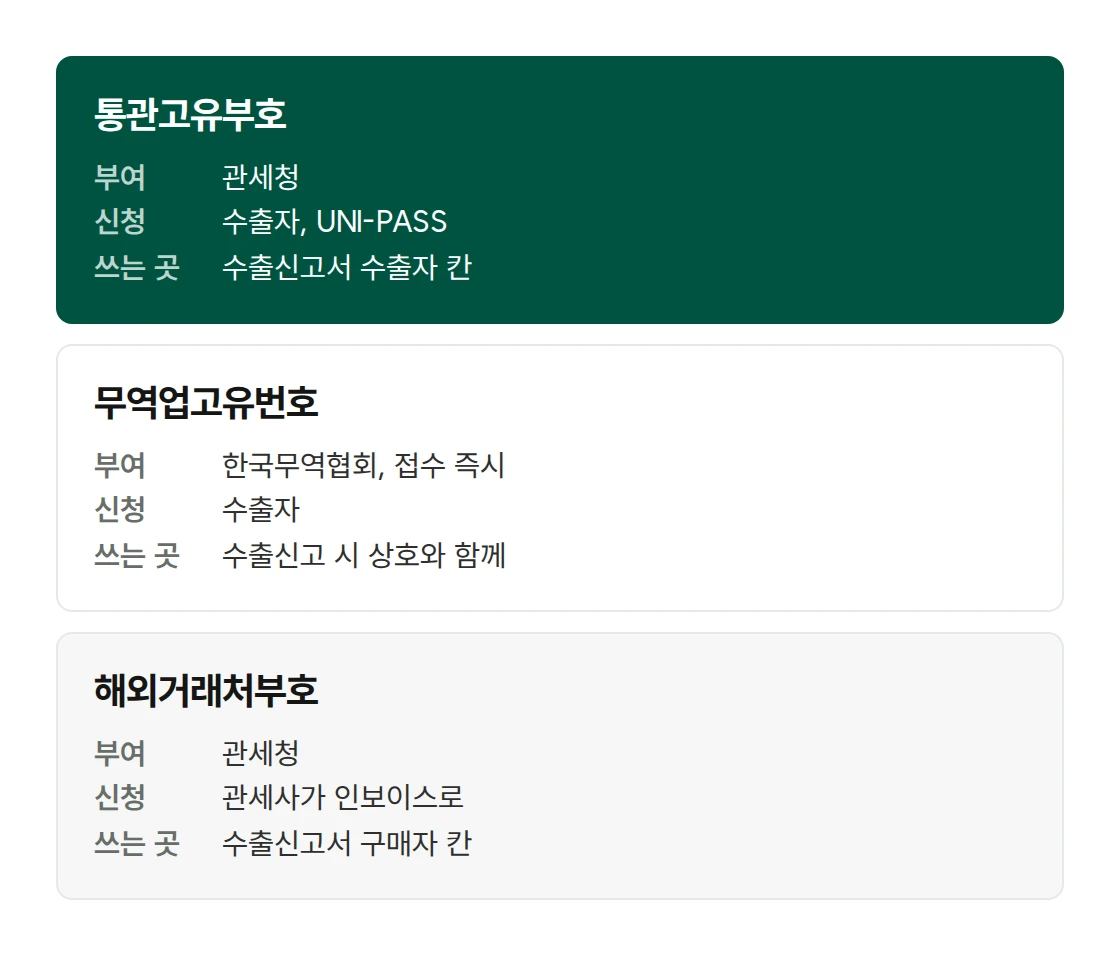
Enter the exporter's customs clearance code on the export declaration.
Apply through the UNI-PASS code application system, attaching a copy of the business registration certificate and a copy of the representative's identification (and, for a corporation, a copy of the corporate registry). A Licensed Customs Broker may also apply on your behalf with a power of attorney.
If the company name or address changes, file a change application. The application service is described in code issuance service.
Trade business ID number
The trader's identification number is a number the Ministry of Trade, Industry and Energy assigns to manage trade operators electronically. If you apply to the Korea International Trade Association, it is issued as soon as the application is received.
Under the Foreign Trade Management Regulation, this number must be entered with the exporter's company name when the export declaration is filed, so once you receive it, tell the Licensed Customs Broker together with the customs clearance code.
If the company name, representative, address or telephone number changes, notify the Korea International Trade Association within 20 days of the change.
The buyer's overseas supplier code
Enter in the buyer box of the export declaration the overseas supplier code that the Korea Customs Service assigned to the overseas buyer.
A buyer you trade with for the first time has no code, so the Licensed Customs Broker applies for one using the buyer's country, company name and address written on the invoice. You only need to write these 3 items accurately in English on the invoice.
If the buyer asks whether you are a business that can export, answer that you can file export declarations in Korea once you have received the customs clearance code.
Whether the importing country separately requires exporter registration is for the buyer to check with its local customs broker.
Related articles
- How to prepare an export invoice and exemption from issuing a tax invoice
- Hand-carry and express shipment: how to declare small exports
- Export inspection: differences and preparation for inspection at the place of declaration and at the place of loading
Source: Enforcement Decree of the Customs Act, Article 246 (Declaration of export, import or return), Notice on Registration and Management of Customs Clearance Codes and Overseas Supplier Codes, Article 4 (Application for codes), Article 6 (Application for a business customs clearance code), Article 9 (Application for an overseas supplier code), Foreign Trade Management Regulation, Article 24 (Application for and assignment of the trader's identification number), Notice on Export and Return Clearance, Annex 1 (Instructions for completing the export declaration). Checked on October 22, 2026. Based on the Enforcement Decree in force from February 27, 2026, the customs clearance code Notice from April 13, 2026, the Foreign Trade Management Regulation from March 8, 2024 and the export Notice from June 26, 2026.