
Guides
All 27 guides
Import declaration of hygiene products: from business notification to thorough inspection

Hygiene products such as disposable cups, toilet paper, and toothbrushes are imported under the Hygiene Products Control Act, not as food. After sanitation education, make the hygiene products importer business notification once, then declare each product to the Regional Office of Food and Drug Safety, undergo thorough inspection on the first import, and file the import declaration with customs.
- 1What the importer does before declaring hygiene products
- 2Goods that are hygiene products
- 3Hygiene products versus utensils and containers for food
- 4Business notification as a hygiene products importer
- 5Documents and timing for the import declaration of hygiene products
- 6Types of inspection for imported hygiene products and processing periods
- 7Customs import declaration and confirmation by the head of customs
- 8Common mistakes in the hygiene products import procedure
- 9Materials to prepare when requesting an agent
- 10Related articles
- Legal basis
- Hygiene Products Control Act, Regulation on Inspection of Imported Hygiene Products, Food Sanitation Act, Customs Act
- Last updated
Overseas manufacturing facility registration: documents to request from the factory and a confirmation form example
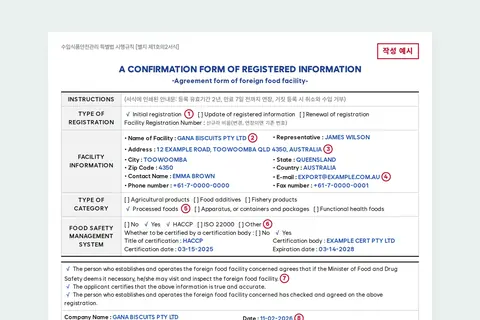
Food and food contact utensils and containers require the overseas factory to be registered with the MFDS before the import declaration. The documents to request from the factory are the business license from the exporting country and the overseas manufacturing facility registration information confirmation, and the business name and address must be identical, character for character, across every document.
- 1Overseas manufacturing facility registration comes first
- 2Documents for overseas manufacturing facility registration
- 3Checking whether the factory is already registered
- 4Example of filling out the overseas manufacturing facility registration information confirmation
- 5Common mistakes in overseas manufacturing facility registration
- 6Renewal and change applications
- Legal basis
- Special Act on Imported Food Safety Control
- Last updated
Importing food: documents to request from the factory and steps for the first import
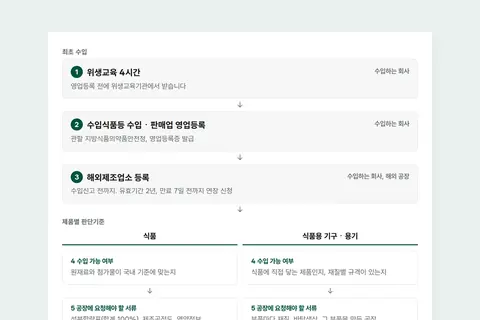
For your first import of food or food contact articles (utensils and containers), you complete sanitation education, business registration, and overseas manufacturing facility registration once, then prepare factory documents and Korean labeling for each product. For food, obtain the ingredient composition table and manufacturing flow chart. For utensils and containers, obtain the material and base color of each part.
- 1Food import procedure in 8 steps
- 2First import: sanitation education and business registration
- 3Difference between MFDS business registration and adding a business type at the tax office
- 4First import: overseas manufacturing facility registration
- 5First check whether the product can be imported
- 6Documents to request from the factory: food
- 7Documents to request from the factory: food contact utensils and containers
- 8Korean labeling
- 9MFDS import declaration and inspection
- 10Private brand (OEM) products
- 11Materials to prepare when requesting an agency service
- Legal basis
- Special Act on Imported Food Safety Control, Regulation on Declaration and Inspection of Imported Food, etc., Enforcement Decree of the Value-Added Tax Act
- Last updated
Reduction of customs duties on overseas trusted and processed goods: reduced customs duty on goods re-imported after repair

If you export raw materials for processing abroad or export goods for repair abroad and then re-import them, the reduction of customs duties on overseas trusted and processed goods lowers customs duty by the export declaration price multiplied by the customs duty rate. Attach documents proving the processing or repair to the reduction application, and prepare a bill of materials and a processing contract in advance.
- 1Prepare for the reduction of customs duties on overseas trusted and processed goods at the time of export declaration
- 2Legal basis: Customs Act, Article 101, reduction of customs duty on overseas processed goods, etc.
- 3Two categories eligible for reduction and the reduction amount
- 4Repair within the defect warranty period: reduction includes freight and repair costs
- 5Document certifying the repair and documents to prepare in advance
- 6Cases with no reduction and the difference from re-import exemption
- 7Scope of our clearance services for the reduction of customs duties on overseas trusted and processed goods
- Legal basis
- Customs Act, Value-Added Tax Act
- Last updated
Exemption from customs duties for re-exportation: security, conditions, extension of the period and penalty tax

Goods to be exported again, such as exhibition items and goods for repair, can be exempted from customs duty under the exemption from customs duties for re-exportation if you apply for the exemption before acceptance of the import declaration. If the amount of duty exempted is KRW 500,000 or more, the head of customs may require security, and if the goods are not exported within the period, the exempted duty and a penalty tax of 20% of the duty (up to KRW 5,000,000) are collected.
- 1Exemption from customs duties for re-exportation: conditions and what the importer does at import declaration
- 2Legal basis: Customs Act, Article 97 (exemption from customs duties for re-exportation)
- 3Covered goods and re-export periods
- 4Extension of the re-export period and time of export
- 5Penalty tax for failure to re-export and use for another purpose
- 6Who must provide security for the exemption from customs duties for re-exportation, and conditions for exemption from security
- 7Documents for re-export and value-added tax
- 8Scope of customs clearance services for the exemption from customs duties for re-exportation
- Legal basis
- Customs Act, Notice on Implementation of the System for Exemption from Customs Duties for Re-exportation under Article 97 of the Customs Act, Notice on Collection Procedures, Value-Added Tax Act
- Last updated
Exemption from customs duties for re-import: conditions and documents, within 2 years of export

If exported goods return within 2 years of the acceptance date of the export declaration without having been processed, repaired, or used overseas, customs duty can be exempted as a exemption from customs duties for re-import. Check whether a drawback was claimed at export and whether the exporter and importer are the same, and apply for the exemption with the certificate of export declaration before the import declaration is accepted.
- 1Conditions for the exemption from customs duties for re-import: 3 things to check before the import declaration
- 2Legal basis: Article 99 of the Customs Act, exemption from customs duties for re-import
- 3Goods considered for exemption even if used overseas
- 4When a drawback was received, or the exporter and importer differ
- 5Documents for the exemption from customs duties for re-import and when to apply
- 6Conditions for VAT to be exempted as well
- 7Scope of our re-import clearance service
- Legal basis
- Customs Act, Enforcement Decree of the Value-Added Tax Act, Notice on Export and Return Clearance
- Last updated
Import declaration after list clearance: within 30 days of release
Even express shipments already delivered under list clearance can be declared for import if they are brought back, within 30 days of the release date, to a place designated by the head of customs. Ubis Customs Service files the import declaration for goods whose return schedule has been arranged with the logistics company.
- 1What an importer who wants to declare list clearance goods must do
- 2Legal basis: import declaration of express shipment goods under list clearance
- 3The 30-day deadline and confirmation of identical goods
- 4Why carriers and warehouses are reluctant to accept re-entry
- 5Scope of our clearance service and how to request
- Legal basis
- Notice on Import Clearance Procedures for Express Shipments
- Last updated
FTA certificate of origin issuance methods: agency issuance and self-issuance by agreement
Depending on the agreement, an FTA certificate of origin is issued by customs or a chamber of commerce, or prepared directly by the exporter or producer. Some agreements, such as the Korea-EU and Korea-UK FTAs, allow only approved exporters to prepare it directly, so first check the agreement for the destination country.
- 1Certificate of origin issuance methods by agreement
- 2Preparer and validity period by self-issuance agreement
- 3When approved exporter status is required
- Legal basis
- Act on Special Cases of the Customs Act for the Implementation of Free Trade Agreements
- Last updated
Responding to FTA origin verification: documents the exporter submits and deadlines

When the importing country verifies origin, the exporter submits, within the deadline, documents that prove the origin criterion stated on the certificate of origin. If Korean customs requests them, submit within 30 days; if the documents are not submitted, the importer's FTA preferential tariff is denied.
- 1Origin verification procedure
- 2Documents to submit
- 3Submission deadlines
- 4When the certificate of origin you prepared has an error
- Legal basis
- Act on Special Cases of the Customs Act for the Implementation of Free Trade Agreements, Notice on Procedures under the Act on Special Cases of the Customs Act for the Implementation of Free Trade Agreements
- Last updated
Self-issuing an FTA certificate of origin: preparing and keeping the bill of materials and manufacturing flow chart
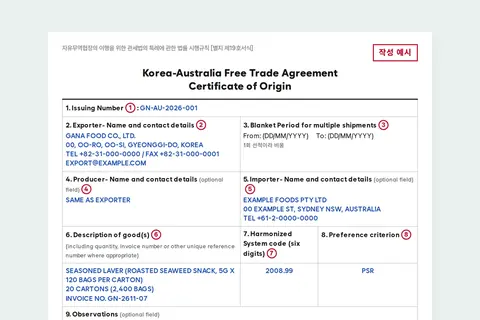
A self-issued certificate of origin is prepared and signed directly by the exporter or producer. Before preparing it, confirm that the criteria for determining origins are met using the bill of materials and the manufacturing flow chart; after preparing it, record it in the issuance register and keep the supporting documents for 5 years.
- 1Burden of proving origin under self-issuance and the order of preparation
- 2Confirming origin with the bill of materials and the manufacturing flow chart
- 3Completing the self-issued certificate of origin form
- 4Recording in the issuance register and keeping documents
- Legal basis
- Act on Special Cases of the Customs Act for the Implementation of Free Trade Agreements, Notice on Procedures under the Act on Special Cases of the Customs Act for the Implementation of Free Trade Agreements
- Last updated