

Prepare for the reduction of customs duties on overseas trusted and processed goods at the time of export declaration
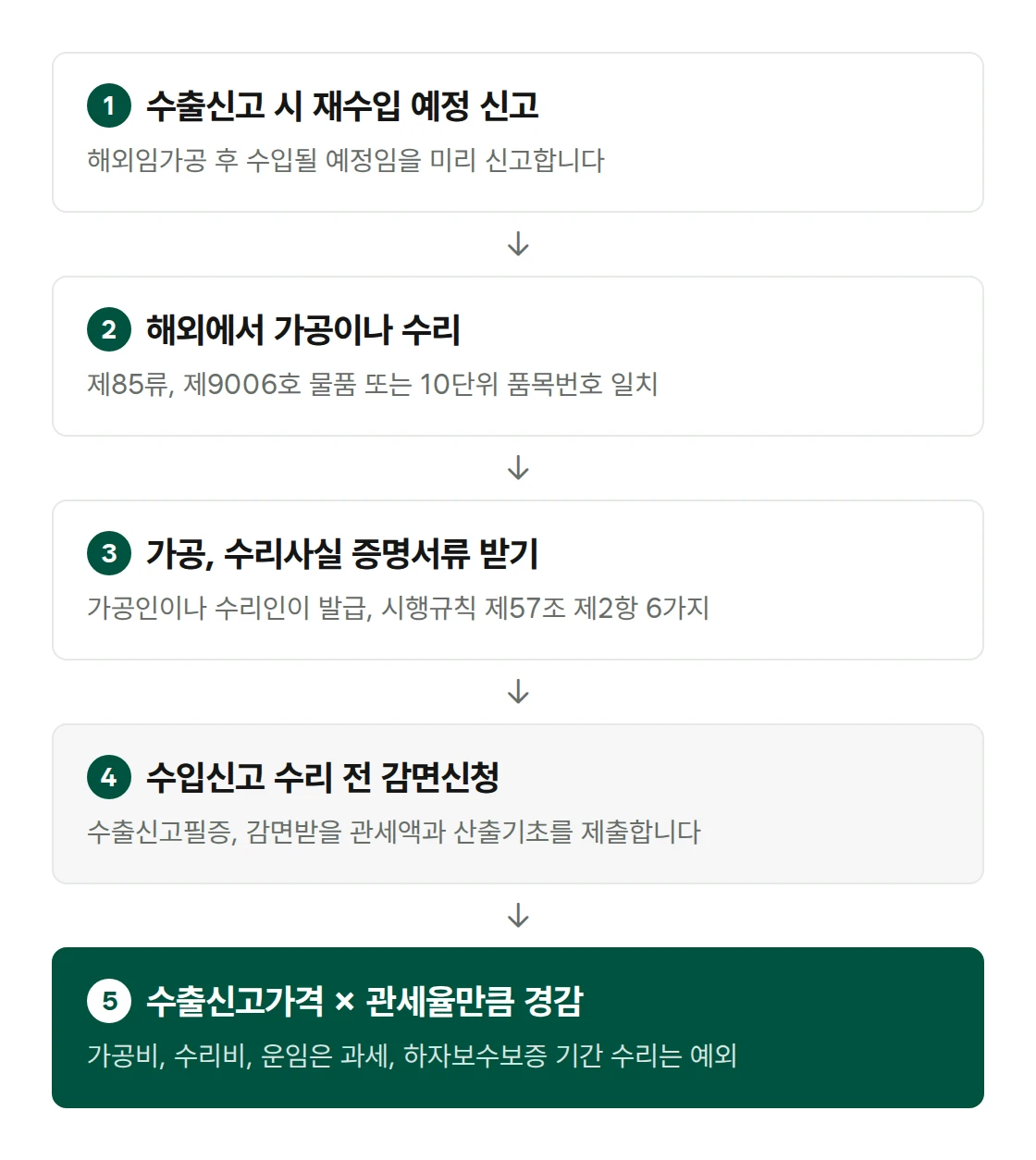
For goods to be processed or repaired abroad, declare at the time of export declaration that they are scheduled to be imported after overseas processing (Enforcement Rule of the Customs Act, Article 57 (1)). On re-import, attach to the reduction application the document issued by the processor or repairer certifying the processing or repair and the certificate of export declaration. Also prepare a bill of materials and a processing contract before export in case customs requests supplementary documents.
The customs duty reduced is the export declaration price of the exported goods multiplied by the customs duty rate of the imported goods (Enforcement Decree of the Customs Act, Article 119). The formal name in the law is Customs Act, Article 101, reduction of customs duty on overseas processed goods, etc., and in practice it is called the processing tax reduction.
Legal basis: Customs Act, Article 101, reduction of customs duty on overseas processed goods, etc.
(1) When goods falling under any of the following subparagraphs are imported, the customs duty on them may be reduced as prescribed by Presidential Decree.
1. Goods manufactured or processed, from raw materials or parts exported, into goods prescribed by Ordinance of the Ministry of Finance and Economy
2. Goods exported for processing or repair that meet the standards prescribed by Ordinance of the Ministry of Finance and Economy
(2) The customs duty on the goods under paragraph (1) shall not be reduced if any of the following subparagraphs applies.
1. Where customs duty has been reduced or exempted on the goods or raw materials. However, the case under paragraph (1) 2 is excluded.
2. Where a refund has been received under this Act or the "Act on Special Cases Concerning the Refund of Customs Duties, etc. Levied on Raw Materials for Export"
3. Where customs duty has not been imposed because goods under bonded processing or goods whose storage period has elapsed were sold on condition of re-export
Two categories eligible for reduction and the reduction amount
| Category | Eligible goods | Customs duty reduced |
|---|---|---|
| Paragraph (1) 1: manufacture or processing after export of raw materials | Goods of Chapter 85 and heading 9006 | Export declaration price of raw materials and parts × customs duty rate |
| Paragraph (1) 2: export for processing or repair | The 10-digit HS numbers of the exported goods and the imported goods match | Export declaration price of the goods processed or repaired × customs duty rate |
The eligible goods are set by Article 56 of the Enforcement Rule of the Customs Act, and the reduction amount by Article 119 of the Enforcement Decree of the Customs Act.
Subparagraph 1 covers only goods of Chapter 85 and heading 9006. If goods in any other chapter are manufactured abroad from exported raw materials and imported, the reduction under subparagraph 1 is not available.
Subparagraph 2 provides for cases where the reduction is available even if the 10-digit HS numbers differ. These are goods discarded because of degraded yield or performance that are exported, regenerated through a melting process or similar, and imported again, and cases where the head of customs can confirm from the manufacturing serial number or the characteristics of the product that the goods were exported from Korea (Enforcement Rule, Article 56 (2), proviso).
The Korea Customs Service Customer Support Center FAQ states: "If the above conditions are met, customs duty equal to the export declaration price × the customs duty rate applicable to the imported goods can be exempted, and tax is imposed on the processing (repair) fee + round-trip freight, etc."
Repair within the defect warranty period: reduction includes freight and repair costs
If a defect is found or the imported goods break down within the defect warranty period under the sales contract (limited to 1 year after acceptance of the import declaration) and the goods are exported for repair at the expense of the foreign seller, the reduction is calculated differently (Enforcement Decree, Article 119, subparagraph 2, proviso). The customs duty rate is multiplied by the sum of the amounts below.
- Export declaration price of the exported goods
- Freight and insurance of the exported goods up to the port of discharge
- Freight and insurance of the goods after processing or repair from the port of shipment to the port of import in Korea
- An amount equivalent to the cost of processing or repair
Prepare the date of acceptance of the import declaration, the defect warranty clause of the contract, and the documents showing that the seller bore the repair cost.
Document certifying the repair and documents to prepare in advance
The document issued by the processor or repairer states the 6 items in Article 57 (2) of the Enforcement Rule of the Customs Act. If you tell the overseas factory these items in advance, you will not need to obtain the document again at re-import.
- Name, specification, quantity and price of the original goods
- Name, specification, quantity and price of the goods added or replaced by manufacture, processing or repair
- Costs incurred for manufacture, processing or repair
- Details of the manufacture, processing or repair
- The amount for which reduction or exemption is sought and the basis for its calculation
- Other materials that can confirm that the imported goods were manufactured, processed or repaired from goods exported from Korea
A bill of materials (BOM) and a processing contract are not attachments required by law. Customs may request supplementary documents to confirm whether the exported raw materials or parts were used as they are in the imported goods and how much the processing and repair costs were.
If you can explain with the bill of materials where the exported raw materials were used in the imported goods, and with the processing contract the processing details and costs, you can answer a request for supplementary documents quickly.
Submit the reduction application before acceptance of the import declaration (Enforcement Decree of the Customs Act, Article 112 (1)). The application also states the exporting country, the place of shipment and the customs duty amount for which reduction is sought (Enforcement Rule, Article 57 (1)).
The reduction of customs duties on overseas trusted and processed goods is not subject to the security requirement under Customs Act, Article 108 (1). Article 131 (1) of the Enforcement Decree of the Customs Act limits the provision of security under Article 108 (1) of the Act to "cases where customs duty has been reduced or exempted pursuant to Article 97 or 98 of the Act" and "cases where approval of installment payment has been obtained pursuant to Article 107 of the Act."
Cases with no reduction and the difference from re-import exemption
No reduction is available for goods for which a refund was received at export or on which customs duty was not imposed because they were sold on condition of re-export (Article 101 (2) 2 and (3)). Goods or raw materials on which customs duty was reduced or exempted are also not eligible, but this restriction does not apply to goods exported for processing or repair (paragraph (1) 2) (proviso to paragraph (2) 1).
If goods that received a customs duty reduction or exemption are exported for repair and then re-imported with a reduction under Article 101 (1) 2, post-clearance management of the original reduction continues (Customs Act, Article 108 (4), proviso).
For goods re-imported as they are within 2 years without processing or repair abroad, consider customs duty exemption under Customs Act, Article 99, exemption from customs duties for re-import. Article 99, subparagraph 1, excludes goods processed or repaired abroad from the exemption.
If a business exports goods without transferring the right to use or consume them and then re-imports them with a customs duty reduction under Article 101, value-added tax is also exempted in the same proportion as the customs duty reduction (Value-Added Tax Act, Article 27, subparagraph 12; Enforcement Decree of the same Act, Article 54).
Scope of our clearance services for the reduction of customs duties on overseas trusted and processed goods
Ubis Customs Service handles, on your behalf, the export declaration stating the scheduled import after overseas processing and the import declaration claiming the reduction at re-import. Once the overseas processing or repair contract is set, please request export clearance before the export declaration.
Related articles
- Exemption from customs duties for re-import: conditions and documents, within 2 years of export
- Exemption from customs duties for re-exportation: security and conditions, period extension and penalty tax
Source: Customs Act, Article 101 (Reduction of customs duty on overseas processed goods, etc.), Article 108 (Provision of security and post-clearance management), Enforcement Decree of the same Act, Article 112 (Application for customs duty reduction or exemption), Article 119 (Amount of customs duty reduction on overseas processed goods), Article 131 (Declaration of provision of security, etc.), Enforcement Rule of the same Act, Article 56 (Overseas processed goods eligible for customs duty reduction or exemption), Article 57 (Application for customs duty reduction or exemption on overseas processed goods), Value-Added Tax Act, Article 27 (Exemption for import of goods), Enforcement Decree of the same Act, Article 54 (Scope of re-imported goods eligible for customs duty reduction or exemption). Retrieved from the National Law Information Center on 2026-10-26, and the Korea Customs Service Customer Support Center FAQ "Reduction of customs duty on overseas processed goods, etc." confirmed on 2026-10-26.