
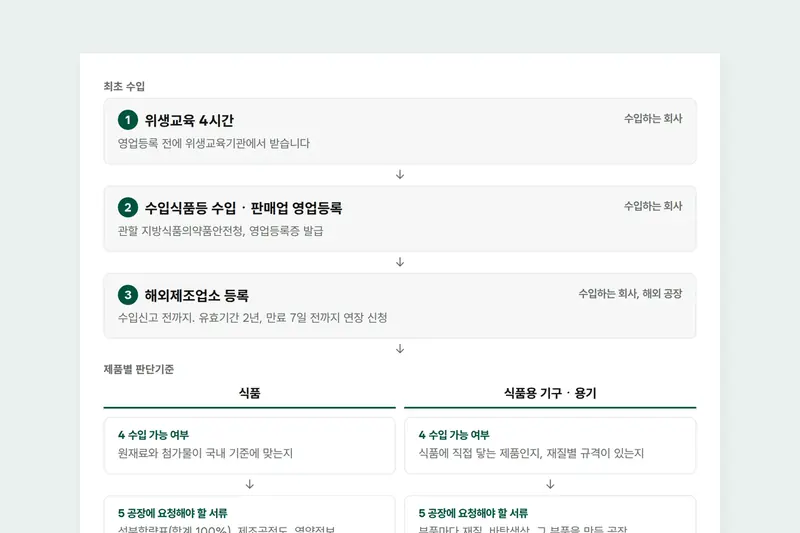
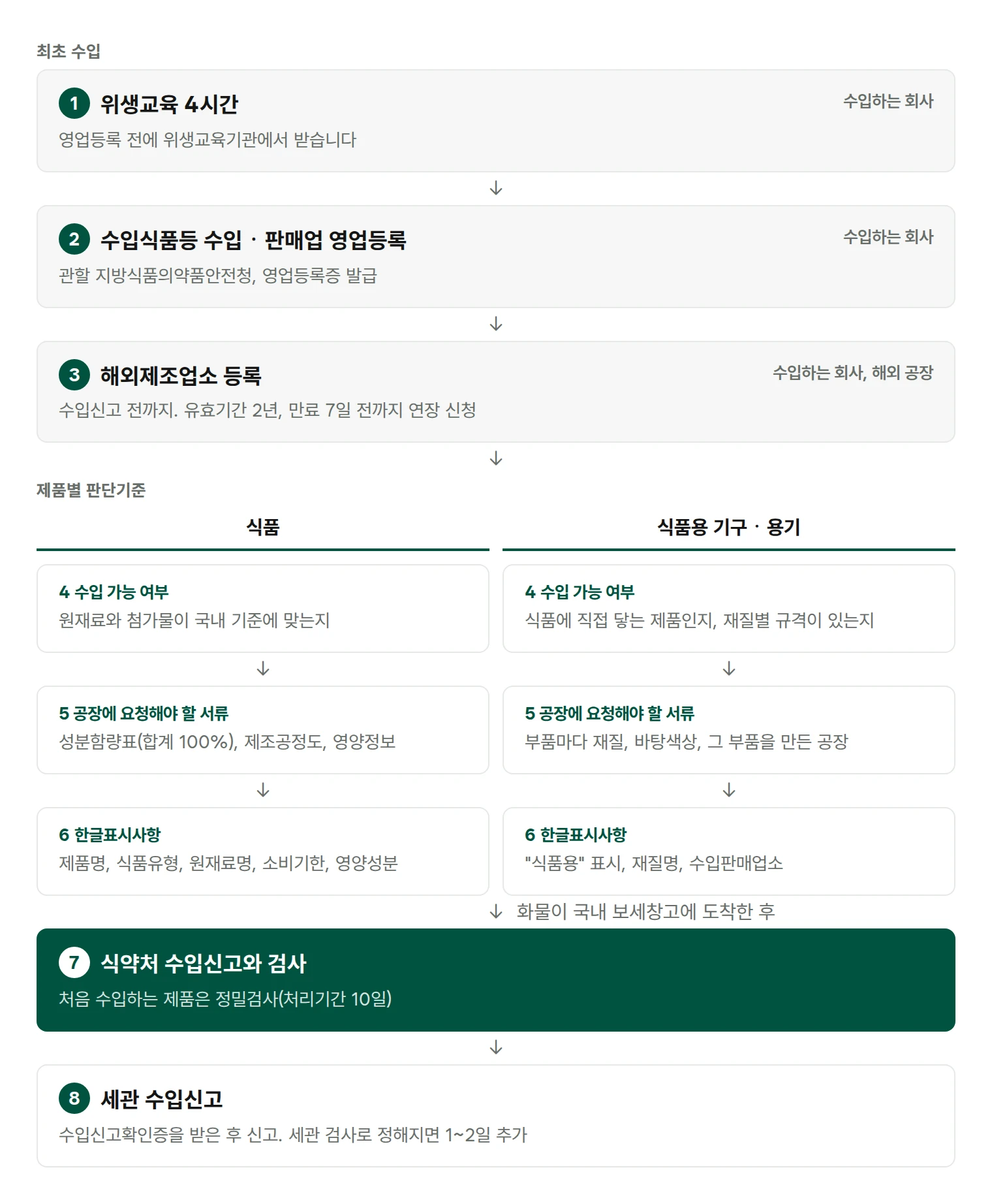
Food import procedure in 8 steps
For your first import of food or food contact articles (utensils and containers), you complete sanitation education, business registration, and overseas manufacturing facility registration once. For each product, you then prepare the documents and Korean labeling and file import declarations in turn with the MFDS and Korea Customs Service. Food and utensils and containers differ in the documents to request from the factory and in the inspection standards.
Obtain all documents to be requested from the factory before shipment, so that clearance is not delayed after the cargo arrives.
| Item | Food | Food contact utensils and containers |
|---|---|---|
| Scope | Processed food, agricultural products, marine products, food additives, etc. | Products that directly touch food, such as cups, plates, lunch boxes, and cooking tools |
| Documents to request from the factory | Ingredient composition table, manufacturing flow chart | Material, base color, and manufacturing factory of each part |
| Inspection standard | Standards and specifications for food | Standards and specifications for utensils, containers, and packaging (by material) |
| Items that must be identical for a repeat import | Country of manufacture, overseas manufacturing facility, manufacturing method, ingredient names (processed food) | Country of manufacture, overseas manufacturing facility, material, base color |
First import: sanitation education and business registration
To register as an imported food import and sales business, first complete 4 hours of sanitation education at a sanitation education institution. After you start the business, you take 3 hours of training every year.
After you receive the training completion certificate, apply for business registration with the Regional Office of Food and Drug Safety that has jurisdiction over the business location. The business name and location on the business registration certificate go into the importer and seller field of the Korean labeling.
- Sanitation education: Korea Food Industry Association, Korea Health Functional Food Association, Korea Food Safety Association
- Business registration guide: Government24, business registration as an imported food import and sales business
Difference between MFDS business registration and adding a business type at the tax office
To import and sell food or food contact utensils and containers, you must complete both the MFDS business registration as an imported food import and sales business and the addition of a business type to your business registration at the tax office. Completing one does not complete the other.
| Item | MFDS business registration | Adding a business type at the tax office |
|---|---|---|
| What you apply for | Business registration as an imported food import and sales business | Amendment filing for the business registration that adds food import or sales to the business type (item) on the business registration certificate |
| Where you apply | Regional Office of Food and Drug Safety with jurisdiction over the business location (Food Safety Korea e-civil service or in person) | Tax office with jurisdiction (Hometax business registration amendment filing or in person) |
| Attachments | Sanitation education completion certificate; facility use agreement if the storage facility is leased | Business registration certificate; copy of the MFDS business registration certificate |
| Document issued | Business registration certificate | Amended business registration certificate |
| Basis | Special Act on Imported Food Safety Control, Article 15; its Enforcement Rule, Article 16 | Enforcement Decree of the Value-Added Tax Act, Articles 11 and 14 |
The order is sanitation education, MFDS business registration, then adding the business type at the tax office. Because the application at the tax office attaches a copy of the business registration certificate, complete the MFDS business registration first.
- Even if you add a food wholesale or retail business type at the tax office, you cannot import food without the MFDS business registration.
- Even if you register the business with the MFDS, the business type on your business registration certificate does not change. File the amendment separately at the tax office.
- If you file a business closure with the tax office, the MFDS may cancel the business registration ex officio.
First import: overseas manufacturing facility registration
The overseas factory that made the product must be registered with the MFDS before the import declaration. Obtain the business license from the exporting country, and also obtain the overseas manufacturing facility registration information confirmation from the factory.
For an example of how to fill out the confirmation and cases of receiving supplement requests, see Overseas manufacturing facility registration: documents to request from the factory and a confirmation form example.
First check whether the product can be imported
Before you order the product, check whether its ingredients and materials meet Korean standards. If it contains an ingredient that cannot be used in Korea, the only options after the cargo arrives are re-export or disposal.
| If you do not check | Result |
|---|---|
| A colorant on the ingredient list is not in the Korean food additive standards | The factory changes the ingredient to a colorant that can be used, and you obtain the ingredient list again |
| A product containing an ingredient that cannot be imported is shipped together with other products | That product is re-exported or disposed of |
| You receive only the product name, without the ingredient composition table and manufacturing flow chart | The food type cannot be determined, so whether the product can be imported is judged after you obtain both documents |
Documents to request from the factory: food
The ingredient composition table lists the ratio of every ingredient and additive in the product, and the total must be 100%. If only some are listed or the total does not add up, it cannot be determined whether the product can be imported.
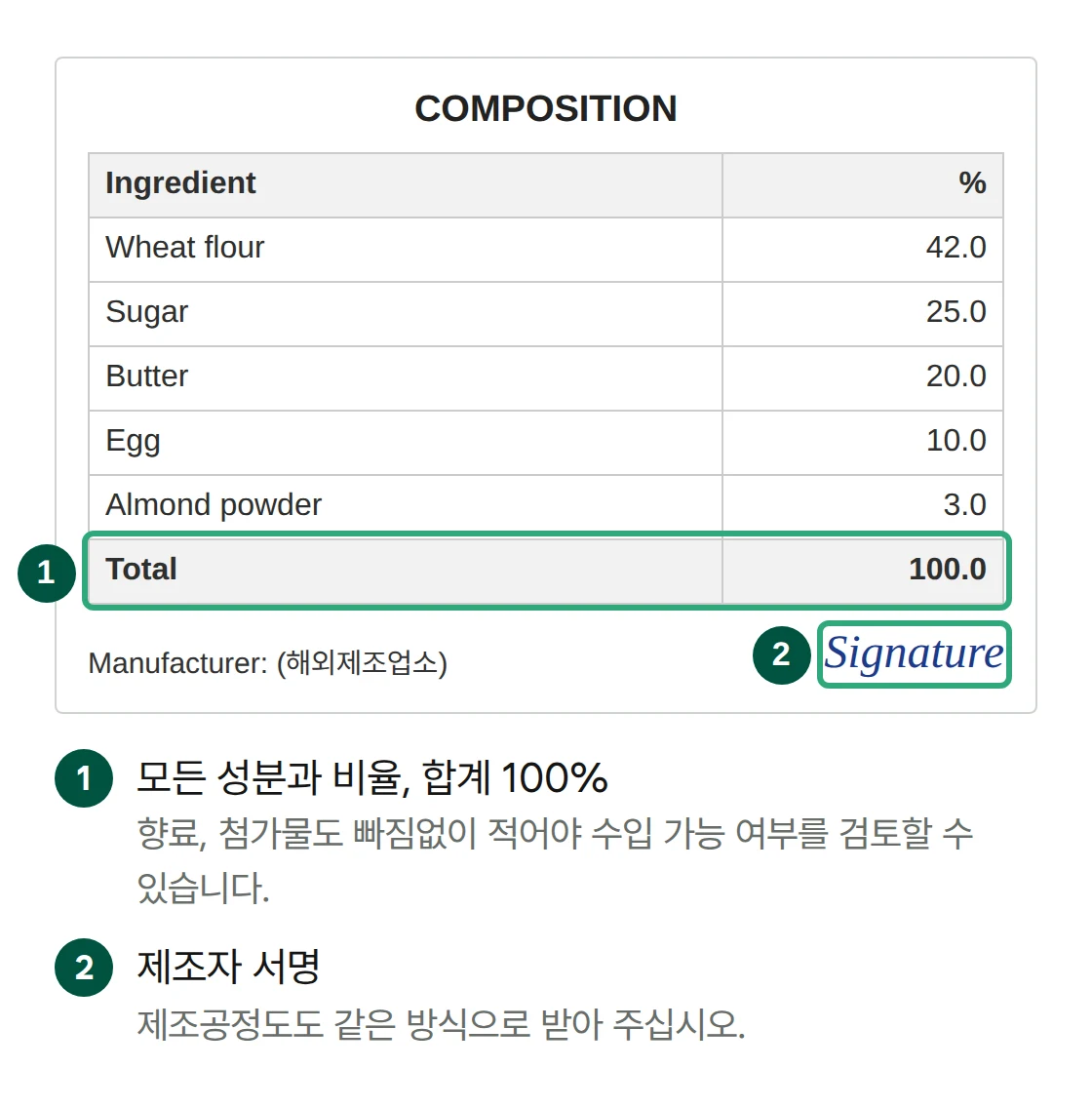
- Ingredient composition table: all ingredients and additives, ratios, a total of 100%, and the factory's signature. For compound ingredients (seasonings, sauces, etc.), obtain the components and ratios inside them as well.
- Additive numbers: Ask the factory to write the INS number or CAS number together with the name of each additive. Even for the same name, check the number to confirm whether it can be used in Korea.
- Plant ingredients: For plant ingredients such as herbs, roots, and flowers, obtain the scientific name and the part used (leaf, root, fruit, etc.). Even for the same plant, whether it can be used in food depends on the part used.
- Manufacturing flow chart: A document listing the sequence of processes from raw material input to packaging, such as heating, drying, and sterilization. It is used to determine the food type.
- Product photos: Obtain color photos of the front and back of the package showing the exporting country's labeling, and of the place where the consume-by date is marked.
If the ingredient composition table is only in Chinese or Japanese, also request an English version. An ingredient name run through a translator may read as a different ingredient, so ask the factory to write the original name and the English name side by side.
Documents to request from the factory: food contact utensils and containers
For utensils and containers, obtain the material and base color of every part that touches food. Parts that come together, such as lids, gaskets, and straws, must also be listed one by one.
Disposable cups, spoons, chopsticks, forks, knives, and straws are hygiene products, not utensils and containers for food. File a separate business notification as a hygiene products importer for these products and file the import declaration as hygiene products.
For a lunch box container, fill it in as follows.
| Part | Material | Base color | Manufacturing factory |
|---|---|---|---|
| Body | Polypropylene (PP) | White | Body factory |
| Lid | Polypropylene (PP) | Blue | Body factory |
| Lid gasket | Rubber (silicone rubber) | Transparent | Gasket factory (confirm overseas manufacturing facility registration) |
At the time of the import declaration, you submit a component parts declaration with this information.
- Missing parts: If a small part such as a lid gasket is missing from the parts list the factory sent, obtain the list again.
- Gasket: It is easy to assume that a silicone gasket inside a lid does not touch food, but if it can touch food, it is inspected separately.
- Packaging marking: If the material marked on the outer packaging differs from the material in the factory documents, you will receive a supplement request.
Even for the same factory and the same material, a different base color is subject to a separate thorough inspection. Three colors means three inspections, so reducing the number of colors on the first import reduces inspection fees.
Utensils and containers made of natural raw materials that pose no risk of harm, such as stone or uncolored glass (excluding glass for heat cooking and lead crystal glass), are subject to document inspection even on the first import.
Korean labeling
The Korean labeling must be attached to the product before customs clearance. At the time of the import declaration, the MFDS checks the packaging or documents showing the Korean labeling.
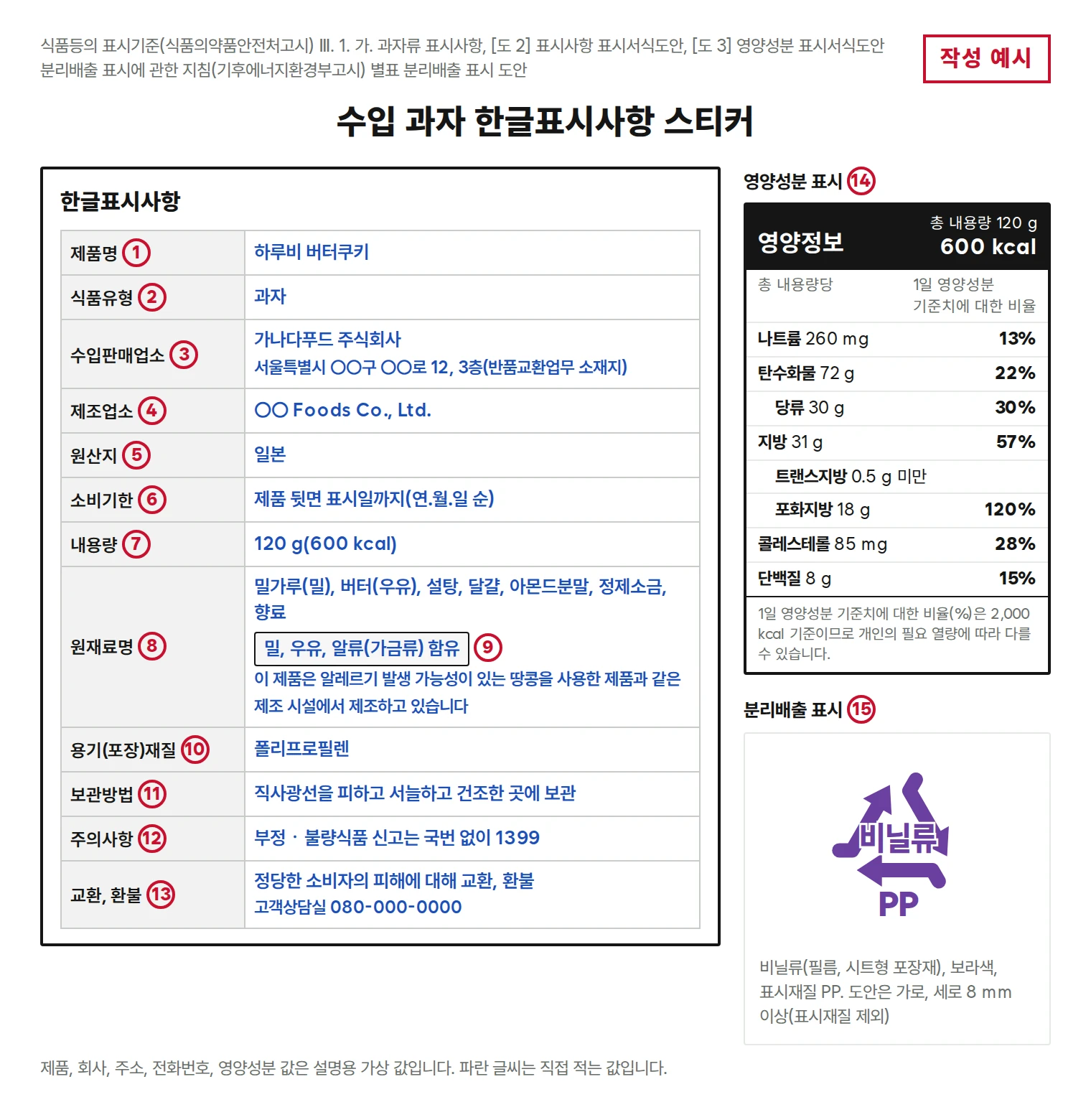
| Common mistakes | How to write it correctly |
|---|---|
| Calorie unit | Write kcal, not cal |
| Country of origin | Provide a separate country of origin field instead of placing it next to the ingredient names |
| Customer service phone number | Include the phone number in the exchange and refund guide |
| Where the sticker is placed | Do not cover the manufacturer name, material, or consume-by date in the exporting country's labeling |
| Utensils and containers | Write the words "for food" or the food-use symbol, and the material name |
To write a phrase such as "microwave safe" on utensils and containers, confirm that it matches the actual use.
Before shipment, obtain and check a photo of the product with the label attached. If products arrive without the exporting country's label, the cost of labeling work at the bonded warehouse is added.
MFDS import declaration and inspection
A product imported for the first time undergoes a thorough inspection, and you pay the inspection fee directly to the inspection body. If you import the same product that underwent a thorough inspection again within 5 years, it is subject to document inspection.
Even a product that had a thorough inspection at under 100 kg undergoes a thorough inspection again when you later import 100 kg or more in declared weight, so a declared weight of 100 kg or more is recommended for the first import quantity. For example, if you next import 200 kg of a product that had its first thorough inspection at 50 kg, it undergoes a thorough inspection again.
For the inspection categories and conditions for repeat imports, see Imported food thorough inspection: criteria for first imports and repeat imports.
Private brand (OEM) products
If you commission a foreign factory to manufacture a product and import it in packaging printed in Korean with your company's brand, it may qualify as an imported food, etc. by OEM. If it does, the on-site hygiene evaluation of the overseas factory and the duty of in-house quality testing after import are added.
The notice defines this product as one "imported after a domestic food business operator commissions manufacturing or processing from an overseas manufacturing facility or overseas workplace in the exporting country by contract, with the orderer's trademark (logo, symbol, text, figure, etc.) printed in Korean on the packaging".
Before you write OEM on the Korean labeling, confirm that the product meets these 2 requirements. If it is hard to judge, prepare the product photos and the contract and submit an inquiry to the MFDS.
Materials to prepare when requesting an agency service
If you send the materials below at one time, we will advise you of whether the product can be imported, the expected inspection category, and the inspection fee together.
- Business registration certificate (food business) and business registration certificate (tax office)
- English business name and address of the overseas factory, business license from the exporting country
- Food: ingredient composition table (total 100%, additive numbers), manufacturing flow chart, packaging photos
- Utensils and containers: material and base color of each part, factory that made each part, product photos
- Invoice, packing list, bill of lading (B/L)
Fees are in the pricing guide, and the scope of services is in the imported food services guide.
Source: Special Act on Imported Food Safety Control, Article 5 (Registration of Overseas Manufacturing Facilities), Article 18 (Duties of Business Operators), Enforcement Rule of the Special Act on Imported Food Safety Control, Article 27 (Import Declaration of Imported Food, etc.), Article 16 (Registration of Business), Article 23 (Sanitation education Hours), Annex 9 (Inspection Methods for Imported Food, etc.), Annex 10 (Classification Criteria for Imported Food, etc.), Regulation on Declaration and Inspection of Imported Food, etc. Article 7 (Scope of Recognition of the Same Imported Food, etc. from the Same Company), Article 25 (Scope of Minimum Import Quantity), Standards for On-Site Hygiene Inspection and Methods of Hygiene Evaluation of Imported Food, etc. with the Orderer's Trademark Attached, Article 2 (Definitions), Special Act on Imported Food Safety Control, Article 15 (Registration of Business), Enforcement Decree of the Value-Added Tax Act, Article 14 (Changes in Business Registration Details), Article 11 (Application for Business Registration and Issuance of Business Registration Certificate). As in force on October 8, 2026 for the Special Act on Imported Food Safety Control, September 30, 2026 for its Enforcement Rule, and April 1, 2026 for the Enforcement Decree of the Value-Added Tax Act.