

Conditions for the exemption from customs duties for re-import: 3 things to check before the import declaration
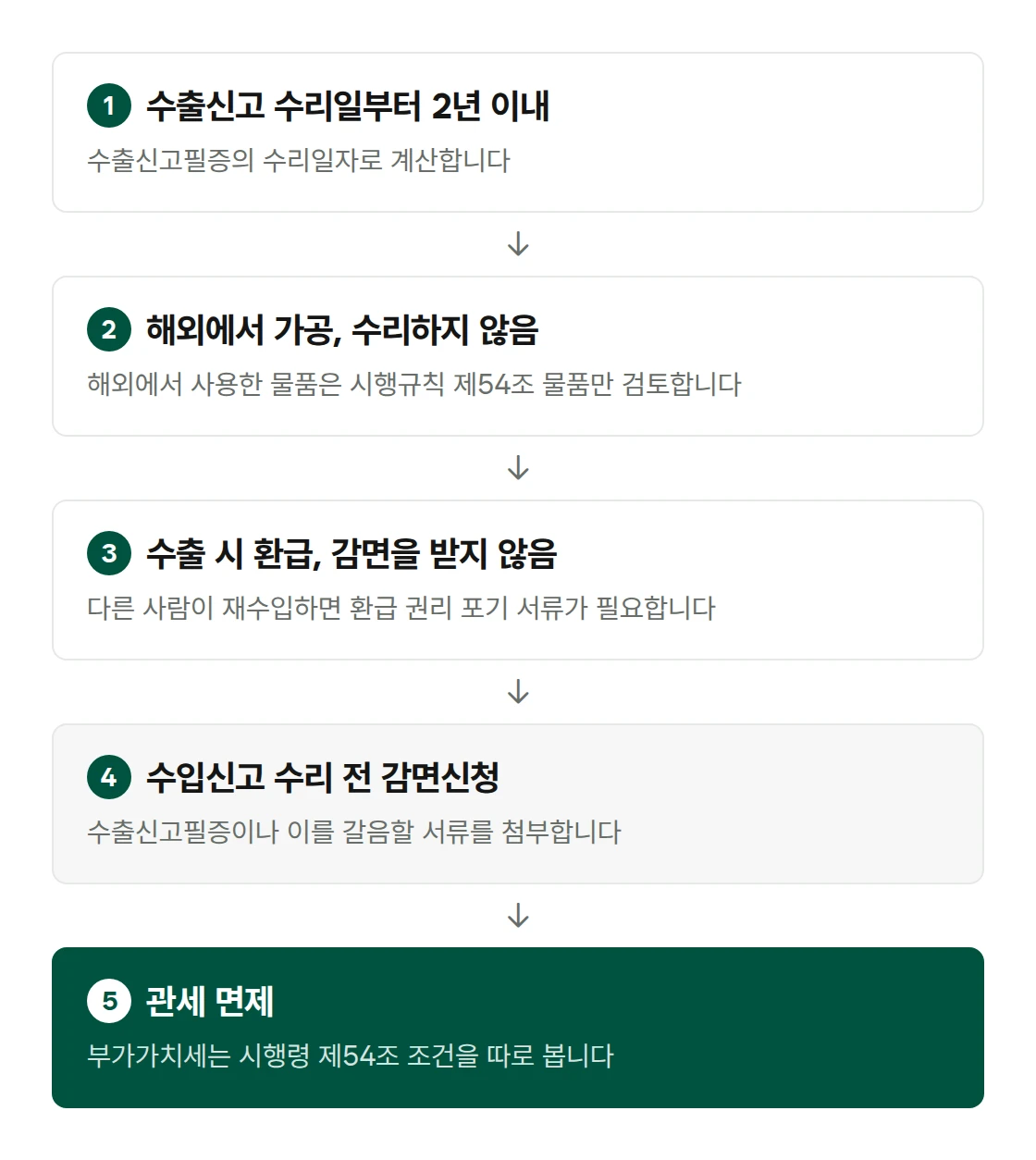
Before you file an import declaration to re-import exported goods, check 3 things. Check whether 2 years have not passed since the acceptance date of the export declaration, whether the goods were not processed or repaired overseas, and whether no customs duty drawback was received at export.
If all 3 requirements are met, customs duty can be exempted under Article 99 of the Customs Act. Submit the application for reduction or exemption together with the certificate of export declaration before the import declaration is accepted.
Legal basis: Article 99 of the Customs Act, exemption from customs duties for re-import
Article 99 (Exemption from customs duties for re-import) When goods falling under any of the following subparagraphs are imported, the customs duty on them may be exempted.
1. Goods that were exported from the Republic of Korea (including exports after bonded processing) and are re-imported (hereinafter in this Article referred to as "re-import") within 2 years from the acceptance date of the export declaration without having been manufactured, processed, repaired, or used overseas (excluding goods prescribed by Ordinance of the Ministry of Finance and Economy, such as goods that can be used over a long period and were exported for temporary use overseas under a lease contract or a contract for work, and goods exhibited or used at fairs, exhibitions, product shows, international sporting events, and other similar events). However, customs duty is not exempted in any of the following cases.
(a) Where a customs duty reduction or exemption was received on the goods or the raw materials
(b) Where a drawback was received under this Act or the "Act on Special Cases Concerning the Refund of Customs Duties, etc. Levied on Raw Materials for Export"
(c) Where a person other than a person who may receive a drawback under this Act or the "Act on Special Cases Concerning the Refund of Customs Duties, etc. Levied on Raw Materials for Export" re-imports the goods. However, this does not apply where the person re-importing submits to the head of customs a document proving that the person who may receive a drawback on the re-imported goods has waived the right to the drawback.
(d) Where customs duty was not imposed because bonded processing goods or goods whose storage period has elapsed were sold on the condition of re-export
2. Containers of export goods that are imported again
3. Goods that are re-imported after being exported for the purpose of overseas testing and research
This is the original text of Article 99 of the Customs Act. The 2 years are counted from the acceptance date of the export declaration, so first check the acceptance date on the certificate of export declaration.
Goods considered for exemption even if used overseas
Subparagraph 1 of Article 99 excludes goods used overseas from the exemption, but goods specified in Article 54 (1) of the Enforcement Rule of the Customs Act are not excluded from the exemption even if used overseas. These goods are the following 6.
- Among goods that can be used over a long period and were exported for temporary use overseas under a lease contract or a contract for work, goods with a useful life of 3 years or more (2 years for molds) under Article 15 of the "Enforcement Rule of the Corporate Tax Act"
- Goods exhibited or used at fairs, exhibitions, product shows, international sporting events under Article 2, subparagraph 1 of the "International Athletic Games Support Act", and other similar events
- Equipment and tools used to install, assemble, or unload export goods overseas
- Devices attached to export goods to maintain the quality of the goods or to measure and record their condition during transport
- Export goods found to be defective
- Containers exported to load import goods that are used repeatedly
Goods repaired or processed overseas are not covered by the exemption in subparagraph 1. For such goods, consider the reduction under Article 101 of the Customs Act (see Reduction of customs duties on overseas trusted and processed goods).
When a drawback was received, or the exporter and importer differ
Goods on which a customs duty drawback was received at export cannot receive the exemption from customs duties for re-import (Article 99 (1)(b)). The same applies where a customs duty reduction or exemption was received on the goods or the raw materials (item (a)).
The exemption also does not apply if someone other than the person who may receive the drawback re-imports the goods (item (c)). This restriction does not apply if the person re-importing submits to the head of customs a document proving that the person who may receive the drawback has waived the right to the drawback.
If the exporter and importer differ, as in a transaction where the manufacturer exports and another company re-imports, the re-importing company first checks whether the manufacturer applied for a drawback. If no drawback was received, obtain from the manufacturer a document proving that it has waived the right to a drawback, and submit it together with the application for exemption.
Documents for the exemption from customs duties for re-import and when to apply
Submit the application for reduction or exemption to the head of customs before the import declaration is accepted (Enforcement Decree of the Customs Act, Article 112 (1)). If you could not submit it before acceptance, you may submit it within 15 days of the acceptance date, but only where the goods have not been taken out of the bonded area (same Article (2) 2).
When applying for the exemption, submit the certificate of export declaration, the certificate of return declaration, or a document that takes its place (Enforcement Rule of the Customs Act, Article 54 (2)). If the head of customs can recognize by other materials that the goods qualify for the exemption, submission may be omitted.
For goods that you plan to re-import, state the model and serial number in the export declaration and keep photos of the goods. To receive the exemption on re-import, the exporter can file the export declaration with documents submitted or request a customs inspection (Notice on Export and Return Clearance, Article 7 (2) 3).
The exemption from customs duties for re-import is not subject to the security requirement of Article 108 (1) of the Customs Act. Article 131 (1) of the Enforcement Decree of the Customs Act limits the provision of security under Article 108 (1) of the Customs Act to "where customs duty was reduced or exempted under the provisions of Article 97 or Article 98 of the Act" and "where approval for installment payment was received under the provisions of Article 107 of the Act".
The exemption from customs duties for re-exportation (Article 97), which applies to goods that are imported and then exported again, is subject to security (see Exemption from customs duties for re-exportation).
Conditions for VAT to be exempted as well
Even if customs duty is exempted under the exemption from customs duties for re-import, VAT is assessed under separate conditions. Article 54 of the Enforcement Decree of the Value-Added Tax Act defines the goods exempted as "goods that a business operator takes out of the country without transferring the right to use or consume them and then imports again, for which customs duty is exempted under Article 99 of the Customs Act".
For goods where you must determine whether the right to use or consume was transferred, such as sold goods that are returned, please prepare the transaction documents and contact us before the import declaration.
Scope of our re-import clearance service
Ubis Customs Service checks the acceptance date of the certificate of export declaration and whether a drawback was received, and files the import declaration for the exemption from customs duties for re-import on your behalf. Once the return or repair schedule of exported goods is set, please submit the request through Import clearance together with the export declaration number.
Related articles
- Reduction of customs duties on overseas trusted and processed goods: customs duty reduction on re-import after repair
- Exemption from customs duties for re-exportation: security, conditions, period extension, and penalty tax
- Hand-carry and express shipment: how to declare small-quantity exports
Source: Customs Act, Article 99 (Exemption from customs duties for re-import), Article 108 (Provision of Security and Follow-Up Management), Enforcement Decree of the same Act, Article 112 (Application for Customs Duty Reduction or Exemption), Article 131 (Report of Provision of Security, etc.), Enforcement Rule of the same Act, Article 54 (Re-Imported Goods Exempt from Customs Duty, etc.), Enforcement Decree of the Value-Added Tax Act, Article 54 (Scope of Re-Imported Goods Whose Customs Duty Is Reduced or Exempted), Notice on Export and Return Clearance, Article 7 (Export Declaration and Documents to Submit). Retrieved from the National Law Information Center on October 26, 2026.