

Exemption from customs duties for re-exportation: conditions and what the importer does at import declaration
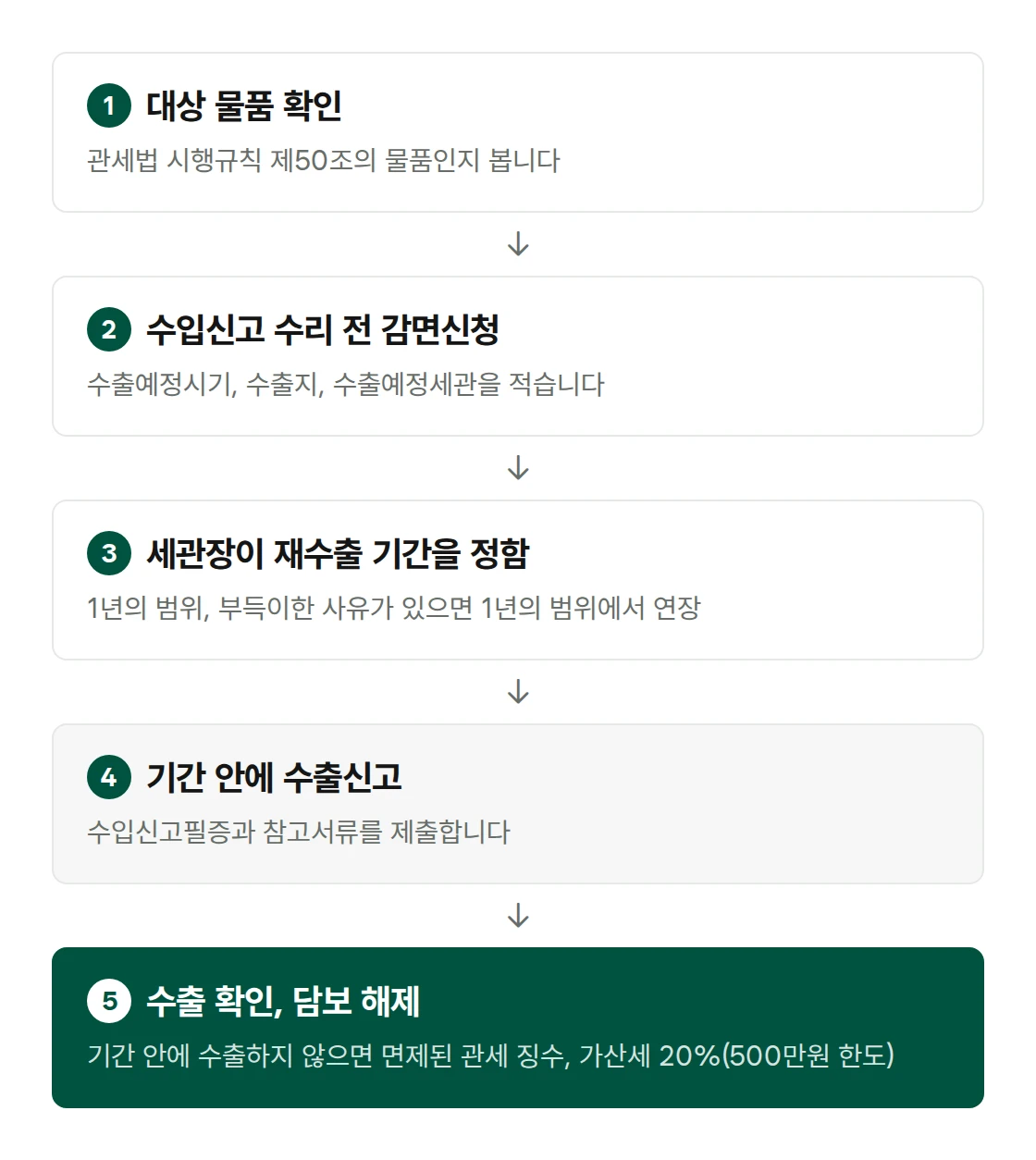
Goods to be exported again can be exempted from customs duty if you apply for the exemption on the condition of re-export before acceptance of the import declaration (Enforcement Decree of the Customs Act, Article 112 (1)). Enter the planned export time, the place of export and the customs office of planned export on the application (Enforcement Rule of the Customs Act, Article 51).
Export the exempted goods within the period set by the head of customs, and do not use them for another purpose or transfer them during that period. If the goods are not exported within the period, the exempted duty is collected immediately and a penalty tax is also imposed.
If the amount of duty reduced or exempted is KRW 500,000 or more, the head of customs may require security equal to the duty exempted, so check before the import declaration whether security must be provided.
Legal basis: Customs Act, Article 97 (exemption from customs duties for re-exportation)
(1) Customs duty may be exempted on goods that are exported again within any of the following periods from the acceptance date of the import declaration.
1. Goods prescribed by Ordinance of the Ministry of Finance and Economy: the period set by the head of customs according to the standards prescribed by Presidential Decree, within a range of 1 year. However, the head of customs may extend that period within a range of 1 year if it finds that there is an unavoidable reason.
2. Goods prescribed by Ordinance of the Ministry of Finance and Economy for which there is an unavoidable reason to export after more than 1 year: the period set by the head of customs
(2) Goods exempted from customs duty under paragraph (1) may not be used for any purpose other than the purpose specified in the same paragraph, or transferred, during the period in the same paragraph. However, this does not apply if prior approval of the head of customs has been obtained as prescribed by Presidential Decree.
These are Article 97 (1) and (2) of the Customs Act. The goods covered are set by Article 50 of the Enforcement Rule of the Customs Act, and the standards for the period are set by Article 115 of the Enforcement Decree of the Customs Act.
Covered goods and re-export periods
Article 50 (1) of the Enforcement Rule lists the covered goods in 24 items. The goods companies use often and the periods under Article 115 (1) of the Enforcement Decree are shown in the table below.
| Goods | Enforcement Rule, Article 50 (1) | Exemption from customs duties for re-exportation period |
|---|---|---|
| Items exhibited at fairs, exhibitions and similar events | Item 6 | The end date of the event plus the days needed for re-export |
| Goods for repair | Item 11 | The period recognized as needed for the repair |
| Goods for collecting orders, goods for testing, samples for manufacturing | Item 10 | The period confirmed by the import contract supporting documents |
| Packaging supplies for imported goods and exported goods | Items 1 and 2 | The period confirmed by the import contract supporting documents |
| Machines and instruments for inspecting and testing exported and imported goods | Item 12 | The period confirmed by the import contract supporting documents |
| Equipment for repair and maintenance of industrial machinery imported free of charge | Item 22 | The period confirmed by the import contract supporting documents |
If the period cannot be confirmed from the import contract supporting documents, the head of customs sets it in consideration of the nature and use of the goods, the importer, the useful life and the like (Enforcement Decree, Article 115 (1) 4).
Goods for repair are covered only if the goods imported for repair and the goods exported after repair are recognized as having the same 10-digit HS number. Among packaging supplies, those that are not used repeatedly for cargo transportation in international commerce are excluded (Notice on Implementation of the System for Exemption from Customs Duties for Re-exportation under Article 97 of the Customs Act, Article 2 (2)).
Goods for testing are covered only for performance tests that do not change the nature or shape of the goods at the time of import. If the goods are used to manufacture or process commercial products for sale, they are not covered (Notice, Article 3 (1) 2).
For personal effects and professional equipment that a person entering temporarily uses personally and takes out again, the period runs until the first day of departure after entry (Enforcement Decree, Article 115 (1) 1).
Extension of the re-export period and time of export
The head of customs sets the period within a range of 1 year, and may extend it within a range of 1 year if there is an unavoidable reason (Customs Act, Article 97 (1) 1). For goods with an unavoidable reason to export after more than 1 year, such as parts for repairing or maintaining defects in transport equipment, the period is set by the head of customs (same paragraph, subparagraph 2; Enforcement Rule, Article 50 (2)).
To obtain an extension, submit to the head of customs of the place of import an application stating the acceptance date of the import declaration, the declaration number, the product name, the specification, the quantity, the extension period and the reason for extension (Enforcement Decree, Article 114). The application is the application for approval of extension of the re-export period, and it can also be submitted through the Comprehensive Customs Duties Information Network of Korea (Notice, Article 6-2 (1)).
Whether the goods were exported within the period is determined by the re-export declaration date (Notice, Article 5 (1)).
Penalty tax for failure to re-export and use for another purpose
(3) In any of the following cases, the exempted customs duty is collected immediately from the person who did not export, used the goods for another purpose or transferred them. If the duty cannot be collected from the transferor, the exempted duty is collected immediately from the transferee. However, this does not apply if the goods were lost due to a disaster or other unavoidable reason, or were destroyed with the prior approval of the head of customs.
(4) If goods prescribed by Ordinance of the Ministry of Finance and Economy among the goods exempted from customs duty under paragraph (1) are not exported within the period specified in the same paragraph, the head of customs collects as a penalty tax an amount equal to 20/100 of the customs duty that would be imposed on the goods, within a range not exceeding KRW 5,000,000.
These are Article 97 (3) and (4) of the Customs Act. Article 50 (1) and (2) of the Enforcement Rule set the goods exempted from customs duty and the goods subject to penalty tax under Article 97 (4) of the Customs Act in the same list, so exempted goods that are not exported within the period are subject to penalty tax.
Theft or loss is not regarded as destruction (Notice, Article 7). Even if the goods are lost, the exempted duty is collected, so keep track of the storage location and quantity.
If you obtain the head of customs' approval for use for another purpose or for transfer within the period, the re-export obligation is released and no penalty tax is collected (Notice, Article 6).
Who must provide security for the exemption from customs duties for re-exportation, and conditions for exemption from security
The exemption from customs duties for re-exportation exempts duty on condition of export within the period, so the head of customs may require security equal to the duty exempted (Customs Act, Article 108 (1)). Article 131 (1) of the Enforcement Decree of the Customs Act sets the reductions and exemptions for which security may be required as follows.
(1) Whether to provide security under Article 108 (1) of the Act shall be determined based on the nature and type of the goods, the possibility of securing the customs claim and the like, and only in any of the following cases.
1. Where customs duty is reduced or exempted under Article 97 or 98 of the Act
2. Where approval for installment payment has been obtained under Article 107 of the Act
Article 37 (1) 4 of the Korea Customs Service's "Notice on Collection Procedures" (the Collection Notice) includes the exemption from customs duties for re-exportation in the scope of security, and excludes 2 cases.
4. Exemption from customs duties for re-exportation and re-export duty reduction under Articles 97 and 98 of the Act. However, cases where the amount of reduction or exemption is less than KRW 500,000 and packaging supplies (transport containers) that are not general-purpose items capable of repeated use are excluded.
Security is not required in 4 cases.
| Cases where security is not required | Basis |
|---|---|
| The amount of reduction or exemption is less than KRW 500,000 | Collection Notice, Article 37 (1) 4, proviso |
| Packaging supplies (transport containers) that are not general-purpose items capable of repeated use | Collection Notice, Article 37 (1) 4, proviso |
| Goods imported by the State, local governments, public institutions, and local public corporations and local public enterprises | Collection Notice, Article 38 (1) 1 to 3 |
| A person confirmed in advance as exempt from providing security | Collection Notice, Article 38 (2) |
To be confirmed as exempt from providing security, submit an application for confirmation of exemption from providing security (Form No. 19) to the head of the customs office with jurisdiction (Collection Notice, Article 39 (1)). A person who falls under any item of Article 35 (1) of the Collection Notice cannot be confirmed as exempt, such as a person who has been delinquent in customs duties or other taxes in the last 2 years, a person with no import record for the last 2 years in a row, and a person in liquidation, bankruptcy or rehabilitation proceedings.
Even if there is no credit rating or the rating is below the standard, an Authorized Economic Operator under the export and import safety management program, a person whose export record in the last 2 years is KRW 500 million or more per year, or a person whose import record in the last 2 years is KRW 500 million or more per year is excluded from the rating requirement (Collection Notice, Article 35 (1) 7 (d), proviso).
Even a person confirmed as exempt must provide security when importing goods under Article 8 (1) 5 of the Enforcement Rule of the Customs Act (goods designated by the Commissioner of the Korea Customs Service, such as goods with large price fluctuations). The head of customs may decline to require security from an Authorized Economic Operator or a person with a compliance score of 80 points or more (Collection Notice, Article 38 (3)).
Security is provided in the form of cash, government bonds or local government bonds, a tax payment guarantee insurance policy, or a guarantee issued by a bank or similar institution (Collection Notice, Article 36 (1)). The temporary import clearance document (ATA Carnet) issued under the "Customs Convention on the ATA Carnet for the Temporary Admission of Goods" is also included among the guarantees recognized by the head of customs (same Article (4) 5).
A company that often receives the exemption from customs duties for re-exportation can provide blanket security in advance and use it for each case (Collection Notice, Article 43).
Security for goods under the exemption from customs duties for re-exportation is released after shipment is confirmed as completed (Notice on Implementation of the System for Exemption from Customs Duties for Re-exportation under Article 97 of the Customs Act, Article 5 (2)). When the person who provided the security submits an application for release of security (Form No. 27), or when the head of customs confirms in the Comprehensive Customs Duties Information Network of Korea that performance is complete, the head of customs promptly carries out the release procedure (Collection Notice, Article 48 (1)).
Documents for re-export and value-added tax
To export within the period, submit the certificate of import declaration for the goods, or a customs certificate that replaces it, and reference documents when filing the export declaration (Enforcement Decree, Article 116 (1)). The head of customs records the fact of export on the documents and returns them to the export declarant (same Article (2)).
Goods whose customs duty is reduced or exempted under Article 97 of the Customs Act are also exempt from value-added tax at import. Where the duty is reduced, the exemption applies only at the same ratio as the reduction (Value-Added Tax Act, Article 27, subparagraph 13; Enforcement Decree of the same Act, Article 55).
Scope of customs clearance services for the exemption from customs duties for re-exportation
Ubis Customs Service handles checking the covered goods, applying for the exemption, providing and releasing security, applying for an extension of the re-export period, and filing the re-export declaration within the period. Once the event schedule or the repair contract is fixed, please request import customs clearance.
Related articles
- Exemption from customs duties for re-import: conditions and documents, within 2 years of export
- Duty reduction for overseas processing: reduced customs duty on re-import after repair
Source: Customs Act, Article 97 (Exemption from customs duties for re-exportation), Article 108 (Provision of security and follow-up management), Enforcement Decree of the same Act, Article 112 (Application for customs duty reduction or exemption), Article 114 (Application for extension of the re-export period), Article 115 (Exemption from customs duties for re-exportation period), Article 116 (Export of goods reduced or exempted on condition of re-export and collection of penalty tax), Article 131 (Report of provision of security, etc.), Enforcement Rule of the same Act, Article 50 (Goods covered by the exemption from customs duties for re-exportation and goods subject to penalty tax), Article 51 (Application for reduction or exemption of customs duty on re-exported goods), Notice on Implementation of the System for Exemption from Customs Duties for Re-exportation under Article 97 of the Customs Act, Article 2 (Scope of packaging supplies), Article 3 (Scope of goods for collecting orders, goods for testing and samples for manufacturing), Article 5 (Time of re-export and time of release of security), Article 6 (Exemption from penalty tax for goods approved for use for another purpose), Article 6-2 (Application for and approval of extension of the re-export period), Article 7 (Destruction), Notice on Collection Procedures, Article 35 (Persons required to provide security), Article 36 (Types of security, etc.), Article 37 (Scope of security), Article 38 (Persons exempt from providing security), Article 39 (Application for confirmation of whether a person is exempt from providing security, etc.), Article 43 (Provision of blanket security), Article 48 (Release of security), Value-Added Tax Act, Article 27 (Exemption for imports of goods), Enforcement Decree of the same Act, Article 55 (Scope of temporarily imported goods whose customs duty is reduced or exempted). Retrieved from the National Law Information Center on October 26, 2026.