
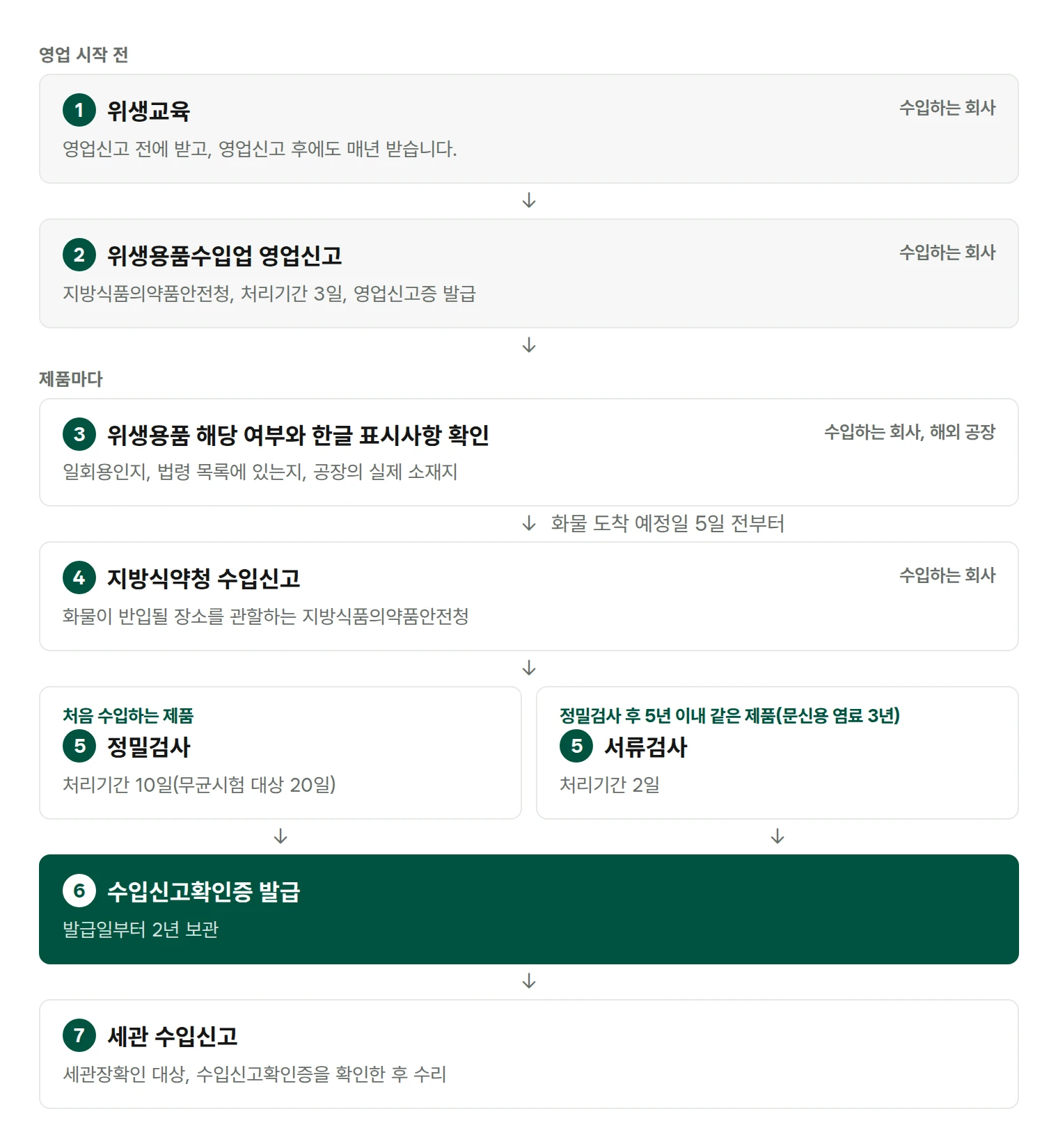
What the importer does before declaring hygiene products
The importer completes sanitation education and the business notification as a hygiene products importer first. After that, the importer files an import declaration for each product with the Regional Office of Food and Drug Safety.
After inspection by the Regional Office of Food and Drug Safety and receipt of the import declaration confirmation certificate, the importer files the import declaration with customs. The type of inspection depends on whether the product is imported for the first time.
Goods that are hygiene products
The Act and its Enforcement Decree list the hygiene products. Goods not on the list are not declared under the Hygiene Products Control Act, even if they look similar.
| Category | Goods named in the law |
|---|---|
| Detergents | Preparations for washing vegetables, fruit, etc., and preparations for washing food containers, processing tools, cooking tools, etc. |
| Rinse aids | Preparations used in the final rinse of an automatic dishwasher |
| Hygienic wet towels | Wet towels packaged for wiping hands, etc. at food service establishments |
| Oral care products | Toothbrushes, dental floss, tongue cleaners |
| Tattoo dye | Dye injected under the skin with a needle, etc. for permanent or semi-permanent coloring (excluding cosmetics) |
| Disposable eating utensils | Disposable cups, spoons, chopsticks, forks, knives, straws |
| Paper and fiber products | Toilet paper, disposable dishcloths, towels, paper napkins, wet wipes for food service establishments |
| Other disposable products | Disposable toothpicks, cotton swabs, diapers, panty liners (excluding quasi-drugs), dry tissues used with added water |
Hygienic wet towels are hygiene products, but they are excluded from the hygiene products importer business.
Wet wipes are hygiene products only when they are packaged for wiping hands, etc. at food service establishments. Wet wipes sold for household use are not on this list, so check the requirements of other laws separately.
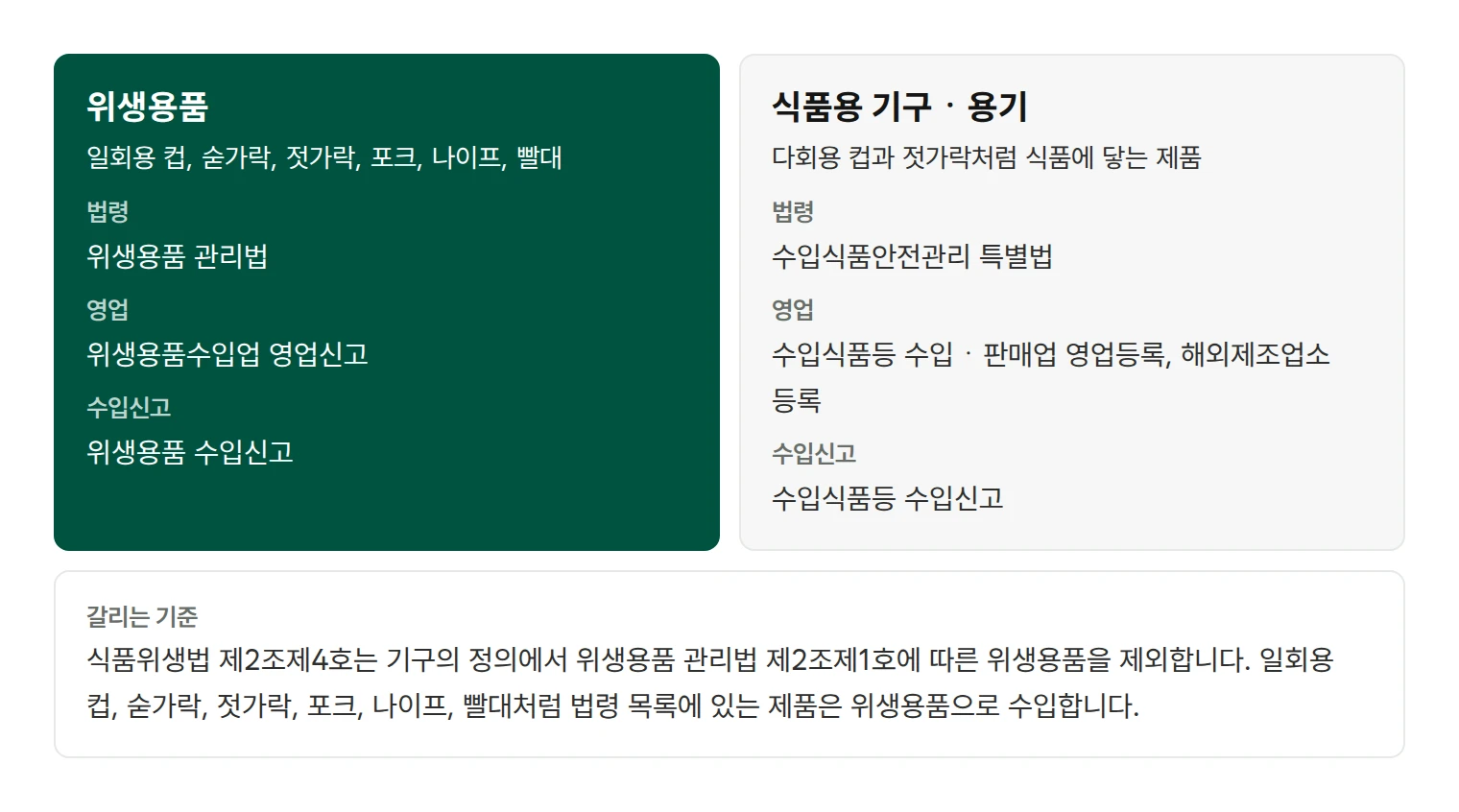
Hygiene products versus utensils and containers for food
Even the same cup or chopsticks are hygiene products if disposable and utensils and containers for food if reusable. The Food Sanitation Act excludes the hygiene products of the Hygiene Products Control Act from its definition of utensils.
The list in the law includes disposable cups, and cup lids are not listed separately. For a product whose name is not on the list, such as a cup lid, or whose status as disposable is unclear, ask the Regional Office of Food and Drug Safety that has jurisdiction and obtain the answer before shipment.
Utensils and containers for food are declared to the Regional Office of Food and Drug Safety after you complete the business registration as an imported food import and sales business and the registration of the overseas manufacturing facility. The business notification as a hygiene products importer alone does not allow you to import them.
Business notification as a hygiene products importer
Complete sanitation education before making the business notification as a hygiene products importer. Receive sanitation education every year after the notification as well.
Submit the business notification form together with the training completion certificate. Once the notification is accepted, the business notification certificate is issued.
| Item | Details |
|---|---|
| Where to notify | Regional Office of Food and Drug Safety |
| Attached documents | Sanitation education completion certificate, storage warehouse lease contract or logistics service contract |
| Office | An independent office. For e-commerce or mail-order sales, a residence can also be used as the office |
| Storage warehouse | An independent building, or a warehouse separated and partitioned from other product storage facilities |
| Processing period | 3 days |
Submit the storage warehouse lease contract only if you lease a warehouse, and the logistics service contract only if you have a storage contract with a logistics company. If no storage warehouse is needed, for example when goods are sold directly from a bonded warehouse to another business operator, you do not have to have a warehouse.
A company that already holds the business registration as an imported food import and sales business must still make the business notification as a hygiene products importer separately to import hygiene products. In this case, the business notification fee is waived.
Documents and timing for the import declaration of hygiene products
File the import declaration with the Regional Office of Food and Drug Safety that has jurisdiction over the place where the cargo will be brought in. You can declare in advance from 5 days before the expected arrival date, and in that case the document inspection is completed before the cargo is brought in.
- Korean labeling: packaging with the Korean labeling printed or attached as a sticker, or a document stating the Korean labeling
- Overseas test report: a report from an overseas testing and inspection body designated by the MFDS, only if you want to skip the inspection
- Export plan, copy of the business notification certificate: only for imports to earn foreign currency or to manufacture the company's own products
- Research and survey plan, reason for return: only for products for research and survey or products returned after export
On the import declaration, write the actual location for the address of the overseas manufacturer and the exporter. If you write only a postal code or a P.O. box, or an address that differs from the facts, the declaration documents are returned.
The declaration documents are also returned for a product whose smallest sales unit package has neither Korean labeling nor labeling of the exporting country. Get packaging photos from the factory before shipment and check the labeling.
Types of inspection for imported hygiene products and processing periods
Hygiene products imported for the first time undergo thorough inspection. Pay the thorough inspection fee directly to the testing and inspection body in charge of the inspection.
| Inspection | Target | Processing period |
|---|---|---|
| Document inspection | The same product imported again within 5 years after thorough inspection, material for the company's own products, products for research and survey, etc. | 2 days |
| On-site inspection | Products among the document inspection targets that the Regional Office of Food and Drug Safety considers to need on-site confirmation | 3 days |
| Thorough inspection | Products imported for the first time, the same product imported again after a nonconformity, etc. | 10 days (20 days for products subject to the sterility test) |
| Random sampling inspection | Products selected under the MFDS sampling plan | 5 days (10 days for the fungal count test, 20 days for the sterility test) |
The next import goes through document inspection only if all of the following conditions are the same as for the product that underwent thorough inspection. If even one condition differs, it is not the same product eligible for document inspection.
| Goods | Items that must be the same |
|---|---|
| Detergents, rinse aids | Product name, country of manufacture, overseas manufacturer, ingredient names and mixing ratios |
| Wet wipes for food service establishments | Product name, country of manufacture, overseas manufacturer, ingredient names |
| Disposable cups, spoons, chopsticks, forks, knives, straws | Country of manufacture, overseas manufacturer, material and color of the surface that touches food (may differ between items) |
| Disposable toothpicks | Country of manufacture, overseas manufacturer, material and color of the surface that touches the human body |
| Toilet paper, disposable dishcloths, towels, paper napkins, cotton swabs, diapers, panty liners, dry tissues | Country of manufacture, overseas manufacturer, ingredient names, the same inspection items |
| Oral care products | Country of manufacture, overseas manufacturer (including ingredient names for dental floss) |
| Tattoo dye | Country of manufacture, overseas manufacturer, ingredient names (within 3 years) |
If the color of the surface that touches food differs for a disposable cup, each color undergoes its own thorough inspection. With 3 colors, there are also 3 thorough inspections.
Hygiene products that are imported repeatedly and pose a low risk of harm can become subject to automatic acceptance in the Hygiene Products Import Information System from May 12, 2026. Products imported for the first time and products subject to thorough inspection or on-site inspection are excluded from automatic acceptance.
Customs import declaration and confirmation by the head of customs
Hygiene products are subject to confirmation by the head of customs. Customs checks the import declaration confirmation certificate for hygiene products issued by the Regional Office of Food and Drug Safety and then accepts the import declaration.
Confirmation by the head of customs is determined by the laws linked to the HS code, and some HS codes are linked to both the Hygiene Products Control Act and the Special Act on Imported Food Safety Control. In that case, submit the certificate that matches whether the product is disposable or reusable.
| Goods example | HS code | Linked laws |
|---|---|---|
| Paper cup | 4823.69-0000 | Hygiene Products Control Act, Special Act on Imported Food Safety Control |
| Plastic cup (tableware) | 3924.10-0000 | Hygiene Products Control Act, Special Act on Imported Food Safety Control |
| Wooden chopsticks | 4419.90-3000 | Hygiene Products Control Act, Special Act on Imported Food Safety Control |
| Toilet paper | 4818.10-0000 | Hygiene Products Control Act |
| Toothbrush | 9603.21-0000 | Hygiene Products Control Act (from July 16, 2026) |
The HS code differs depending on material and shape. If the material differs, as with bamboo chopsticks, look up the HS code and the linked laws again.
Keep the import declaration confirmation certificate for hygiene products for 2 years from the date of issuance, and the certificate of import declaration issued by customs for 5 years. Also keep the transaction statement stating the import date, country of manufacture, buyer, etc. for 2 years from the import date.
Common mistakes in the hygiene products import procedure
| Mistake | Result and correct method |
|---|---|
| You hold only the business registration for imported food, etc. and have not made the business notification as a hygiene products importer | You cannot file the import declaration of hygiene products. Make the business notification separately |
| You declare reusable cups or chopsticks as hygiene products | Reusable ones are utensils and containers for food, so file the import declaration of imported food, etc. |
| You declare household wet wipes as hygiene products | Only wet wipes packaged for food service establishments are hygiene products |
| You write only a P.O. box or postal code in the factory address field | The declaration documents are returned. Obtain the actual location and write it |
| You split the same product that arrived on the same ship on the same arrival date into several declarations | The same product that arrived on the same ship or aircraft on the same arrival date is declared as 1 case |
| You import for sale without the import declaration of hygiene products | The business is subject to a 2-month suspension, and penalties also apply |
Materials to prepare when requesting an agent
Send us the product photos, material, and use, and we first confirm whether the product is a hygiene product.
- Business notification certificate as a hygiene products importer, business registration certificate
- Product photos (front and back of the packaging), whether it is disposable or reusable, and the use
- Material or ingredient names (including the mixing ratios for detergents), and the color of the surface that touches food
- The factory's English company name and actual location, and the exporter's company name and location
- Invoice, packing list, bill of lading (B/L)
Related articles
- Food import procedure: documents to request from the factory and the order of steps for a first import
- Import requirements and KC certification: what to check before customs clearance
Source: Hygiene Products Control Act, Article 2 (Definitions), Article 3 (Business notification), Article 8 (Notification and inspection of imported hygiene products), Article 8-2 (Automation of acceptance of import declarations), Article 9 (Sanitation education), Enforcement Decree of the same Act, Article 2 (Types of hygiene products), Annex 1 (Types of hygiene products), Enforcement Rule of the same Act, Article 12 (Notification of imported hygiene products), Article 3 (Notification of hygiene products manufacturing business, etc.), Article 12-2 (Hygiene products exempt from import declaration), Article 13 (Inspection of imported hygiene products), Article 13-2 (Automation of acceptance of import declarations), Annex 1 (Facility standards by type of business), Annex 2 (Compliance requirements for business operators, etc.), Annex 3 (Inspection methods for imported hygiene products), Annex 7 (Administrative disposition criteria), Annex 9 (Fees), Form No. 13 (Import declaration form for imported hygiene products), Regulation on Inspection of Imported Hygiene Products, Article 3 (Processing of advance import declarations), Article 5 (Confirmation of labeling standards, etc.), Article 8 (Administrative matters), Food Sanitation Act, Article 2 (Definitions), Notice on the Designation of Goods Subject to Confirmation by the Head of Customs and Confirmation Methods under Article 226 of the Customs Act, Annex 2 (Imported goods subject to confirmation by the head of customs), UNI-PASS lookup of laws subject to confirmation by the head of customs (October 27, 2026). Based on the Hygiene Products Control Act, its Enforcement Decree, and its Enforcement Rule in force as of May 12, 2026, and the Food Sanitation Act in force as of October 8, 2026.