
Burden of proving origin under self-issuance and the order of preparation
A self-issued certificate of origin is not applied for with customs or a chamber of commerce, so no agency confirms the origin on your behalf. If the importing country verifies the origin, the preparer proves it with the bill of materials and the manufacturing flow chart that the preparer has kept.
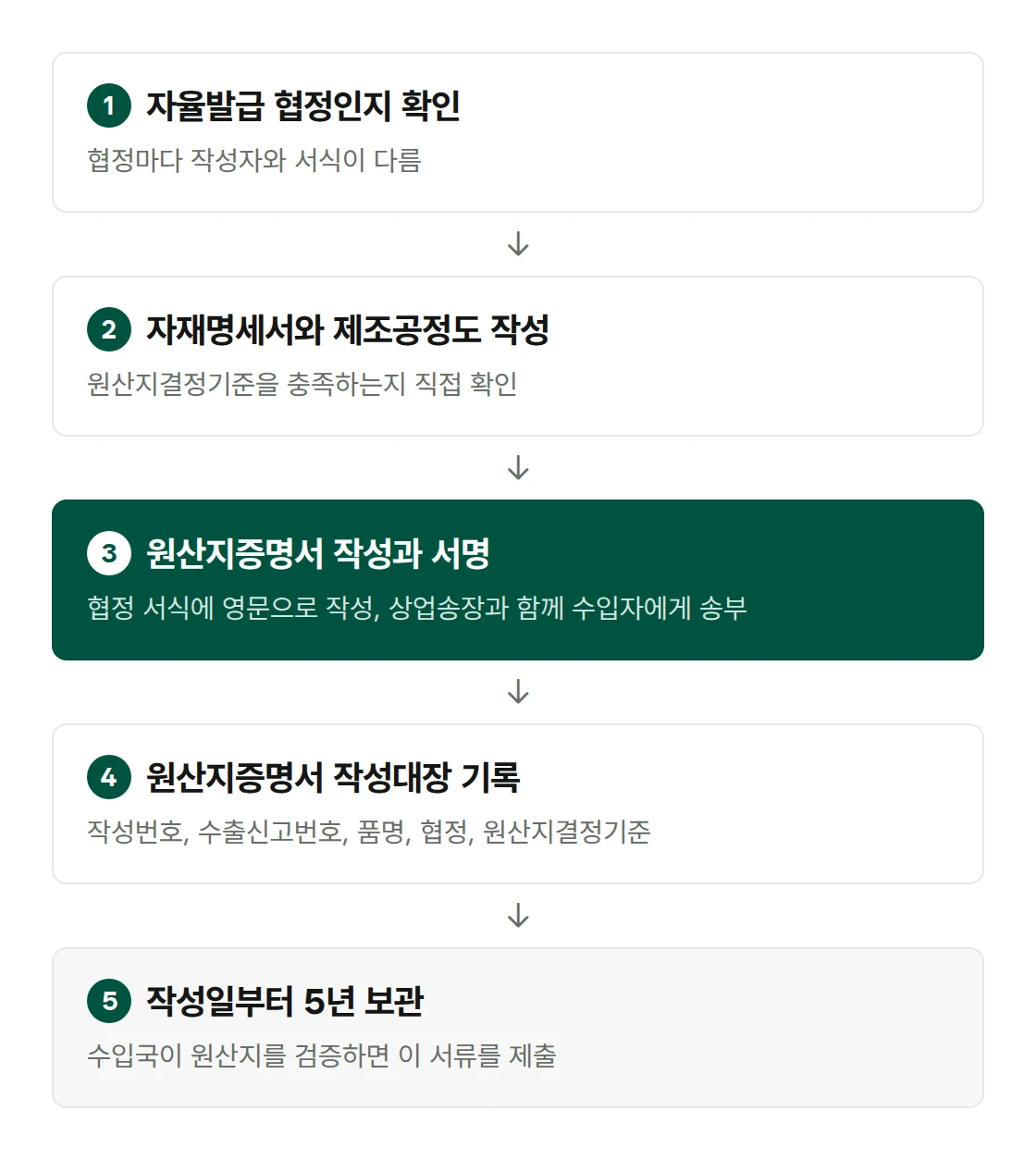
Whether self-issuance is allowed and who may prepare the certificate differ by agreement. Check the agreement for the destination country in the article FTA certificate of origin issuance methods: agency issuance and self-issuance by agreement.
Confirming origin with the bill of materials and the manufacturing flow chart
The bill of materials (BOM) is a table that lists, for each material used in one finished product, the 6-digit tariff code, origin, quantity required and price. The form is Form No. 19 of the Procedures Notice.
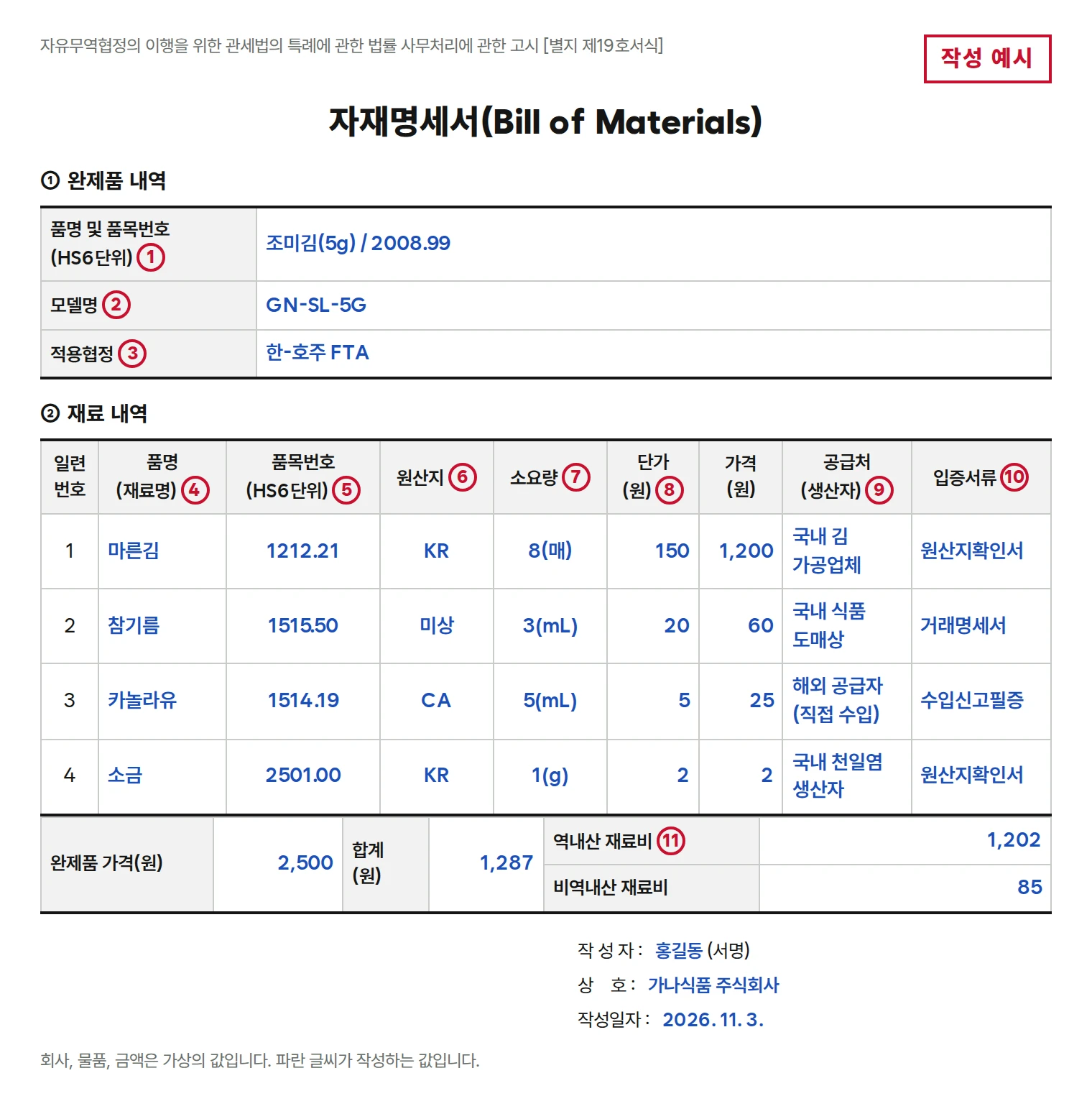
- Tariff code and origin: for imported materials, find them on the certificate of import declaration; for materials purchased in Korea, find them on the Declaration of Origin issued by the supplier.
- Enter "unknown" for materials for which you did not receive a Declaration of Origin, even if they were purchased in Korea.
- Enter the quantity required and the amount per one finished product, and set the unit prices of all materials on the same basis (whether value-added tax is included, and the unit).
The manufacturing flow chart is a document that lists in order the process in which each material is put in to become the finished product. No form is prescribed by law, and the material names and tariff codes are entered the same as in the bill of materials.
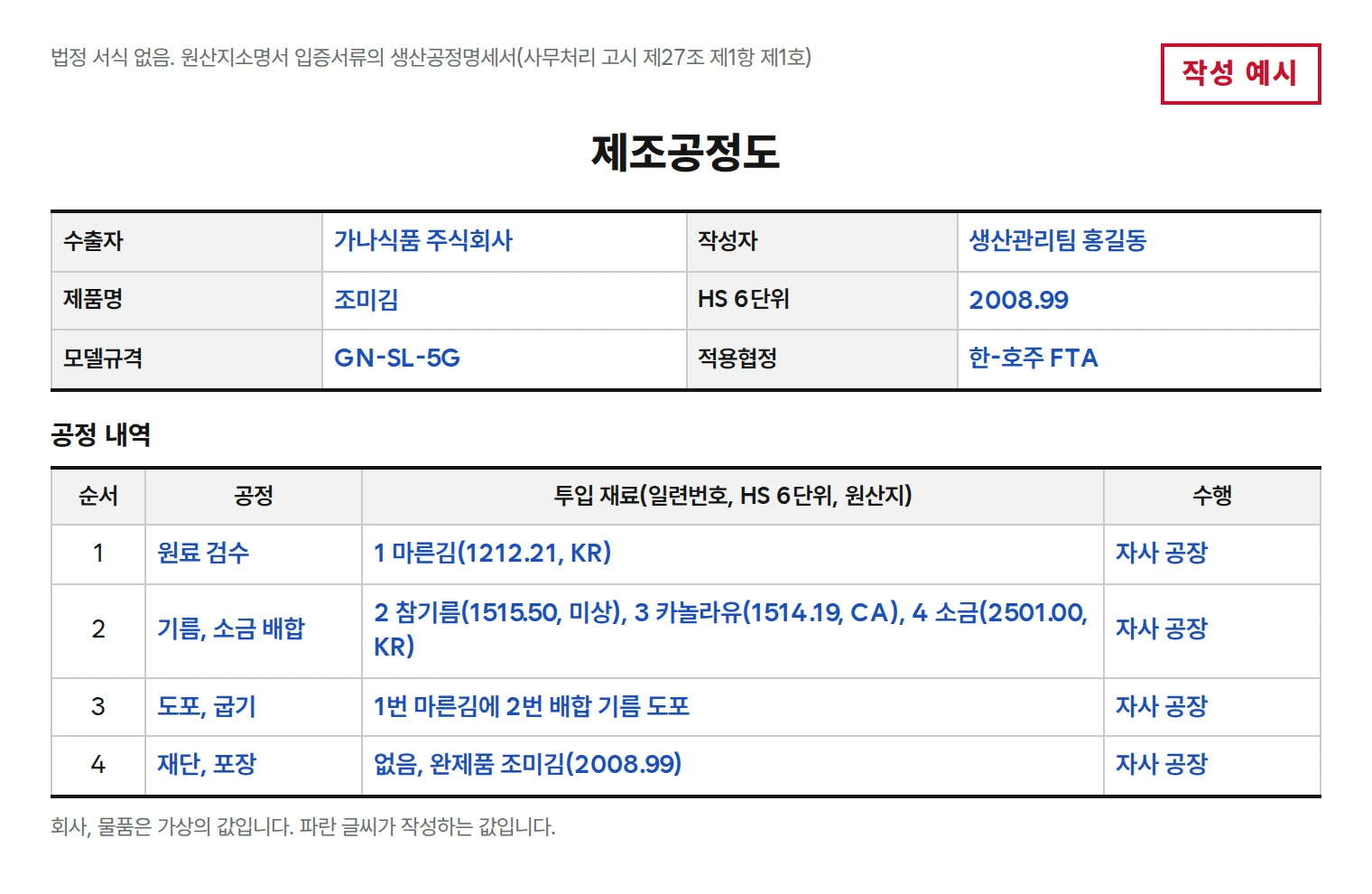
In this example, the non-originating materials sesame oil (heading 1515) and canola oil (heading 1514) go through the coating and roasting process and become seasoned laver (heading 2008), so the heading changes. Under the Korea-Australia FTA, the product-specific origin criterion for seasoned laver is "produced from materials classified in a different heading," so the criterion is met.
The criteria for determining origins differ by agreement and by item, so even with the same documents, whether the criteria are met is judged separately for each agreement.
How to complete each field and common mistakes are explained in the article First FTA certificate of origin: how to prepare the bill of materials, manufacturing flow chart and Declaration of Origin.
Completing the self-issued certificate of origin form
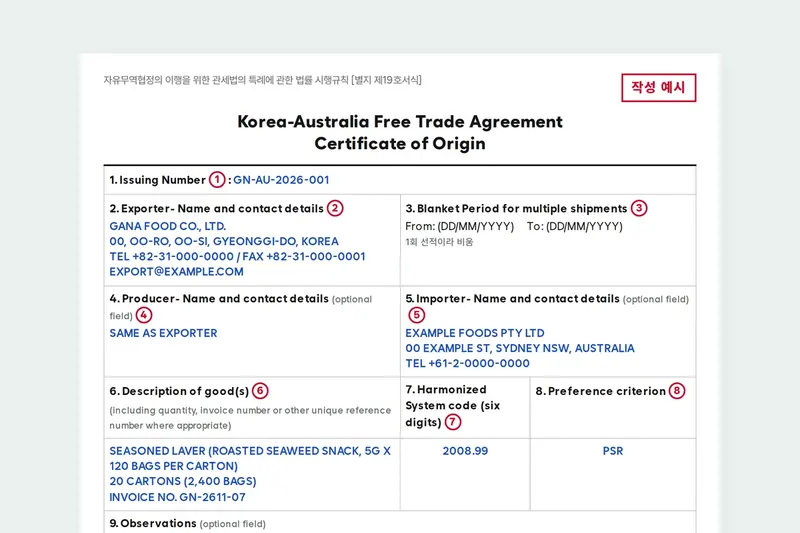
The certificate of origin is prepared in English on the form set by the agreement and signed by a signatory designated in advance. The form differs by agreement, but it is the same in that it states the exporter, the product name, the quantity and the origin.
Entering 20 cartons of seasoned laver on the Korea-Australia FTA form (Form No. 19 of the Enforcement Rule) looks as follows.
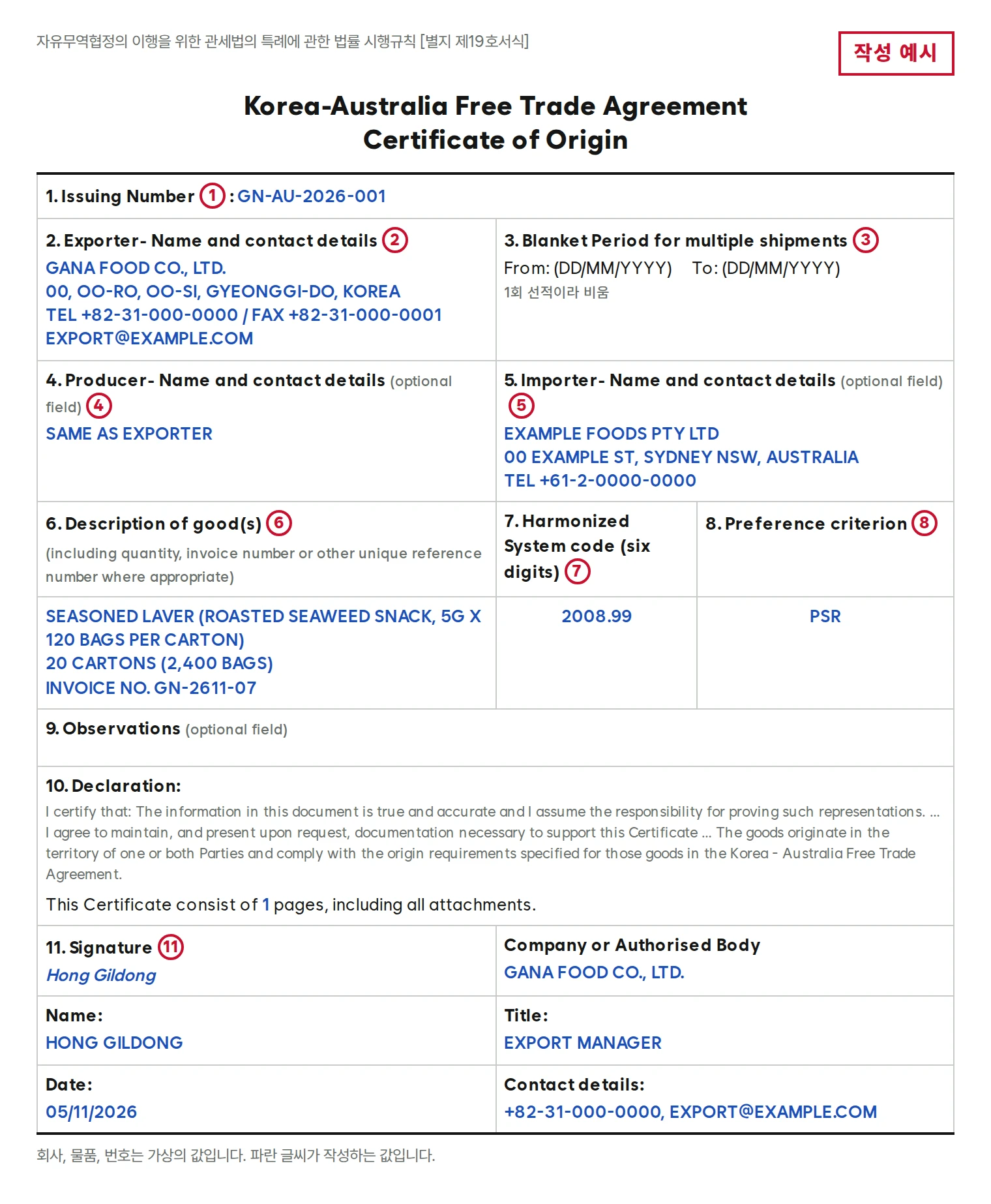
- Product name (Box 6): enter it as "SEASONED LAVER" so that it is clear that it is the same goods as on the commercial invoice. Do not use a general name such as "FOOD."
- Tariff code (Box 7): enter the first 6 digits of the tariff code on the certificate of export declaration. Do not enter the 10-digit Korean code.
- Origin determination criterion (Box 8): enter the criterion confirmed with the bill of materials and the manufacturing flow chart. This example is the product-specific rules of origin (PSR).
- Blanket period (Box 3): enter it only when sending the same goods several times; the certificate can be used only for goods imported within that period.
Send the prepared certificate of origin to the importer together with the commercial invoice. The importer needs the certificate of origin for the import declaration in the importing country, so send it no later than before the cargo arrives in the importing country.
The Korea-Australia FTA certificate of origin is valid for 2 years.
Recording in the issuance register and keeping documents
When you prepare a certificate of origin, record in the ledger of certificates of origin (Form No. 7 of the Enforcement Rule) the preparation number and date, the export declaration number, the product name and tariff code, the importer, and the agreement and origin determination criterion. Keep the supporting documents for 5 years from the date of preparing the certificate of origin; you may keep them on an electronic medium such as a server instead of on paper.
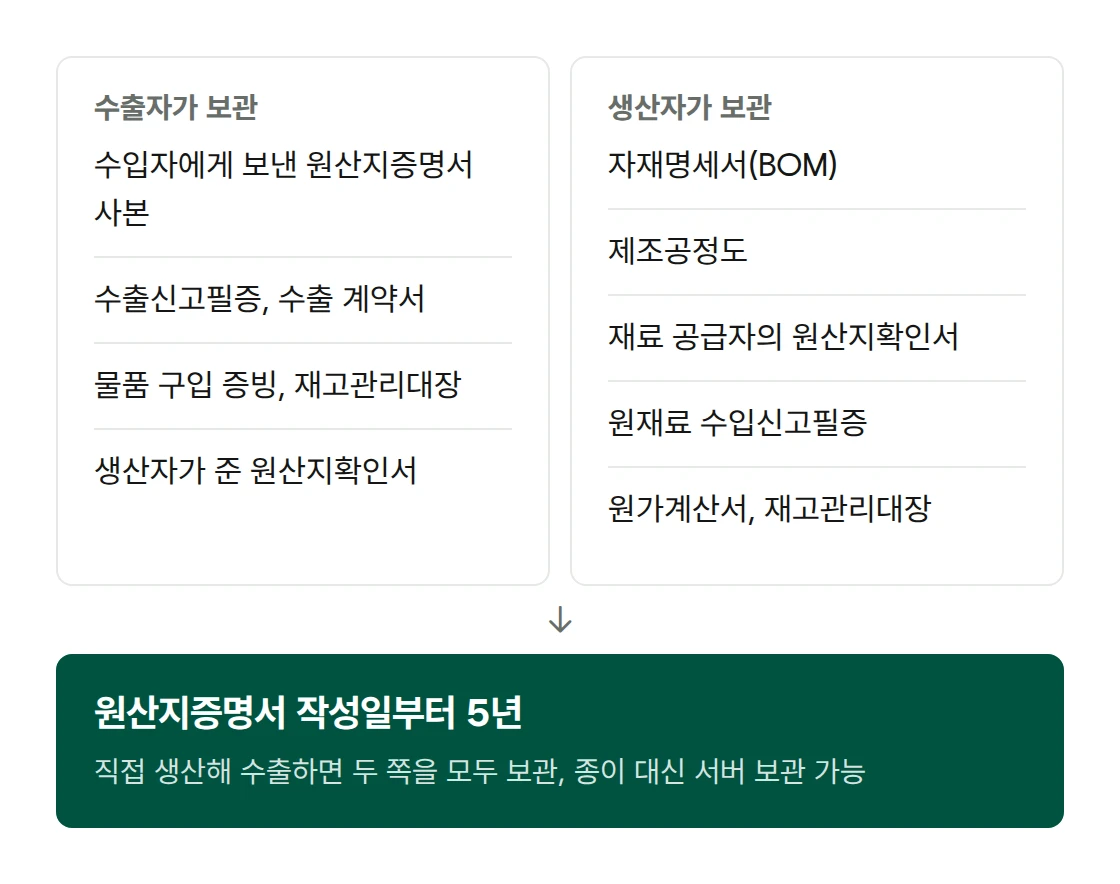
If you produce and export the goods yourself, keep the documents of both the exporter and the producer. If you buy another company's product and export it, obtain the Declaration of Origin for the finished product from the producer and prepare the certificate of origin, and the producer keeps the bill of materials and the manufacturing flow chart.
Failing to keep the documents without justifiable grounds is subject to a fine of up to KRW 20,000,000, and if you have no documents to submit during verification, the importer's application of the preferential tariff may be denied.
Related articles
- FTA certificate of origin issuance methods: agency issuance and self-issuance by agreement
- Responding to FTA origin verification: documents the exporter submits and deadlines
- First FTA certificate of origin: how to prepare the bill of materials, manufacturing flow chart and Declaration of Origin
For goods you are exporting for the first time, having a Licensed Customs Broker review the bill of materials and the manufacturing flow chart before you prepare the certificate of origin helps you prepare for verification (Origin certification services).
Source: Act on Special Cases of the Customs Act for the Implementation of Free Trade Agreements Article 11 (Preparation and issuance of certificates of origin, etc.), Article 15 (Keeping of documents evidencing origin, etc.), Article 44 (Penalties), Enforcement Decree of the same Act Article 6 (Certificate of origin), Article 10 (Origin supporting documents, etc. to be kept), Enforcement Rule of the same Act Article 12 (Declaration of Origin), Article 14 (Self-certification procedures for exported and imported goods, etc.), Form No. 7 (Certificate of origin issuance register), Form No. 19 (Form of certificate of origin under the agreement with Australia), Notice on Procedures under the Act on Special Cases of the Customs Act for the Implementation of Free Trade Agreements Article 27 (Documents proving the origin explanatory statement), Form No. 19 (Bill of Materials), Article 3.25 (Denial of preferential tariff treatment) of the Free Trade Agreement between the Government of the Republic of Korea and the Government of Australia. Confirmed on October 22, 2026, based on the Act in force on October 1, 2025, the Enforcement Decree in force on January 6, 2026, the Enforcement Rule in force on May 1, 2026, and the Notice in force on June 30, 2026.