

Certificate of origin issuance methods by agreement
The issuance method differs by agreement. Even under the same agreement, whether you can prepare the certificate directly depends on approved exporter status or the price of the goods.
Use the figure below to check which group the destination country's agreement belongs to.
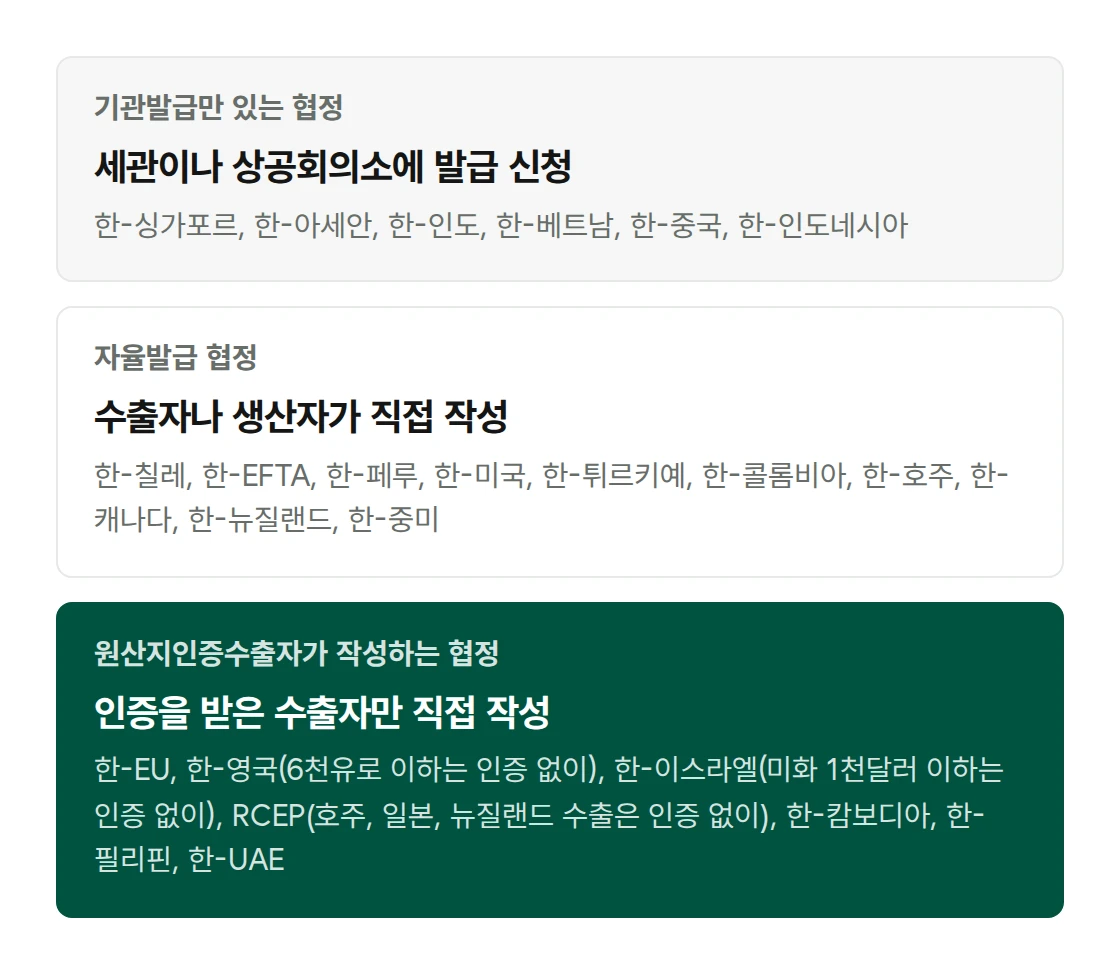
Preparer and validity period by self-issuance agreement
| Agreement | Preparer | Form | Validity period |
|---|---|---|---|
| Korea-Chile FTA | Exporter | Form No. 8 | 2 years |
| Korea-EFTA FTA | Exporter or producer | Annex 16 wording on the commercial invoice | 1 year |
| Korea-EU FTA | Approved exporter, or exporter of goods worth EUR 6,000 or less | Annex 17 wording on the commercial invoice | 1 year |
| Korea-Peru FTA | Exporter | Form No. 16 | 1 year |
| Korea-U.S. FTA | Exporter, producer or importer | Form No. 17, or a document stating the prescribed particulars | 4 years |
| Korea-Türkiye FTA | Exporter | Annex 19 wording on the commercial invoice | 1 year |
| Korea-Colombia FTA | Exporter or producer | Form No. 18 | 1 year |
| Korea-Australia FTA | Exporter or producer | Form No. 19 | 2 years |
| Korea-Canada FTA | Exporter | Form No. 20 | 2 years |
| Korea-New Zealand FTA | Exporter or producer | Annex 20 wording on the commercial invoice | 2 years |
| Korea-Central America FTA | Exporter or producer | Form No. 24-2 | 1 year |
| Korea-UK FTA | Approved exporter, or exporter of goods worth EUR 6,000 or less | Annex 20-2 wording on the commercial invoice | 1 year |
| Korea-Israel FTA | Approved exporter, or exporter of goods worth USD 1,000 or less | Annex 20-3 or Annex 20-4 wording on the commercial invoice | 12 months |
| RCEP | Approved exporter. For exports to Australia, Japan and New Zealand, the exporter or producer | Form posted by the Commissioner of the Korea Customs Service | 1 year |
| Korea-Cambodia FTA | Approved exporter | Form No. 24-10 | 1 year |
| Korea-Philippines FTA | Approved exporter | Form No. 24-12, or Annex 20-5 wording on the commercial invoice | 1 year |
| Korea-UAE CEPA | Approved exporter | Annex 20-6 wording on the commercial invoice | 1 year |
The attached forms and tables for the forms are all in the Enforcement Rule.
For agreements listed as "wording on the commercial invoice," the prescribed origin wording is written on the commercial invoice and used as the certificate of origin, without a separate form. The validity period is counted from the date of issuance or signature.
When approved exporter status is required
Under agreements where the preparer is an approved exporter, only an exporter approved by the Commissioner of the Korea Customs Service or the head of customs may prepare the certificate directly.
- Korea-EU and Korea-UK FTAs: there is no agency issuance method, so to export goods worth more than EUR 6,000, obtain approval first.
- Korea-Israel, RCEP, Korea-Cambodia, Korea-Philippines and Korea-UAE: agency issuance is also available, so without approval, apply to customs or a chamber of commerce for issuance.
How to entrust the agency issuance application to a Licensed Customs Broker is explained in the article Setting UNI-PASS company records permission when entrusting certificate of origin issuance to a Licensed Customs Broker. You can check preparation for approved exporter status in the certificate of origin services guide.
Related articles
- How to prepare a self-issued FTA certificate of origin: preparing and keeping the bill of materials and manufacturing flow chart
- Responding to FTA origin verification: documents the exporter submits and deadlines
- Setting UNI-PASS company records permission when entrusting certificate of origin issuance to a Licensed Customs Broker
Source: Act on Special Cases of the Customs Act for the Implementation of Free Trade Agreements Article 11 (Preparation and issuance of certificates of origin, etc.), Article 12 (Approval of approved exporters), Enforcement Decree of the same Act Article 6 (Certificate of origin), Enforcement Rule of the same Act Article 7 (Issuance methods of certificates of origin), Article 8 (Issuing agencies of certificates of origin), Article 15 (Form of certificates of origin under agreements with partner countries). Confirmed on October 22, 2026, based on the Act in force on October 1, 2025, the Enforcement Decree in force on January 6, 2026, and the Enforcement Rule in force on May 1, 2026.