
Import requirements and confirmation by the head of customs
Goods that require a permit, approval or marking under law, such as KC certification, must be shown to the head of customs to meet those conditions when the import declaration is filed (Customs Act, Article 226). The importer finds the applicable law by HS code in the annex tables of the Notice on the Designation of Goods Subject to Confirmation by the Head of Customs and Confirmation Methods, and prepares requirement documents such as certificates and requirements confirmation certificates before filing the import declaration. Even goods not subject to confirmation by the head of customs remain subject to the certification obligations of the relevant law, so obtain the certification and marking before selling.
These conditions are called import requirements. KC safety certification for electrical appliances and the MFDS import declaration for food are typical examples.
Goods subject to confirmation by the head of customs are designated by notice
The Commissioner of the Korea Customs Service announces in advance, in the Notice on the Designation of Goods Subject to Confirmation by the Head of Customs and Confirmation Methods under Article 226 of the Customs Act, the goods that the head of customs must check at clearance and the confirmation methods.
Annex 1 of the Notice sets the applicable laws and the conditions to be met by the goods, and Annex 2 sets the export and import requirements by goods. Find the HS code of the goods you plan to import in these annex tables to check whether they are subject to confirmation by the head of customs.
Confirmation procedure
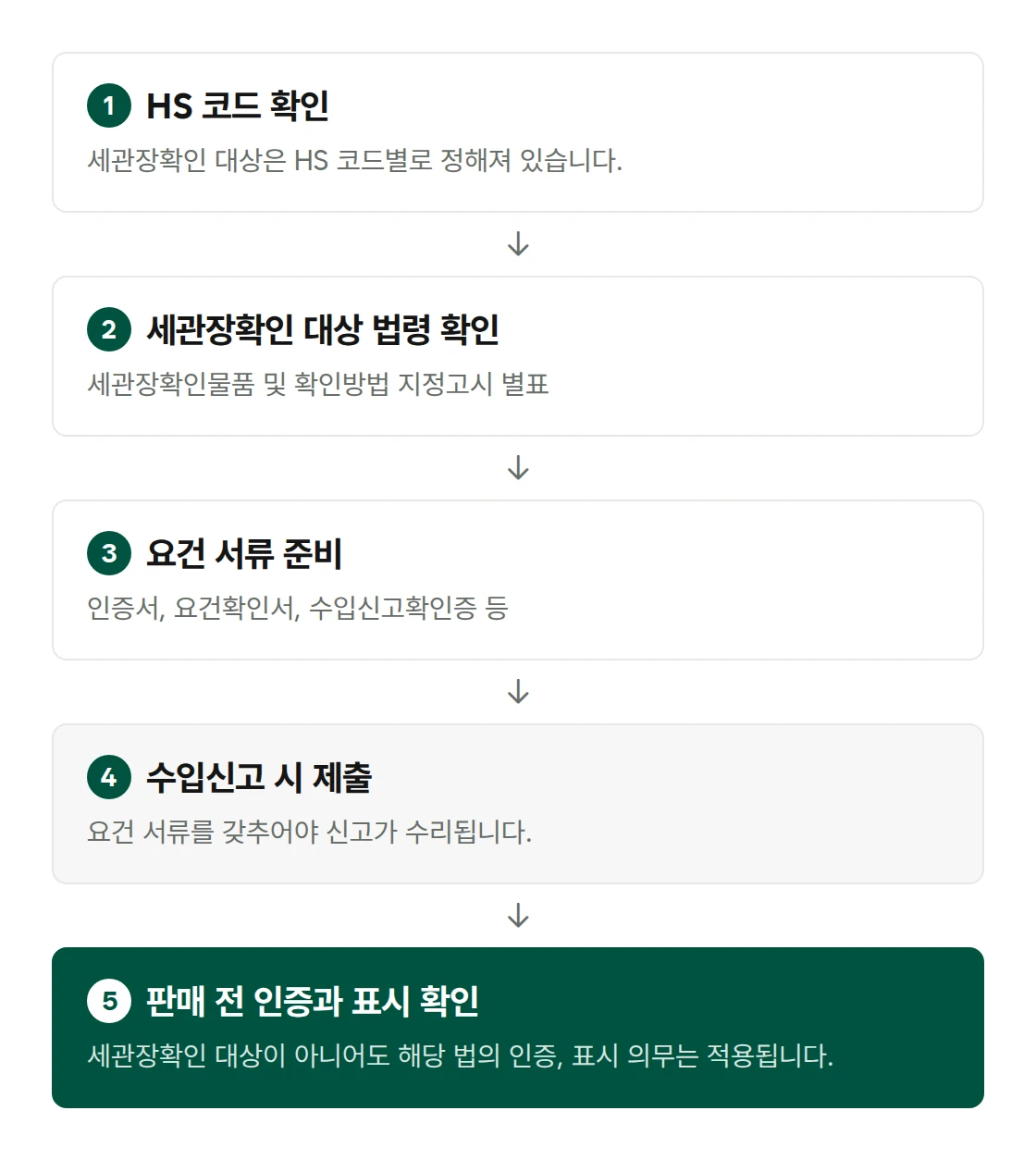
- Check the HS code. The annex tables of the Notice set the applicable law by HS code, so do the tariff classification first.
- Find the law and requirements for that HS code in the annex tables of the Notice.
- Prepare the requirement documents before filing the import declaration. The documents differ by law, such as certificates, requirements confirmation certificates and the MFDS import declaration confirmation certificate. Some requirements, such as the application for requirements confirmation for goods under the Electrical Appliances and Consumer Products Safety Control Act, are filed through the customs portal (UNI-PASS).
- Attach the requirement documents when filing the import declaration. The head of customs may waive the attachment of documents it recognizes as unnecessary.
- Before selling, check that the certification and marking required by the relevant law are in place.
When confirmation by the head of customs is waived
Under Article 7 (2) of the Notice, confirmation by the head of customs may be waived for the following goods.
- Goods exempt from export and import approval under Article 19 of the Enforcement Decree of the Foreign Trade Act
- Goods declared by an importer that meets the criteria in Annex 5 of the Notice, such as an Authorized Economic Operator (AEO) under the export and import safety management program
In both cases, goods subject to 18 laws, including the Electrical Appliances and Consumer Products Safety Control Act, the Special Act on the Safety of Children's Products, the Special Act on Imported Food Safety Control, the Hygiene Products Control Act and the Chemical Substances Control Act, are not waived, and the head of customs checks the requirements.
Certification obligations that remain after clearance
Confirmation by the head of customs is a check made at the clearance stage. The Electrical Appliances and Consumer Products Safety Control Act requires manufacturers and importers of products subject to safety certification to obtain safety certification for each model (Article 5). Selling a product without the safety certification mark, or importing, displaying or storing it for sale, is prohibited (Article 10 (1)), and purchasing agents and import agents may not act as agents for buying or importing such products (Article 10 (2)).
A product that was cleared without submitting a certificate because it was not subject to confirmation by the head of customs must still have the certification and marking required by the relevant law before it is sold.
Related articles
- Thorough inspection of imported food: criteria for first imports and re-imports
- Country of origin marking of imported goods: goods subject to marking and how to mark
- Import declaration of hygiene products: from business notification to thorough inspection
Source: Customs Act, Article 226 (Proof and confirmation of permits, approvals, etc.), Enforcement Decree of the Customs Act, Article 233 (Confirmation of conditions to be met), Article 250 (Declaration documents), Notice on the Designation of Goods Subject to Confirmation by the Head of Customs and Confirmation Methods under Article 226 of the Customs Act, Article 7 (Goods subject to confirmation and items to be confirmed), Annex 3, Enforcement Decree of the Foreign Trade Act, Article 19 (Exemption from export and import approval), Electrical Appliances and Consumer Products Safety Control Act, Article 5 (Safety certification, etc.), Article 10 (Prohibition of sale and use of products subject to safety certification without the safety certification mark, etc.). Based on the laws in force as of October 14, 2026.