

Thorough inspection and document inspection of imported food
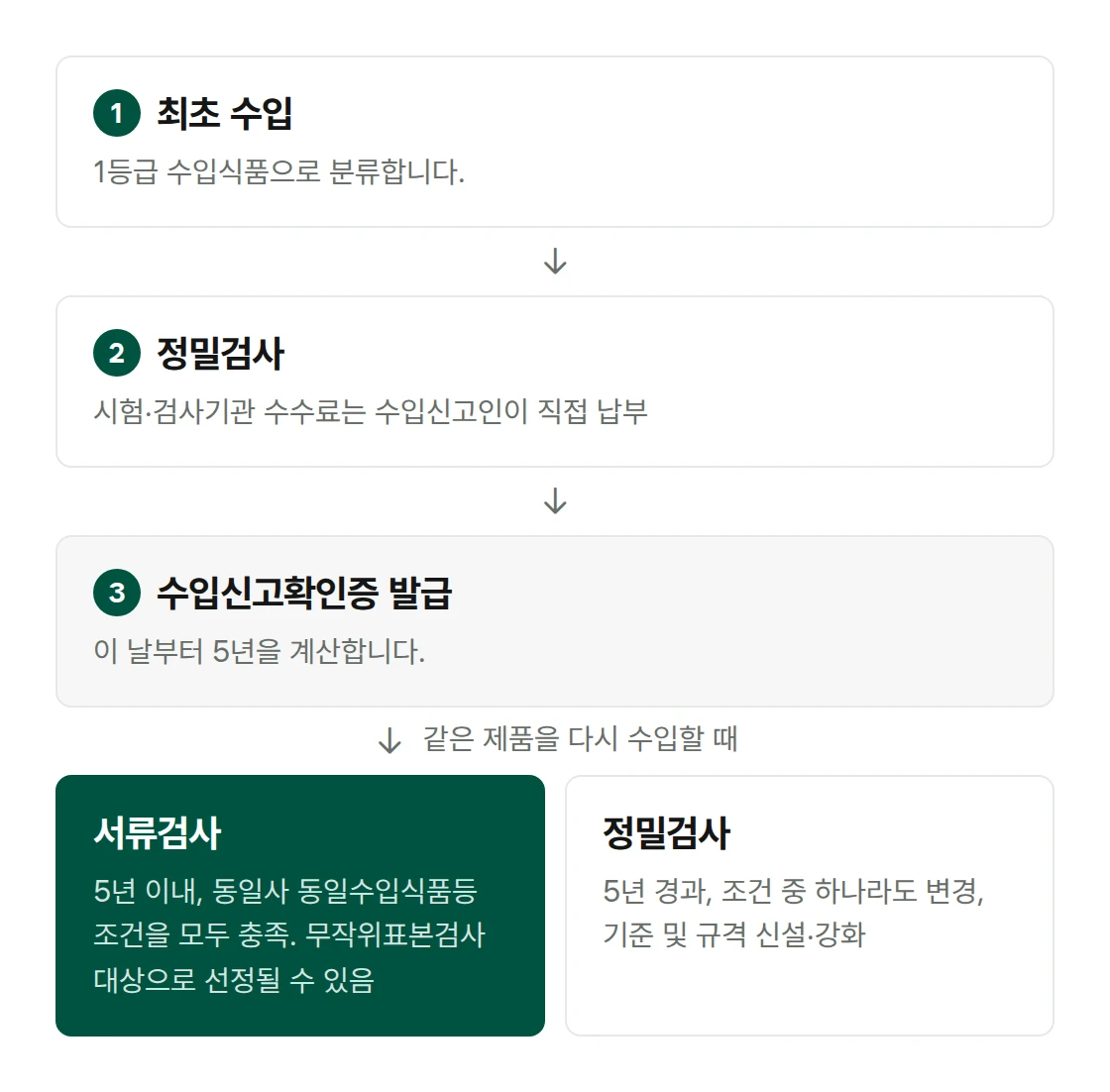
Food imported for the first time is subject to thorough inspection. If you import again within 5 years a product that is identical to the inspected product in the country of manufacture, the overseas manufacturing facility and the other items set for each product category, it is subject to document inspection.
For a first import, the import declarant requests the inspection from a testing and inspection institution designated by the MFDS and pays the inspection fee directly to that institution, so include the inspection period in the clearance schedule.
For a re-import, check with the exporter that the items that must stay the same, such as the overseas manufacturing facility, the manufacturing method and the raw material names, have not changed.
Food, food additives, utensils, containers and packaging, health functional food and livestock products declared to the MFDS undergo one of document inspection, on-site inspection or thorough inspection, depending on whether the product is imported for the first time and whether it is the same as a product that previously passed thorough inspection. Separately, a product may be selected for random sampling inspection.
The 4 types of inspection
| Inspection | Method and main targets |
|---|---|
| Document inspection | The declaration documents are reviewed to decide whether the product complies. It applies to a product re-imported within 5 years that is the same as a product that passed thorough inspection, and to products used for research or study. |
| On-site inspection | The nature, condition, taste, smell, color, labeling and packaging of the product are judged by sensory test. It applies to products among those subject to document inspection that a Regional Office of Food and Drug Safety finds need on-site inspection. |
| Thorough inspection | The product is tested by physical, chemical and microbiological methods, and the inspection includes document inspection and on-site inspection. It applies to products imported for the first time and to products re-imported within 5 years after a non-compliance disposition. |
| Random sampling inspection | The product is inspected under the MFDS sampling plan. It applies to products selected by the MFDS in consideration of risk and other factors. |
Products imported for the first time undergo thorough inspection
A product imported for the first time is classified as Grade 1 imported food, etc. and undergoes thorough inspection. A product returned from a foreign country and a product that a Regional Office of Food and Drug Safety finds, after on-site inspection, to need thorough inspection are also Grade 1.
The import declarant requests the inspection from a testing and inspection institution designated by the MFDS and pays the inspection fee directly to that institution. If you submit the thorough inspection report of an overseas testing and inspection institution under Article 8 of the Act on Testing and Inspection in the Food and Drug Industry, the Regional Office of Food and Drug Safety may accept it in place of thorough inspection or adjust the inspection items.
Thorough inspection fees by material of utensils and containers
This is based on the inspection fee table of the Korea Functional Food Institute (retrieved October 27, 2026, excluding VAT). A separate inspection fee is paid for each combination of overseas manufacturing facility, material and base color.
| Material | Thorough inspection fee |
|---|---|
| Polypropylene (PP) | KRW 96,000 |
| Polystyrene (PS) | KRW 150,000 |
| Polyethylene (PE) | KRW 210,000 |
| Polycarbonate (PC) | KRW 292,000 |
| Melamine resin | KRW 300,000 |
| Polyethylene terephthalate (PET) | KRW 530,000 |
| Rubber (silicone rubber, etc., except the cases below) | KRW 411,000 |
| Rubber containing chlorine (chloroprene rubber, etc.) | KRW 479,000 |
| Rubber whose base polymer has a 1,3-butadiene content of 50% or more | KRW 500,000 |
| Rubber that falls under both of the above cases | KRW 568,000 |
| Rubber nipples | From KRW 441,000 |
| Metal (stainless steel, etc.) | KRW 267,000 |
| Glass (excluding glass for heated cooking), ceramics | KRW 100,000 |
| Glass for heated cooking | KRW 105,000 |
| Earthenware (onggi) | KRW 150,000 |
| Enamel | KRW 137,000 |
| Paper | KRW 474,000 |
| Wood | KRW 550,000 |
The actual inspection items and fees may vary by inspection institution and product. Even for the same material, the inspection items differ in the following cases.
- Subject to document inspection: "Utensils, containers and packaging whose food-contact or food-additive-contact material is stone or uncolored glass (excluding glass for heated cooking and lead crystal glass), or other material made of natural raw materials that poses no risk" undergo document inspection without thorough inspection (Annex 9 of the Enforcement Rule of the Special Act on Imported Food Safety Control).
- Rubber nipples: Total volatile matter (KRW 30,000) and 2 nitrosamine items are added to the rubber items. Nitrosamines are not in the fee table, so check separately with the inspection institution.
- Paper: If food-grade wax is used on the surface in direct contact with food, the PCBs specification (KRW 274,000) may not be applied.
- Metal: The migration specification may not be applied to utensils and containers for dry food (excluding oil and fat food) or to utensils that touch only low-reactivity gases such as nitrogen and carbon dioxide.
- Coated products: For paper, metal and wood, if synthetic resin or rubber is used on the surface in direct contact with food, the specification for that material applies.
Items that must be identical for a re-import
If you import again within 5 years a product that is identical to the inspected product in all items below (same-source identical imported food, etc.), it is subject to document inspection.
The 5 years are counted from the date the import declaration confirmation certificate was issued after the thorough inspection of the first import. If the product underwent random sampling inspection of the priority inspection items set by the MFDS in the meantime, the period is counted again from the date the import declaration confirmation certificate was issued after that inspection.
| Category | Items that must be identical |
|---|---|
| Food (excluding agricultural, forestry and fishery products) | Country of manufacture, overseas manufacturing facility, manufacturing method, raw material names |
| Food additives | Country of manufacture, overseas manufacturing facility, product name, manufacturing method, raw material names |
| Utensils, containers and packaging | Country of manufacture, overseas manufacturing facility, material, base color |
| Health functional food | Country of manufacture, overseas manufacturing facility, product name, manufacturing method, mixing ratio of ingredients and main ingredients |
| Agricultural and forestry products | Country of production, product name, exporter, packing place |
| Fishery products | Country of production, product name, exporter, overseas manufacturing facility |
| Meat, raw milk, edible eggs | Country of production, product category, overseas work site |
| Other livestock products | Country of production, overseas work site, processing method, raw material names |
Even if the importer is different, a product is recognized as same-source identical imported food, etc. if all of the above items are the same.
For utensils, containers and packaging, a product is recognized as same-source identical imported food, etc. only if each component has the same photo, material, base color and the same overseas manufacturing facility that made the component, and the import declarant submits a component declaration form with the import declaration. The overseas manufacturing facility that made each component must be registered with the MFDS before the import declaration.
When thorough inspection is required again
- When 5 years have passed from the start date above
- When even one of the items in the table above differs
- When standards and specifications applicable to the product are newly established or strengthened after the thorough inspection
- When the product is imported again within 5 years after a non-compliance disposition in thorough inspection, random sampling inspection or collection inspection
The minimum import quantity announced by the MFDS is a declared weight of 100 kg. A product that passed thorough inspection when imported at less than 100 kg undergoes thorough inspection again when 100 kg or more is later declared for import.
To have a sample undergo thorough inspection first, check that the declared weight of the sample is 100 kg or more.
Timing of the declaration and the start date of the processing period
An import declaration to the MFDS can be filed from 5 days before the expected arrival date. Even if you declare in advance, the processing period is counted from the date the goods are brought into the place of entry.
Source: Special Act on Imported Food Safety Control, Article 5 (Registration of overseas manufacturing facilities), Enforcement Rule of the same Act, Article 27 (Import declaration of imported food, etc.), Annex 9 (Inspection methods for imported food, etc.), Annex 10 (Classification criteria for imported food, etc.), Regulation on Declaration and Inspection of Imported Food, etc., Article 7 (Scope of recognition of same-source identical imported food, etc.), Article 25 (Scope of the minimum import quantity), Standards and Specifications for Utensils, Containers and Packaging, Korea Functional Food Institute inspection fee table (retrieved October 27, 2026). Based on the laws in force as of October 14, 2026.