

Requirements for the FTA preferential tariff rate (preferential tariff)
The FTA preferential tariff applies only if the importer holds documents evidencing origin and applies before acceptance of the import declaration.
Before shipment, the importer checks that the exporter has obtained or prepared the certificate of origin in the manner set by the agreement, and if the importer could not apply before acceptance, applies for retroactive application within 1 year of the acceptance date. Keep the documents evidencing origin for 5 years from the day after the application date.
Goods originating in an FTA partner country can receive the rate set by the agreement (preferential tariff) if they meet the criteria for determining origins set by the agreement and their origin is proven. The preferential tariff applies only when the importer applies for it, and the application timing and the documents to keep are set by the Act on Special Cases of the Customs Act for the Implementation of Free Trade Agreements (FTA Customs Special Act).
Even if the preferential tariff reduces customs duty to 0%, import value-added tax is paid at 10% of the sum of the customs value, customs duty and other amounts (customs value for imports).
When the preferential tariff does not apply
The preferential tariff applies when its rate is lower than the applicable rate under Customs Act, Article 50. If the preferential tariff rate is equal to or higher than the applicable rate, the applicable rate takes priority, but where the rates are equal, the preferential tariff rate may be applied if the importer applies for it. Rates separately set by the Customs Act, such as anti-dumping duties and countervailing duties, take priority over the preferential tariff rate (FTA Customs Special Act, Article 5).
Application timing
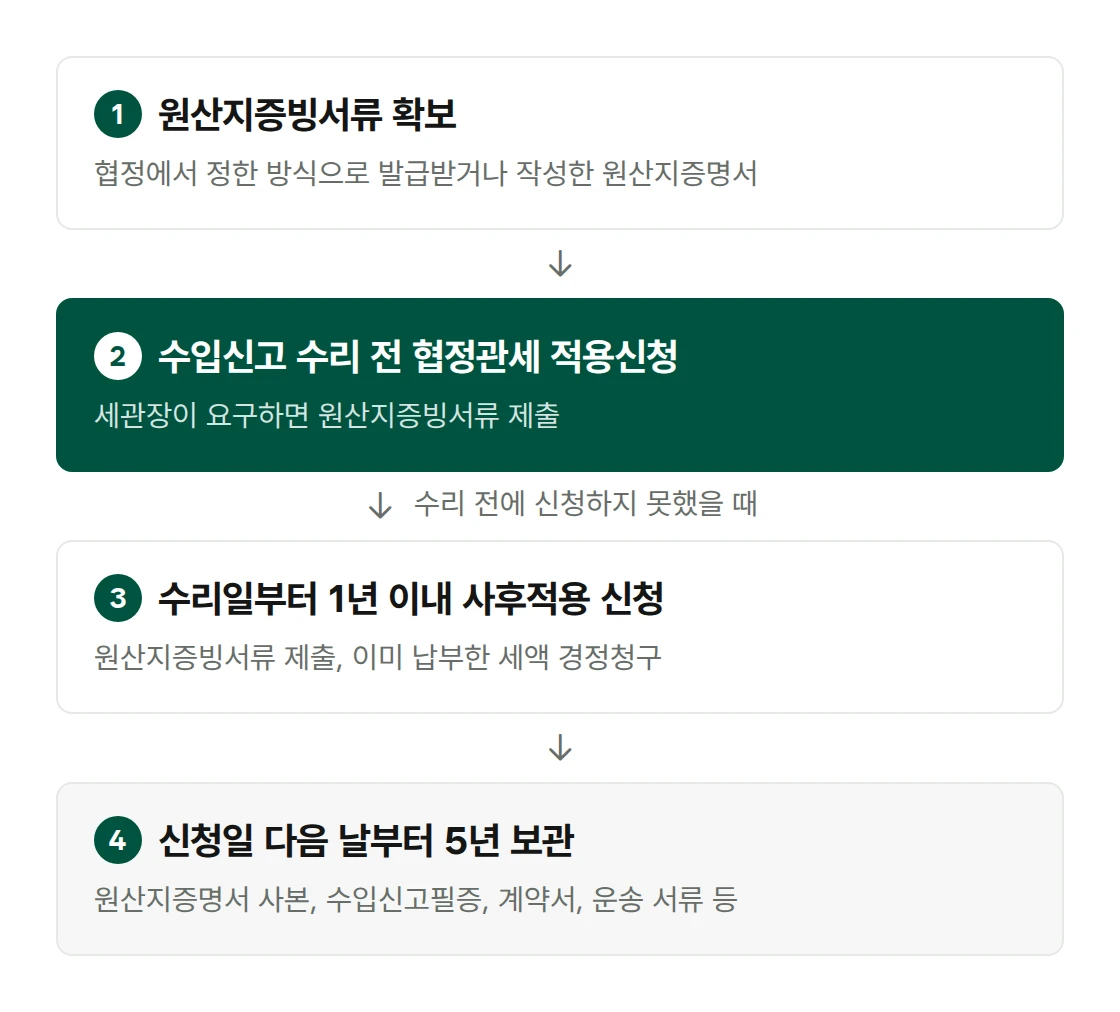
An importer who wishes to receive the preferential tariff applies to the head of customs before acceptance of the import declaration (Article 8). The importer must hold the documents evidencing origin at the time of application and submit them if the head of customs requests. If the requested documents are not submitted, or if origin is difficult to recognize from those documents alone, the head of customs may refuse to apply the preferential tariff.
If you could not apply before acceptance, you may apply for retroactive application within 1 year of the date of acceptance of the import declaration (Article 9). When applying for retroactive application, you must submit the documents evidencing origin, and tax already paid can be refunded through a application for rectification.
The head of customs notifies the result within 2 months of receiving the application for rectification. If goods are imported from a partner country that exchanges origin information electronically and the certificate of origin information has been exchanged, the importer may omit submission of the certificate of origin.
If a tariff classification is changed and a corrected declaration is filed, or the head of customs collects customs duty under a different tariff classification, retroactive application may be requested within the period set by the Enforcement Decree, within a range of 3 months from the date of the corrected declaration or the date of receipt of the payment notice.
Documents to keep
The importer keeps the following documents for 5 years from the day after the date of applying for the preferential tariff (Article 15; Enforcement Decree, Article 10).
- A copy of the certificate of origin (if the application was based on the importer's own certification or knowledge, documents proving that the goods are eligible for the preferential tariff)
- Certificate of import declaration
- Contracts related to the import transaction
- Contracts related to intellectual property transactions
- Materials on the determination of the customs value of the imported goods
- Documents related to the international transport of the imported goods
- A copy of the advance ruling on origin and the supporting documents needed for the advance ruling (if an advance ruling was obtained)
Who issues or prepares the certificate of origin, and in what manner, differs by agreement. Before shipment, the importer checks that the exporter has obtained or prepared the certificate of origin in the manner set by the agreement.
Related articles
- Korea-EU FTA preferential tariff on traveler's baggage: origin declaration wording on receipts and amount threshold
- Retroactive application of the FTA preferential tariff: application deadline and certificate of origin requirements
Source: Act on Special Cases of the Customs Act for the Implementation of Free Trade Agreements, Article 5 (Priority of tariff rate application), Article 8 (Application for the preferential tariff, etc.), Article 9 (Application for retroactive application of the preferential tariff), Article 10 (Proof of origin), Article 15 (Keeping of documents evidencing origin, etc.), and Article 10 of the Enforcement Decree of the same Act (Origin supporting documents, etc. to be kept), Value-Added Tax Act, Article 29 (Tax base). Based on the laws in force on October 14, 2026.