
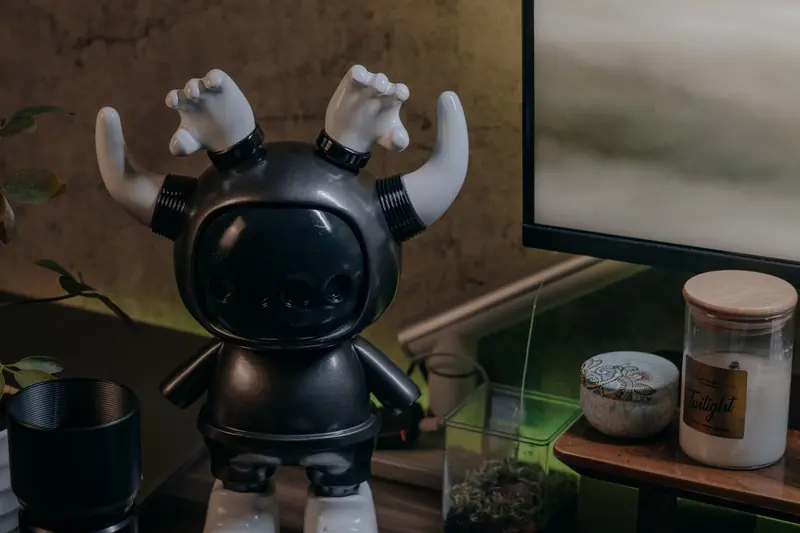
When the forwarding agent tells you to split the goods into personal clearance
Even if a seller or forwarding agent says "this is a licensed product for the local market, so business clearance is difficult" and tells you to receive the goods in individuals' names, you do not have to follow that advice. The Customs Act does not bar a company's import declaration because of the sales region, and the same intellectual property infringement assessment applies even if you split the goods and import them in individuals' names.
Customs decides clearance by checking whether trademark rights and character copyright are infringed and whether children's product requirements are met. The checks are 4 steps before shipment, the import declaration in the company's name, and the procedure after notice from customs.
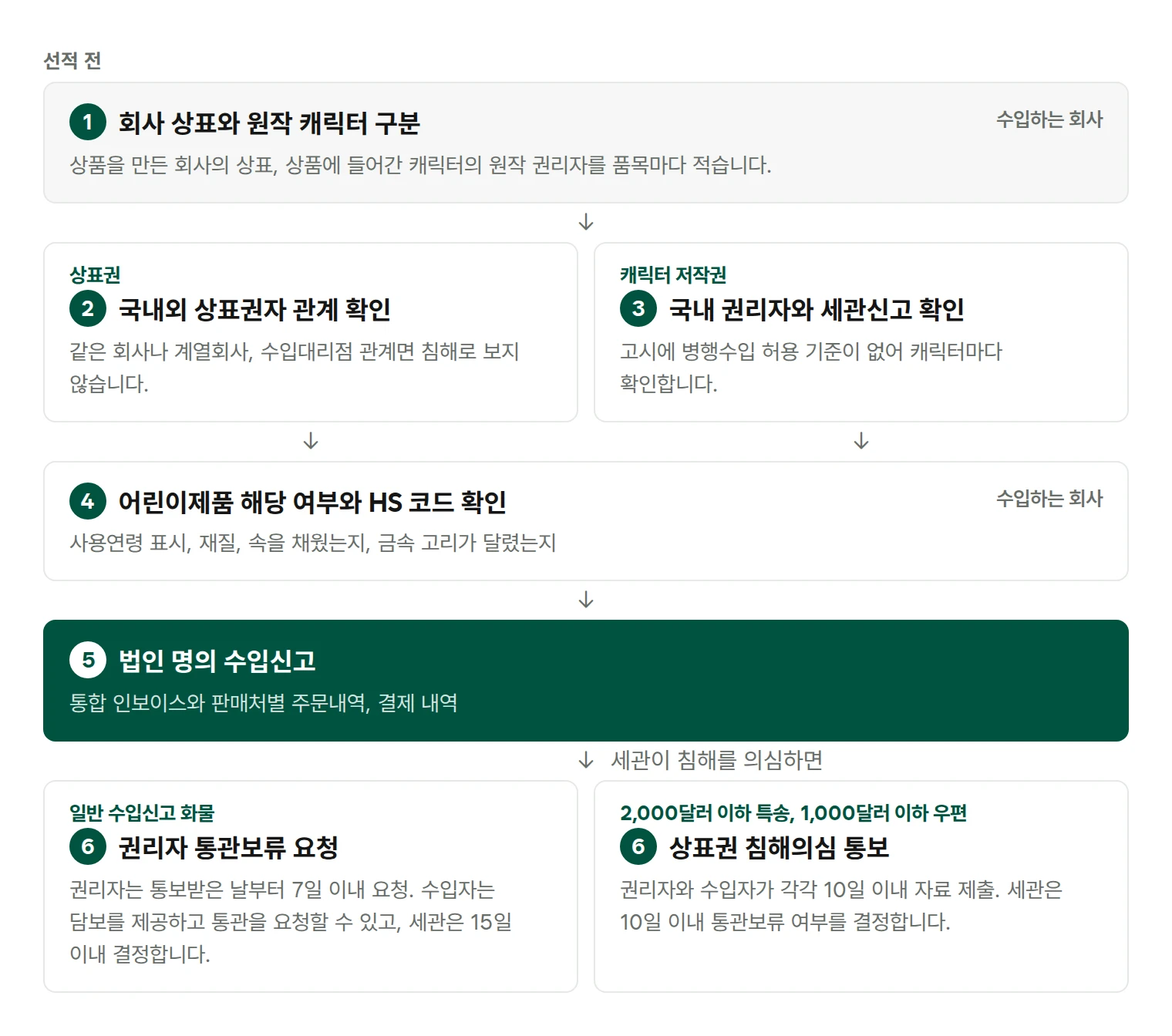
The company's trademark and the original character are assessed separately
One piece of character goods carries 2 rights: the trademark right of the company that makes and sells the product, and the copyright held by the original right holder of the character in the product.
For example, for a figure that a Chinese toy company made with a Japanese animation character, check the Chinese company's trademark and the Japanese original character separately. Even if the trademark side has no problem, clearance may be suspended on the character side.
Genuine goods criteria for parallel import under trademark rights
When a person who holds no trademark right imports genuine goods produced by a legitimate right holder, the Korea Customs Service notice does not regard the following cases as trademark infringement.
| Relationship of domestic and foreign trademark owners | What the domestic trademark owner does | Assessment |
|---|---|---|
| Same company, affiliate, import agent | Not relevant | Not infringement |
| Separate companies | Imports or sells genuine goods produced overseas | Not infringement |
| Separate companies | Manufactures all goods in Korea | Infringement |
| Separate companies | Has goods manufactured overseas by OEM and imports them | Infringement (with an exception) |
| Separate companies | Permits or consents to the import | Not infringement |
An affiliate means a relationship in which one company holds 30% or more of the shares and is the largest shareholder. Even for OEM manufacturing, it is not regarded as infringement if the foreign manufacturer has a trademark license from the foreign trademark owner.
If the domestic trademark owner has permitted or consented to the import, the importer submits a report of trademark license terms or an import clearance consent form to customs.
Check who the domestic trademark owner is and its relationship with the foreign company through the Korean Intellectual Property Office trademark search and notices from domestic distributors. For a brand with an exclusive domestic distributor, first check whether that distributor is the trademark owner or the exclusive licensee.
Character copyright is checked for each character
The Korea Customs Service notice has no provision that allows parallel import under copyright as it does for trademark rights, and it regards the act in Article 124 (1) 1 of the Copyright Act as intellectual property infringement.
Under Article 124 (1) 1 of the Copyright Act, "importing, for the purpose of distribution in the Republic of Korea, goods that would infringe copyright or other rights protected under this Act if they had been made in the Republic of Korea at the time of import" is copyright infringement. Whether goods that the original right holder licensed only for sale in China fall under this depends on the domestic rights in the character.
For this reason, whether character goods can be imported is not decided by the brand name alone. For each character, check the domestic right holder, whether the right is registered with the Korea Customs Service, and whether there is an exclusive domestic distributor, and then decide on the first shipment.
Procedure and deadlines when customs suspects infringement
If customs suspects that goods declared for import infringe an intellectual property right that the right holder registered with customs, it notifies the right holder and the importer. Customs may also give notice for a right not registered with customs if infringement is suspected.
| Item | General import cargo | Express shipments of USD 2,000 or less, postal items of USD 1,000 or less |
|---|---|---|
| Rights covered | All intellectual property rights, including trademark rights and copyright | Trademark rights |
| Right holder | Provides security and requests suspension of clearance within 7 days from the notice. | Submits evidence of infringement within 10 days from the notice. |
| Importer | May provide security and request clearance with explanatory materials. | May submit evidence of non-infringement within 10 days from the notice. |
| Customs decision | Within 15 days from the importer's request | Within 10 days from receipt of the evidence |
Goods bearing a counterfeit trademark and pirated goods are not cleared even if the importer provides security. If there is a final judgment or appraisal result, or if infringement is evident from the packaging, country of origin or declared value, customs suspends clearance ex officio.
If you obtain, before shipment, purchase records showing the seller and the manufacturer and photos of genuine product marks such as license stickers or holograms, you can submit them within the deadline after the notice.
Problems with splitting imports in individuals' names
Goods for sale do not qualify for the small-value exemption even if split into personal clearance. Only goods for personal use of USD 150 or less are exempt from customs duty, and goods that fall under the criteria set by the Commissioner of the Korea Customs Service for repeated or split imports are excluded.
If goods bought from the same overseas supplier on the same date are split and imported within the exemption limit, they are taxed together. If goods for sale in your stores are declared for import in the company's name from the start, you can also deduct the input VAT with the import tax invoice.
Purchase evidence by seller and a consolidated invoice
For goods bought from wholesalers and goods bought from online shopping malls, the documents that prove the price and the purchase differ by seller.
- Wholesaler: the invoice issued by the wholesaler (business name, items, quantity, unit price, amount) and the remittance record
- Online shopping mall: the order record (order number, seller, items, quantity, amount paid) and the payment record
If goods from several sellers are gathered at one forwarding agent and shipped by sea as LCL, name the company as the consignee on the bill of lading and file one import declaration. You can declare with one consolidated invoice made by the forwarding agent, but the items and amounts must match the order and payment records of each seller.
Customs duty is imposed on the customs value, which is the price actually paid for the goods plus freight and insurance to the port of import. If the consolidated invoice amount is lower than the purchase evidence, customs may request more materials or collect additional tax.
Customs duty and HS codes for imported figures
Figures and dolls are often classified under heading 9503 (dolls and other toys), with a customs duty rate of 8%. Plastic figures made for decoration may be classified under subheading 3926.40 (statuettes and other ornamental articles), with a customs duty rate of 6.5%.
| Goods | HS code | Children's product requirements checked at clearance |
|---|---|---|
| Plastic figure in human form | 9503.00-2130 | Not subject |
| Doll in human form made of textile | 9503.00-2110 | Subject |
| Stuffed toy in animal form (material other than textile) | 9503.00-3419 | Subject |
| Hollow plastic figure in animal form | 9503.00-3493 | Not subject |
| Ornamental plastic statuette | 3926.40-0000 | Not subject |
| Doll key ring with a steel ring | 7326.90-9000 | Not subject |
VAT of 10% applies separately. Goods made in China are subject to 0% customs duty with a Korea-China FTA certificate of origin, but a certificate of origin is often hard to obtain for goods bought from wholesalers or shopping malls, so estimate costs at 8%.
There is a ruling that classified a doll key ring with a steel ring under heading 7326 (other articles of iron or steel) (Tariff Classification Division 3-200, January 10, 2025), and in that case the customs duty rate is 8%. The HS code changes with the material and structure of the ring, so check with photos of the actual goods.
Whether the item is a children's product, and country of origin marking
Toys are products subject to safety confirmation under the Special Act on the Safety of Children's Products. If a product is used by children aged 13 or under, the safety confirmation report and Korean labeling are required before it is sold in Korea.
If the product is for adult collectors, it must clearly state on the product that it is not a children's product, for example "for ages 14 and up". Even with this marking, if the function, packaging or advertising has elements of a children's product, it is in principle regarded as a children's product.
If it is not a children's product, distribute it separately from toy stores.
For the HS codes marked "Subject" in the table, customs checks the children's product requirements at the import declaration. Even for HS codes marked "Not subject", the duty of safety confirmation before sale is the same if the item is a children's product.
Figures, dolls and key rings are all subject to country of origin marking, and the marking goes on the goods themselves. Products for the local market may have no marking or a marking only in Chinese characters, so check the country of origin marking method before shipment.
Materials to prepare before requesting our service
If you have the character names and photos of the boxes, we first check the domestic right holders and customs registration. Please submit your request through import clearance.
- List of items to import (brand, character name, product name, quantity, unit price)
- Photos of each item (front and back of the box, the item itself, genuine product mark, age marking, country of origin marking)
- Material and structure (plastic or sewn, stuffed or not, material of the ring)
- Invoices or order records and payment records by seller
- Business registration certificate (if you have no customs clearance code, we apply for it at the same time)
Related articles
- Import requirements and KC certification: checks before clearance
- Country of origin marking of imported goods: goods subject to marking and how to mark
- Customs value of imports: costs added to and deducted from the invoice amount
Source: Customs Act, Article 235 (Protection of intellectual property rights, etc.), Article 30 (Principles of determining customs value), Article 241 (Declaration of export, import or return), Enforcement Decree of the Customs Act, Article 239 (Suspension of clearance, etc.), Article 240 (Request for clearance or release of goods under suspension of clearance, etc.), Enforcement Rule of the Customs Act, Article 45 (Small-value goods exempt from customs duty), Notice on Export and Import Clearance Procedures for the Protection of Intellectual Property Rights, Article 4 (Acts of intellectual property infringement), Article 5 (Cases not regarded as trademark infringement), Article 13 (Notice of export or import declaration of goods suspected of infringement), Article 14 (Request for suspension of clearance by the right holder), Article 18 (Suspension of clearance of goods that evidently infringe), Article 20 (Request for acceptance of the declaration by the exporter or importer), Article 31 (Scope), Article 33 (Submission of evidence of infringement by the trademark owner), Article 34 (Submission of evidence of non-infringement by the declarant), Article 35 (Decision on suspension of clearance), Copyright Act, Article 124 (Acts deemed infringement), Notice on Import Clearance Procedures, Article 68 (Criteria for combined taxation), Value-Added Tax Act, Article 35 (Import tax invoices), Special Act on the Safety of Children's Products, Article 2 (Definitions), Annex 2 of its Enforcement Rule, Children's Product Guidelines, Article 3 (Factors in determining a children's product), Korea Customs Valuation and Classification Institute ruling Tariff Classification Division 3-200 (January 10, 2025), UNI-PASS search of goods subject to confirmation by the head of customs (October 27, 2026). As in force on October 2, 2026 for the Customs Act, February 27, 2026 for its Enforcement Decree, April 14, 2026 for the intellectual property notice, August 11, 2026 for the Copyright Act, and October 29, 2026 for the Children's Product Guidelines.