
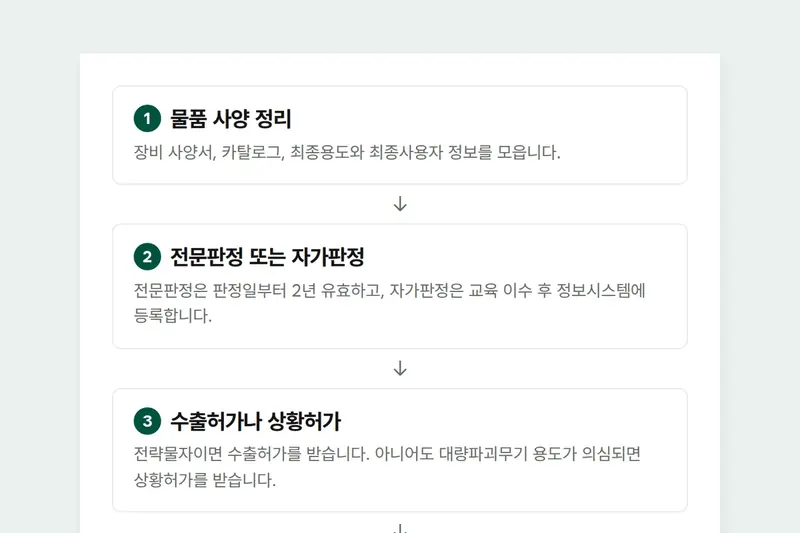
What exporters need to do before exporting semiconductor equipment
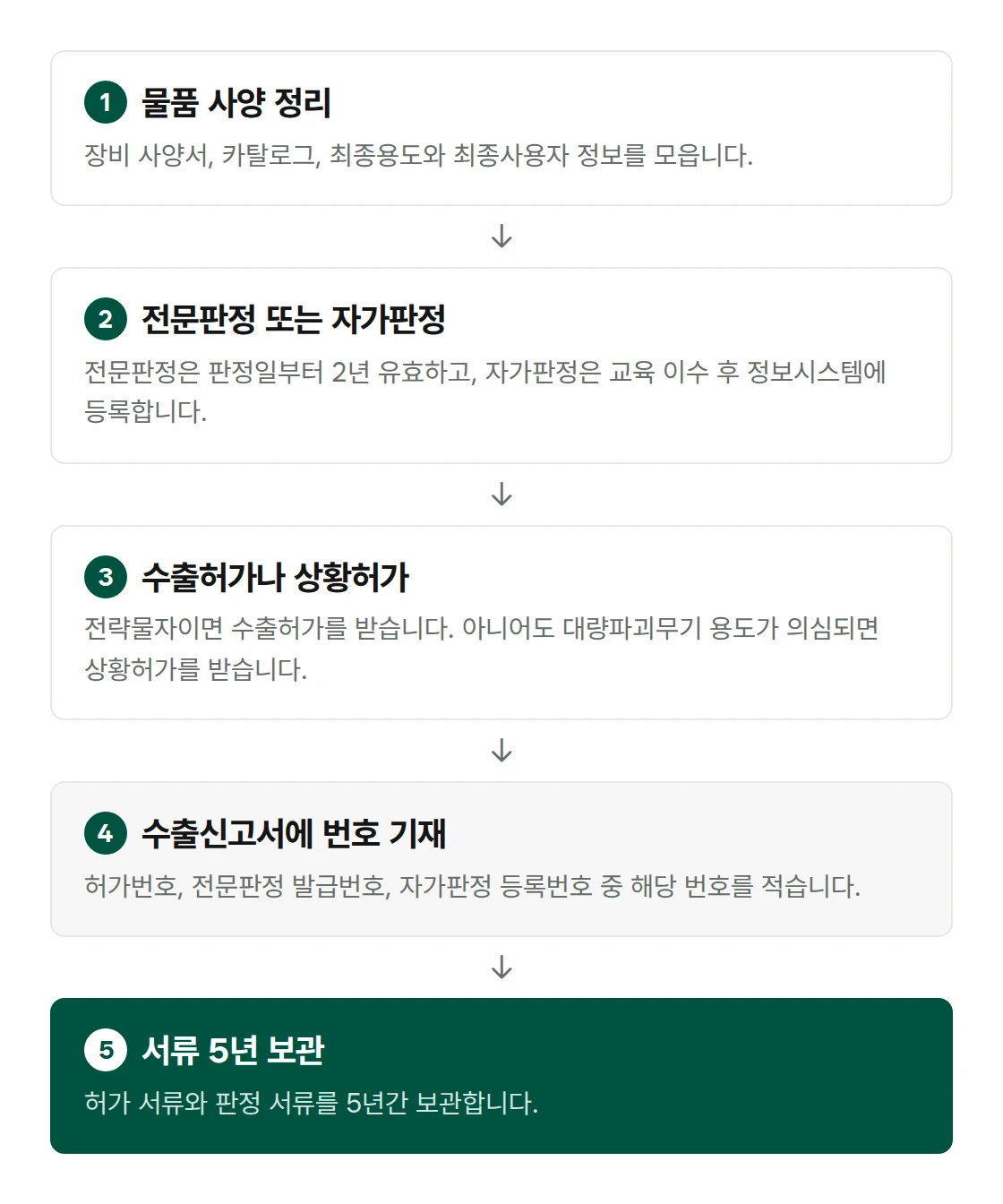
To export semiconductor manufacturing equipment and similar goods, classify the goods as strategic items or not before the export declaration. There are 2 ways to classify: expert classification, applied for with the Korea Strategic Trade Institute or similar bodies, and self-classification, made directly by an exporter who has completed the required training.
If the goods are strategic items, obtain an export license from the Minister of Trade, Industry and Resources or the head of the relevant administrative agency, and then make the export declaration. The export declaration must state the license number or the classification number, so start with classification at the contract stage.
Self-classification and expert classification of strategic items
Strategic items are goods and technologies that the Minister of Trade, Industry and Resources has designated and announced as requiring restrictions such as an export license under international export control regimes (Foreign Trade Act, Article 19). The list is in Annex 2 (dual-use items) and Annex 3 (military items) of the Notice on Import and Export of Strategic Items.
Annex 2 includes semiconductor manufacturing equipment items, such as semiconductor manufacturing deposition equipment (control number 3B501.n). Even equipment of the same type may or may not fall under an item depending on performance criteria, so classify with the equipment specifications and catalog in hand.
For expert classification, the person who intends to export applies to the Minister of Trade, Industry and Resources or the head of the relevant administrative agency, who may delegate or entrust the work to the Korea Strategic Trade Institute or similar bodies (Foreign Trade Act, Article 20 (1)). The result is effective only for the applicant, and its validity period is 2 years from the classification date (Notice on Import and Export of Strategic Items, Article 16 (1)).
If the control criteria or control number is substantively changed, the validity period of the expert classification is deemed to expire on the effective date of that amended notice (same Article). Even within the 2 years, check again if the notice has changed.
Self-classification is made directly by an exporter who has completed the training announced by the Minister of Trade, Industry and Resources, and the exporter registers the performance, use and technical characteristics of the goods in the Strategic Items Import and Export Management Information System (Foreign Trade Act, Article 20-2 (1)). Technology exports cannot be self-classified, except by certain internal compliance program traders announced by the Minister of Trade, Industry and Resources (same Article (2)).
Export license and catch-all license
A person who intends to export or declare for export strategic items must obtain an export license (Foreign Trade Act, Article 19-2). An individual export license is valid for 1 year, and it may be extended once if the head of the licensing agency approves (Notice on Import and Export of Strategic Items, Article 25).
Even if the goods are not strategic items, obtain a catch-all license if the exporter knows or suspects that they will be diverted for use such as weapons of mass destruction (Foreign Trade Act, Article 19-3). The grounds for suspicion set by law are as follows.
- The importer avoids providing information on the end use
- The end user refuses installation, maintenance or training services
- The price terms, payment terms, delivery date or transport route fall outside the usual range
- It is unclear whether the goods will be used in the importing country or re-exported
Entries on the export declaration and customs review
A person who intends to export strategic items and similar goods makes the export declaration after obtaining an export license, a catch-all license or a license exemption (Notice on Export Clearance of Strategic Items, etc., Article 3 (1)). Enter on the export declaration the license number, the expert classification issuance number, the self-classification registration number or the classification number of the advance declaration form (same Article (2)).
The head of customs may review whether the goods are strategic items and the license details, and if necessary requests the expert classification certificate or self-classification certificate issued through the information system (Article 4 (1) of the same Notice). Giving the classification certificate to the Licensed Customs Broker together before the export declaration speeds up the response to the review.
Record keeping and penalties for violations
An exporter keeps the export license and catch-all license documents and the expert classification and self-classification documents for 5 years (Foreign Trade Act, Article 28). Keep the classification documents also for goods confirmed through classification not to be strategic items.
A person who exports or declares for export strategic items without an export license is punished by imprisonment for up to 5 years or a fine of up to 3 times the price of the goods (Foreign Trade Act, Article 53 (2) 2). If the purpose is international proliferation, the penalty is imprisonment for up to 7 years or a fine of up to 5 times the price of the goods (same Article (1)).
Scope of customs clearance services
Ubis Customs Service checks the classification number and license number that the exporter has obtained, enters them on the export declaration, and then makes the export declaration on the exporter's behalf. Once the equipment specifications and the classification result are ready, request export clearance before shipment.
Related articles
- Security, conditions, period extension and additional tax for the exemption from customs duties for re-exportation
- Duty reduction for overseas processing and for re-import after repair
Source: Foreign Trade Act Article 19 (Strategic items), Article 19-2 (Export license), Article 19-3 (Catch-all license), Article 20 (Expert classification), Article 20-2 (Self-classification), Article 28 (Keeping of documents), Article 53 (Penalties), Notice on Import and Export of Strategic Items Article 16 (Effect of expert classification), Article 25 (Validity period of individual export licenses), Annex 2 (Dual-use items), Notice on Export Clearance of Strategic Items, etc. Article 3 (Export declaration), Article 4 (Review and inspection of goods). Checked on November 5, 2026; based on the Foreign Trade Act in force from October 22, 2026, the Notice on Import and Export of Strategic Items in force from September 1, 2026, and the Notice on Export Clearance in force from November 24, 2025.