

The more favorable taxpayer type by purchase ratio
An import seller whose margin excluding VAT is below about 11.6% is better off as a general taxpayer, and one with a higher margin is better off as a simplified taxpayer. This applies to retail businesses that sell imported goods to consumers with annual sales (including VAT) of KRW 48 million or more but less than KRW 104 million.
Sales other than retail have a different value-added ratio by business type, so this threshold cannot be applied as is (Enforcement Decree, Article 111 (2)).
Purchases are the sum of the tax base on import tax invoices (the customs value plus customs duties and the like) and the supply value on tax invoices received in Korea (Act, Article 29 (2)).
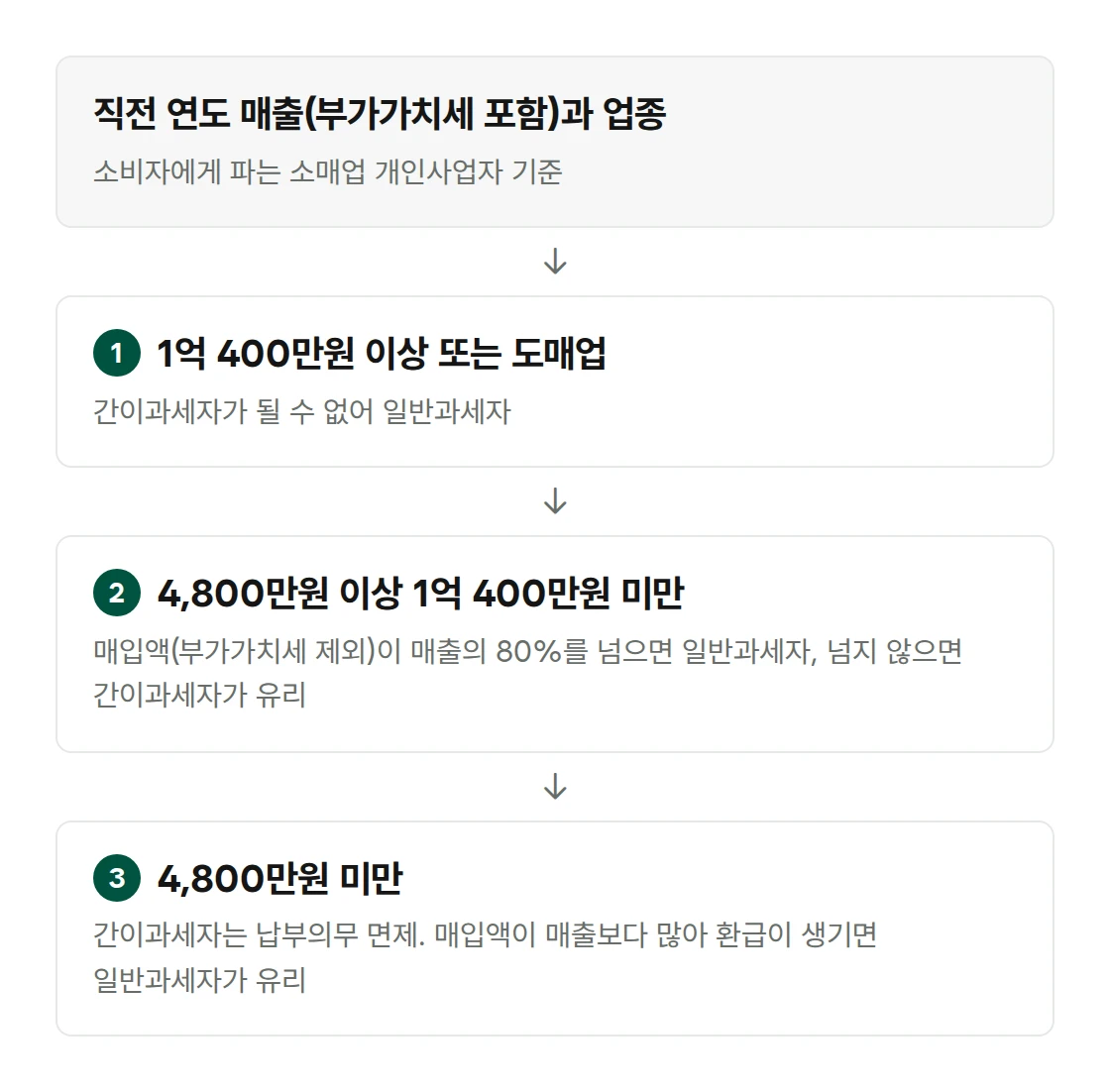
Businesses that can be simplified taxpayers
A simplified taxpayer is an individual business whose total supply price (sales including VAT) for the previous year is less than KRW 104 million (Value-Added Tax Act, Article 61 (1); Enforcement Decree of the same Act, Article 109 (1)).
Wholesale (including wholesale combined with retail), commodity brokerage, manufacturing and the like cannot be simplified taxpayers even with low sales (Enforcement Decree, Article 109 (2)). If you sell imported goods to other businesses, check your business type first.
When starting a new business, the owner reports whether to apply simplified taxation when applying for business registration (Act, Article 61 (3)).
Difference in VAT formulas between simplified and general taxpayers
| Item | General taxpayer | Simplified taxpayer (retail) |
|---|---|---|
| Tax payable | Sales (including VAT) ÷ 11 − purchases × 10% | Sales (including VAT) × 1.5% − purchases (including VAT) × 0.5% |
| Credit for import VAT | All import VAT paid | About 5.5% of import VAT |
| When credits exceed the tax payable | Difference refunded | No refund |
| Annual sales under KRW 48 million | Pays according to the formula | Exempt from payment |
A simplified taxpayer's tax payable is the supply price multiplied by the value-added ratio for the business type and by 10% (Act, Article 63 (2)). The value-added ratio for retail is 15%, so the tax is 1.5% of sales (Enforcement Decree, Article 111 (2)).
Even if a simplified taxpayer's credits exceed the tax payable, the excess is not refunded (Act, Article 63 (6)). A simplified taxpayer whose sales (including VAT) for the year are under KRW 48 million is exempt from paying VAT for that year (Act, Article 69 (1)).
Import tax invoice credit for simplified taxpayers
A simplified taxpayer deducts from the tax payable 0.5% of the supply price of goods for which "tax invoices and the like" were issued (Act, Article 63 (3) 1). Import tax invoices are also entered on the summary of tax invoices by purchaser and submitted (Act, Article 54 (1)), so in practice they are credited the same way.
Article 63 (3) 1 of the Act does not mention import tax invoices separately, so confirm the credit with a tax agent before filing. Import VAT of 10% is paid together with customs duties at the import declaration regardless of taxpayer type (Act, Article 50).
For goods on which KRW 1 million of import VAT was paid, the supply price is KRW 11 million, the sum of the KRW 10 million tax base and KRW 1 million of VAT, and the credit is KRW 55,000, or 0.5% of the supply price. A general taxpayer deducts KRW 1 million for the same goods (Act, Article 38 (1) 2).
Tax payable compared by sales and purchases
| Annual sales (including VAT) and purchases (excluding VAT) | General taxpayer | Simplified taxpayer | More favorable |
|---|---|---|---|
| Sales KRW 80 million, purchases KRW 30 million | KRW 4.27 million | KRW 1.04 million | Simplified taxpayer |
| Sales KRW 80 million, purchases KRW 50 million | KRW 2.27 million | KRW 930,000 | Simplified taxpayer |
| Sales KRW 80 million, purchases KRW 64.26 million | KRW 850,000 | KRW 850,000 | Same |
| Sales KRW 80 million, purchases KRW 75 million | KRW 230,000 refund | KRW 790,000 | General taxpayer |
| Sales KRW 100 million, purchases KRW 85 million | KRW 590,000 | KRW 1.03 million | General taxpayer |
| Sales KRW 40 million, purchases KRW 20 million | KRW 1.64 million | KRW 0 | Simplified taxpayer |
| Sales KRW 40 million, purchases KRW 40 million | KRW 360,000 refund | KRW 0 | General taxpayer |
※ One year for an individual retail business, excluding other credits such as the credit for credit card sales and penalty taxes
With credit card and cash receipt sales, both taxpayer types deduct a further 1.3% of the amount issued (until December 31, 2026, up to KRW 10 million a year) from the tax payable (Act, Article 46 (1)). Any credit above the tax payable is treated as nil, so the gap between the two types narrows for businesses with large card sales (same Article, paragraph (2)).
The purchase ratio that separates simplified and general taxpayers
The purchases at which both taxpayer types pay the same tax are about 80.3% of sales (including VAT). With sales S and purchases P, the general taxpayer's S ÷ 11 − 0.1P and the simplified taxpayer's 0.015S − 0.0055P are equal at P = 0.803S.
Measured against sales excluding VAT, both types pay the same tax when purchases are about 88% of sales. A seller whose margin excluding VAT is below about 11.6% is better off as a general taxpayer.
With annual sales under KRW 48 million, a simplified taxpayer's tax payable is KRW 0, so the general taxpayer type is more favorable only in a year when purchases exceed sales excluding VAT, as in the first year of business, and a general taxpayer receives a refund.
Issuing tax invoices and when the taxpayer type changes
If customers are businesses, check whether you can issue tax invoices. A simplified taxpayer whose supply price for the previous year was under KRW 48 million, or who is in the first taxable period, issues receipts instead of tax invoices (Act, Article 36 (1) 2). The KRW 48 million test applies for one year from July 1 of the following year (Act, Article 36-2 (1)).
A business that gives up simplified taxation cannot return to it until the taxable period that includes the date three years after the first day of the month in which it wishes to apply general taxation (or, if it gave up simplified taxation when applying for business registration, the first day of the month in which the business started) (Act, Article 70 (3)).
However, a business that was issuing only receipts as a simplified taxpayer when it gave up (previous-year sales under KRW 48 million or in the first taxable period) and whose supply price for the previous year was KRW 48 million or more but less than KRW 104 million can reapply for simplified taxation by reporting at least 10 days before the start of the taxable period (same Article, paragraphs (4) and (5); Enforcement Decree, Article 116 (3)).
If a simplified taxpayer's sales for a year reach KRW 104 million or more, the business becomes a general taxpayer from July 1 of the following year (Act, Article 62 (1)).
When the taxpayer type changes, input tax on inventory is also settled. A simplified taxpayer that becomes a general taxpayer can deduct input tax on inventory (Act, Article 44 (1)), and a general taxpayer that becomes a simplified taxpayer adds input tax on inventory to the tax payable (Act, Article 64).
Business registration and the importer's name before the first import
Import VAT is credited with the import tax invoice received after filing the import declaration in the business's name (Act, Article 35 (1) and Article 38 (1) 2; input tax credit for import VAT).
Input tax before applying for business registration is not deductible. However, if registration is applied for within 20 days after the end of the taxable period that includes the purchase, input tax from the first day of that taxable period is deductible (Act, Article 39 (1) 8).
Related articles
- Import VAT: paid even at a 0% tariff, and the input tax credit
- Customs value for imports: costs added to and deducted from the invoice amount
Source: Value-Added Tax Act, Article 29 (Tax base), Article 35 (Import tax invoices), Article 36 (Receipts, etc.), Article 36-2 (Period of application of receipt issuance by simplified taxpayers), Article 38 (Deductible input tax), Article 39 (Non-deductible input tax), Article 44 (Special input tax credit for inventory on change to a general taxpayer), Article 46 (Tax credit for use of credit cards, etc.), Article 50 (Report and payment of VAT on imported goods), Article 54 (Submission of summaries of tax invoices), Article 61 (Scope of simplified taxation), Article 62 (Periods of application of simplified and general taxation), Article 63 (Tax base and tax amount of simplified taxpayers), Article 64 (Addition of input tax on inventory on change to a simplified taxpayer), Article 69 (Exemption of simplified taxpayers from payment), Article 70 (Waiver and reapplication of simplified taxation), Enforcement Decree of the Value-Added Tax Act, Article 109 (Scope of simplified taxation), Article 111 (Calculation of tax base and tax amount of simplified taxpayers), Article 116 (Waiver and reapplication of simplified taxation). Based on the laws in force as of November 6, 2026.